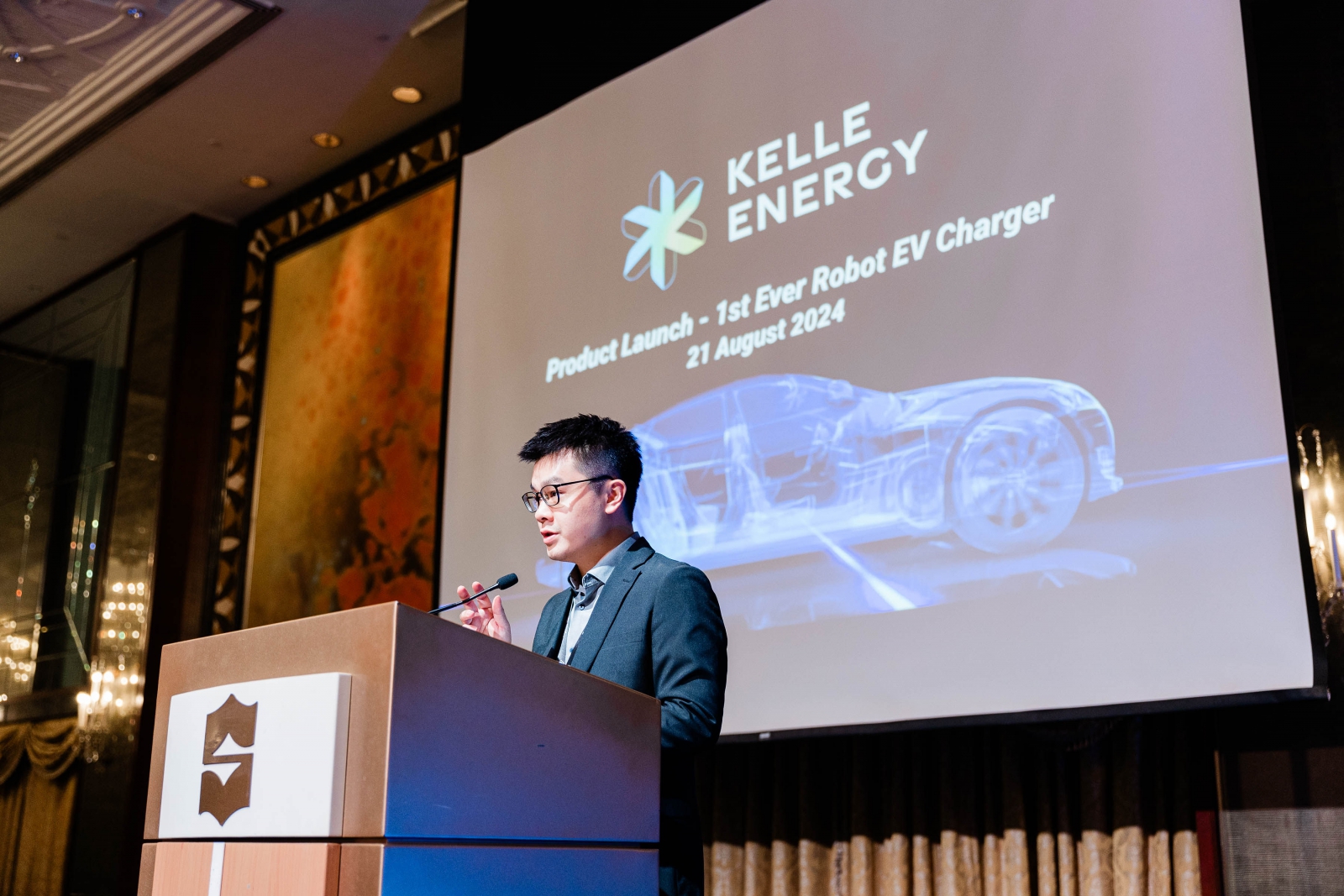
CEO Jason Koh of Kelle Energy speaks to RECESSARY about EV charging and energy storage strategy. (Photo:Kelle Energy)
At the site, a staff member grips a remote control, guiding a compact machine shaped like a miniature locomotive as it slowly approaches an electric vehicle, preparing to begin the charging process.
Developed by Singapore-based startup Kelle Energy, the device is Southeast Asia’s first mobile robotic EV charging station. It features direct current (DC) fast charging and integrates an energy storage system with a mobile design. In an interview with RECCESSARY, CEO Jason Koh (許棋揚) explains how the company aims to free charging services from fixed locations while exploring new real-world applications in an increasingly competitive traditional charging station market.
Backed by a Chinese battery maker, mobile DC charging targets Southeast Asia’s infrastructure gap
Speaking about market demand, Koh points to persistent infrastructure bottlenecks across Southeast Asia. “In geographically large countries such as Malaysia and Indonesia, existing infrastructure struggles to support DC fast charging demand,” he says. Koh notes that deploying fixed DC charging stations involves complex and time-consuming procedures, often requiring coordination across multiple authorities, making permits difficult to secure.
As the global push toward decarbonization accelerates EV adoption, the importance of charging infrastructure has come into sharper focus. Kelle Energy’s EPLVS as a portable EV charging solution is designed for flexible deployment via remote control, eliminating the need for extensive rewiring, substation coordination, or equipment replacement, and significantly improving overall service efficiency.
In terms of applications, public spaces stand to benefit the most from DC charging infrastructure. Koh argues that introducing DC fast charging in public settings should be prioritized to reshape the perception that EV charging is time-consuming, ultimately helping to boost market adoption.
Unlock the full article to explore three key takeaways:
- Southeast Asia’s first mobile EV charging unit equipped with an integrated energy storage system is powered by technology developed in China.
- Singapore-based Kelle Energy is targeting regional expansion, with Malaysia selected as its initial launch market.
- With energy storage at the core of its business model, Kelle Energy is now turning its focus to battery residual value, recycling, and second-life applications.