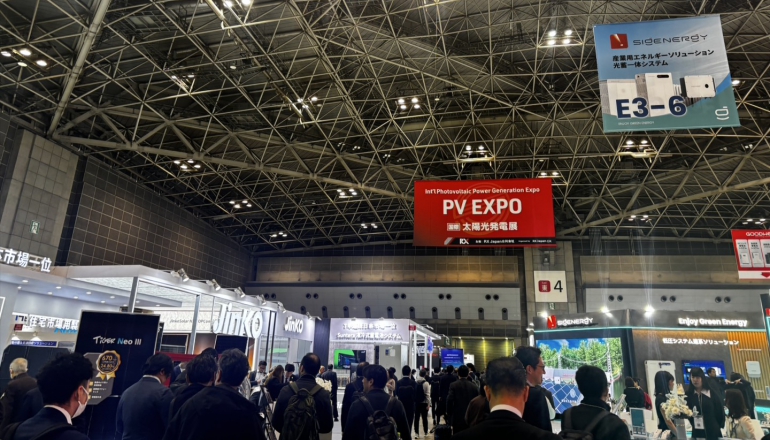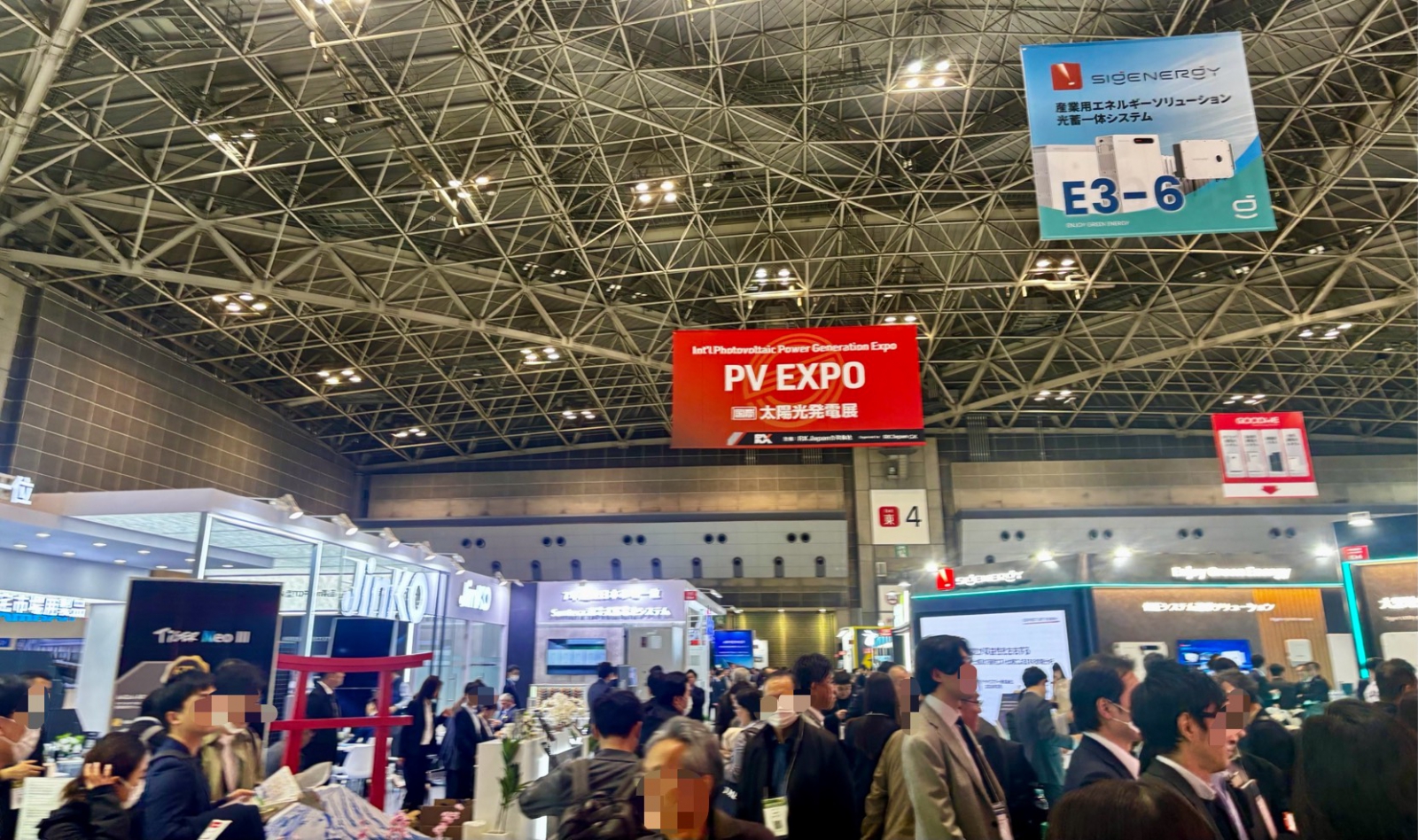
At Japan Smart Energy Week in Tokyo, many solar companies showcased large scale ground-mounted modules, while the market is increasingly shifting toward rooftop solar. (Photo: Daisy Chuang)
Japan aims to raise the share of renewable energy in its power mix to 40% to 50% by 2040, with solar playing a central role at 23% to 29%. However, solar development faces challenges similar to those in Taiwan, including environmental concerns and local opposition. As a result, Japan is stepping up efforts to promote residential and rooftop solar, while also investing in next generation technologies. This shift is reshaping the market and creating new opportunities for Taiwanese companies.
Japan shifts to rooftop solar as utility-scale projects face constraints
Japan faces mounting pressure to cut emissions and remains short of its renewable energy targets. Masaki Higurashi, director of the New and Renewable Energy Division at Japan’s Agency for Natural Resources and Energy, said that as of March 2025, installed solar capacity reached 76.6 GW, with annual additions of about 3.5 to 5 GW in recent years. To meet the 2030 target of 103.5 to 117.6 GW, however, Japan will need to add 27 to 41 GW over the next six years, or roughly 4.5 to 7 GW annually, highlighting the need for faster deployment.
Land constraints are a growing challenge. Japan’s dense population and mountainous terrain have limited sites for utility-scale solar, while large projects, including those near Mount Aso, have faced increasing public opposition. Higurashi said the government will tighten regulations and promote a more community-based approach, including setting up a Renewable Energy Regional Coexistence Council, strengthening rules under the Act on Protection of Cultural Properties and the Landscape Act, and improving information sharing mechanisms.
Meanwhile, support for large-scale solar is being scaled back. Japan decided in 2025 to end subsidies for new utility-scale solar projects from fiscal year 2027. Policy focus will instead shift toward next generation technologies such as perovskite solar, while deployment increasingly moves to rooftop installations on public facilities rather than large ground-mounted projects.
Unlock this article to learn three key takeaways:
- Utility-scale solar development in Japan faces constraints, with subsidies set to decline.
- Taiwanese firms target rooftop applications and partner with local channels to expand downstream markets.
- Perovskite solar is expected to reach commercialization within three years, with Taiwanese players eyeing space-based energy applications.