.jpg)
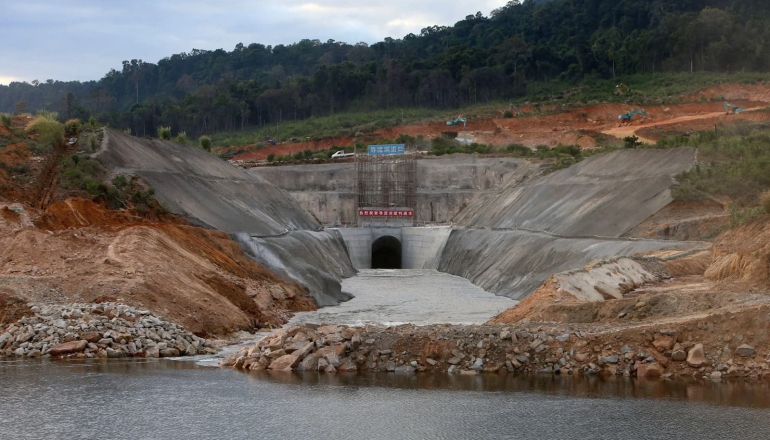
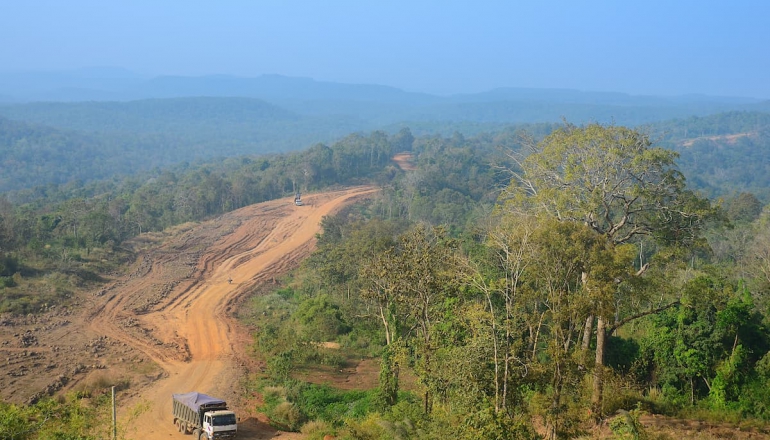
An aerial view from April 2022 of the access road that carves its way through the forest to the 150-megawatt Stung Tatai Leu hydropower dam in Kravanh National Park, on the edge of the Southern Cardamom REDD+ project’s border. Image by Mongabay.
“[Officially], the Southern Cardamom REDD+ project was suspended for more than a year and then restarted/reinstated recently. But what I actually see here on the ground is that, throughout that period, Wildlife Alliance have continued to restrict us and violate our rights,” said Pon Chhang, a young representative for the Indigenous Chorng community in Koh Kong province’s Thma Bang district.
Sitting in the shade on the banks of a small stream in Chumnoab commune, Chhang, along with several other ethnic Chorng community members, alleged continued abuse at the hands of the Southern Cardamom REDD+ project’s proponents: Cambodia’s Ministry of Environment and New York-headquartered NGO Wildlife Alliance.
Due to wide-ranging allegations of abuse, carbon credit certifying agency Verra on June 19, 2023, suspended the sale of carbon credits from the 465,000-hectare (1.15-million-acre) Southern Cardamom REDD+ project. Human Rights Watch published a 118-page report detailing allegations of physical abuse, threats, violence and a failure to meet best practice standards by Wildlife Alliance and the Ministry of Environment in February 2024.
After 14 months of investigation, Verra reinstated the project on Sept. 10, 2024, and allowed it to once more sell carbon credits on the provision that Wildlife Alliance address the alleged abuses. However, Verra’s review process has come under increased scrutiny.
When Mongabay visited in late October 2024, communities who said they lost land to the REDD+ project maintained that their movements and liberties remain heavily restricted by Wildlife Alliance. The conservation NGO has denied depriving people of access to “legally recognized farmland.”
Chorng community members told Mongabay that the REDD+ project resulted in reduced access to both the forest and their traditional farmland plots, which has left them materially poorer since the project began selling carbon credits in 2018.
“They oppress us by not allowing us to enter the forest,” Chhang told Mongabay. “Our way of life before was sustainable, the Indigenous people harvested nontimber forest products in a way that meant they would remain for generations. When there was no company taking the land, no NGO taking the land, we had no logging, no destruction.”
Long-standing tensions
Wildlife Alliance has long faced allegations that its approach to conservation in Cambodia has been heavy-handed, with multiple reports over the years detailing the NGO’s staff burning down homes and destroying property in a tactic that former staff previously suggested had been encouraged within Wildlife Alliance. Many of the issues reported over the years bore similarities to the allegations laid out in Human Rights Watch’s report.
According to Chhang, rotational farming plots that had been passed down from generation to generation with no formal land title had simply been consumed by the Southern Cardamom REDD+ project with little to no consultation.
“We weren’t told, in the beginning, that our land would be needed for their REDD+ project,” Chhang said. “They still don’t make the maps or boundaries available to us, they didn’t illustrate the maps, they only demarcated the land with help from the government.”
Multiple community members across Chumnoab commune told Mongabay that the Southern Cardamom REDD+ project’s suspension, and Verra’s decision to lift the ban on carbon credit sales, have resulted in few improvements.
Rim Sao Si, a lifelong resident of Chak Russei village in Chumnoab commune, said the entire community is suffering as a result of losing land to the REDD+ project.