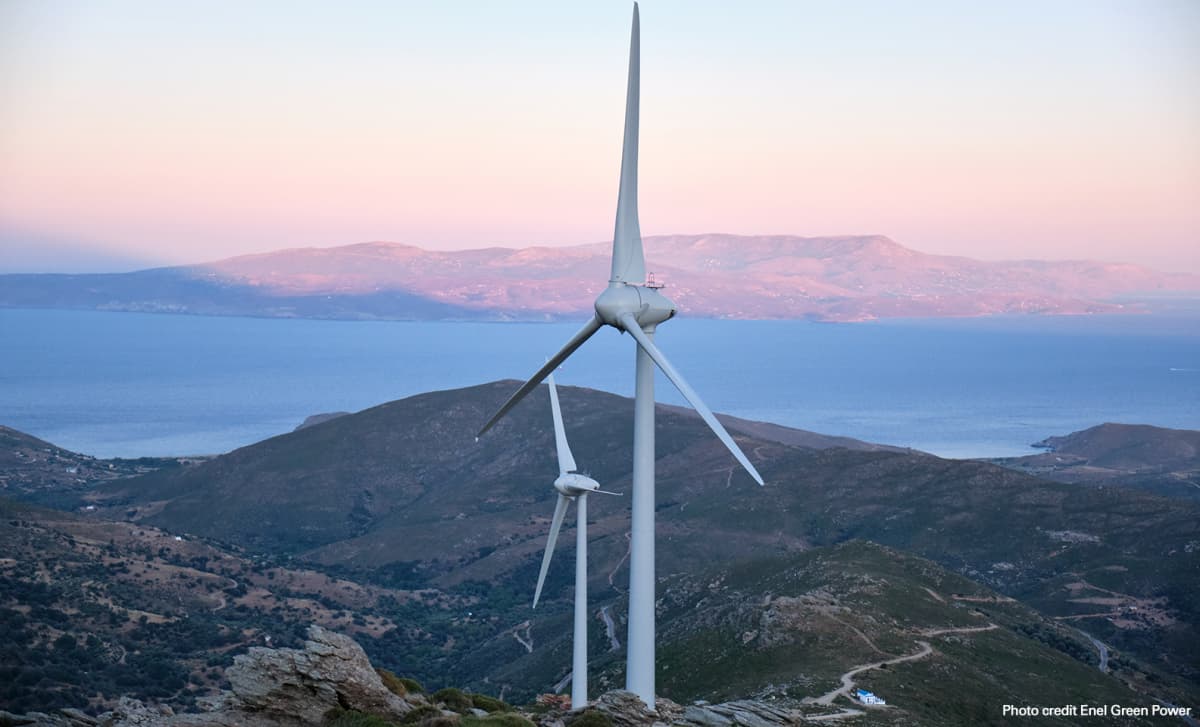
"We have great sun and we have great wind," says Greece's deputy energy minister Tsafos. Photo: Principia, Enel Green Power.
The European Union should strive for a well-connected energy system designed in a way that allows different national strengths to complement each other, says Nikos Tsafos, deputy energy minister of Greece. The country is expected to continue leveraging its good wind and solar energy potential to ensure security of supply and play an important role in the Mediterranean region, but the sources’ volatility needs to be addressed. Clean Energy Wire spoke with Tsafos on the sidelines of the Future of Energy Security summit in London in April 2025.
Clean Energy Wire: You have analysed and researched the intersection of energy and climate policy and geopolitics for many years. Taking all your experience into account, how would you describe the situation the world is in right now when it comes to its energy supply?
Nikos Tsafos: We just had an immense energy shock in Europe. Much of the worst parts of the shock are behind us, we are still not where we were in 2019 before the Covid-19 pandemic and before the war in Ukraine. Electricity prices are much higher, and gas prices – depending on your baseline – may even be double of what you had in the 2010s.
The real challenge is to figure out how to pursue energy and climate policy when you have the immense pressure of energy prices as a daily issue. There is a map that gets published, which shows the price of electricity for the next day. Every day that Greece is shown in red on the map [and prices are high] is a political issue and we are under pressure to deal with it. At the same time, we have to also think ahead, at 2030, 2040 and 2050.
When I think about the broader changes in the world – big agenda items like trade tensions, strategic autonomy, industrial robustness, defence in Europe, or responding to climate change – it is a real challenge to figure out how to pursue an energy policy that just makes sense.