With the 2024 Euros and Paris Olympics vowing to be greener, the focus shifts to the challenges of cutting emissions from major sporting events.
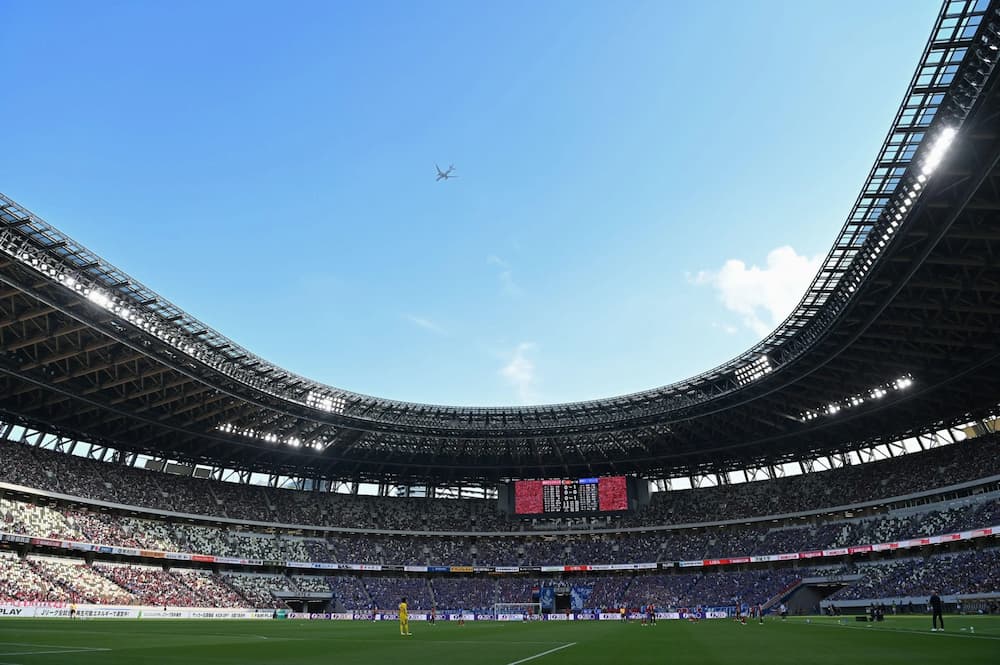
A plane flies over a football match at the Japan National Stadium, the primary venue for the 2020 Tokyo Olympics. The upcoming UEFA Euro 2024 football tournament and Paris Olympics have both pledged to be greener than previous iterations (Image: Alamy)
It’s time to add another new word to the Olympic motto: Faster, Higher, Stronger, Greener – Together.
The Paris Olympics has made an ambitious climate pledge this year, to halve its carbon footprint relative to previous Summer Games.
For comparison, the 2012 London Olympics and 2016 Rio Olympics emitted 3.3 million tonnes and 3.6 million tonnes of CO2 respectively, according to the organising committees. Even the Tokyo Olympics, where there were no spectators due to the Covid-19 pandemic, reportedly generated 1.96 million tonnes of carbon.
To meet the emission target, Paris 2024 has employed an “ARO” approach, meaning Avoid and Reduce emissions, and Offset the rest. The organisers of the Games say they have developed a “pioneering” tool to anticipate emissions and thus guide their decisions, such as whether to use an existing building or construct a new one.
Sporting competitions draw global audiences of billions. Their large socio-economic and cultural influence means environmental impacts go far beyond their direct emissions.
Sustainability has therefore become a growing consideration, at the Paris Olympics as at football events such as the 2022 FIFA World Cup in Qatar and the upcoming Euro 2024 in Germany. In China, carbon-reduction initiatives were introduced in recent years for the Beijing Winter Olympics, the Chengdu World University Games and the Asian Games in Hangzhou.
However, concerns remain about the accuracy of emission calculation for some events and the effectiveness of carbon offsets.
What drives emissions from ‘big sport’?
Reusing venues and replacing fossil fuel with renewable energy use are essential to cutting emissions at a large sporting event.
Approximately 95% of venues for the Paris Games will be pre-existing or temporary facilities, and this factor alone is expected to reduce carbon emissions by one million tonnes compared to new buildings. The Asian Games in Hangzhou also prioritised using existing venues, with only 12 of the 56 competition sites built from scratch.