.jpg)
Taiwan President Lai Ching-te and the Taiwan Semiconductor Industry Association have both expressed support for restarting nuclear power, putting the future of nuclear energy development in the spotlight. (Image: iStock)
Taiwan President Lai Ching-te (賴清徳) has recently proposed restarting the No. 2 and No. 3 nuclear power plants, placing the island, which had been moving toward a nuclear-free future, back at an energy crossroads.
On April 8, Taiwan Semiconductor Industry Association (TSIA) Chairman and Senior Vice President of TSMC Cliff Hou (侯永清) publicly voiced support for restarting nuclear power, citing the need for a more stable energy supply. Opponents, however, argue that nuclear energy competes with renewables for both grid priority and investment resources, warning that Taiwan cannot return to what they describe as the “baseload power” mindset.
For RECCESSARY, the key question is whether nuclear and renewable energy can truly coexist. The answer hinges on grid dispatch dynamics, the allocation of investment resources and, ultimately, the direction of Taiwan’s broader energy transition.
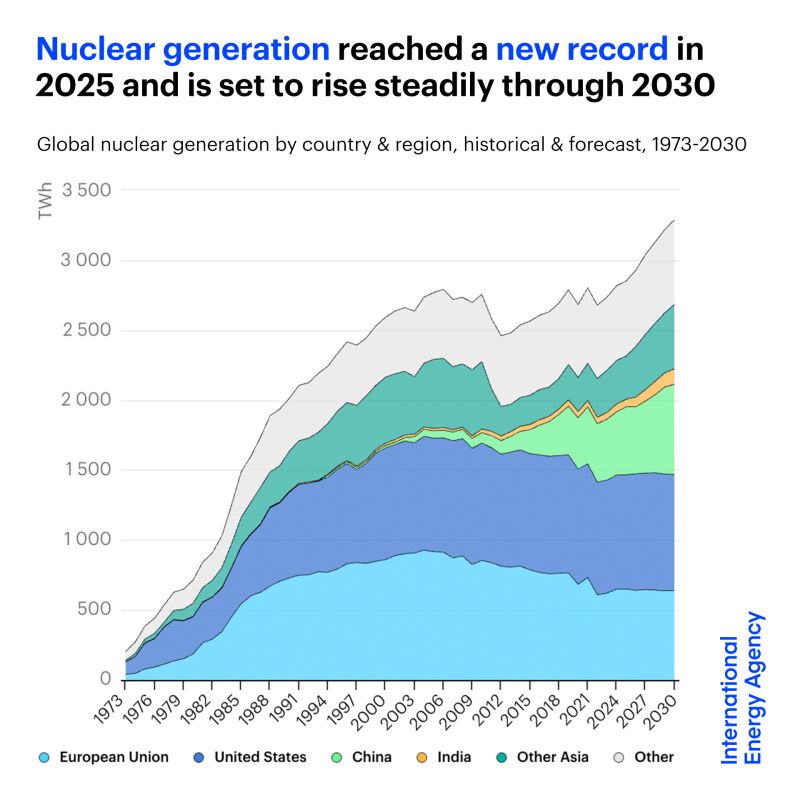
Global nuclear power generation hit a record high in 2025 and is expected to grow steadily through 2030. (Photo: IEA)
Unlock the full article to explore three key takeaways:
- Nuclear restarts could require grid restructuring, adding uncertainty to the energy transition pathway.
- As renewables expand, nuclear power’s limited flexibility poses challenges for grid dispatch.
- Policy and resource reallocation could reshape the outlook for renewables and energy storage.