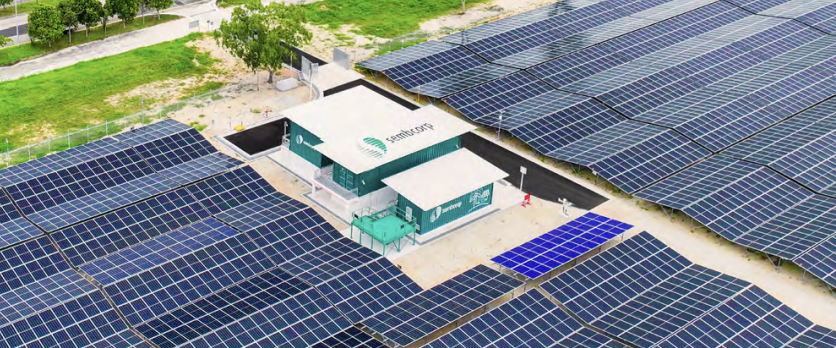
Sembcorp Jurong Island Solar Farm, Singapore’s largest ground-mounted solar project. Temasek Holdings is expanding its sustainability-aligned portfolio(Photo: Temasek Sustainability Report 2026)
Singapore state investor Temasek Holdings is expanding its sustainability-aligned portfolio and deepening energy transition bets, even as its portfolio emissions remain flat and its 2030 emissions reduction target moves out of reach.
In its 2026 fiscal year sustainability report released on July 8, Temasek said sustainability-aligned investments rose by SGD 3 billion (USD 2.3 billion) to SGD 49 billion (USD 37 billion) in the financial year ended March 31. These investments now span energy infrastructure, grid solutions, storage, nuclear technology, AI-related efficiency and other transition-linked sectors.
Portfolio emissions remained flat at 21 million tonnes of CO2 equivalent for the second consecutive year, leaving Temasek off track to meet its 2030 goal of halving emissions from 2010 levels.
Why is Temasek’s decarbonization falling short?
Singapore Airlines (SIA) and Sembcorp Industries remain the biggest contributors to Temasek’s portfolio emissions, together accounting for 62% of the total.
Unlock the full article to explore three key takeaways:
Temasek’s portfolio emissions have remained flat at 21 million tCO2e for two consecutive years, with Singapore Airlines and Sembcorp Industries accounting for 62% of the total.
Sembcorp’s Alinta Energy acquisition is expected to push Temasek’s portfolio emissions higher in the near term, even as Temasek frames the deal as a platform for renewable energy growth in Australia.
Temasek is keeping its 2030 emissions target in place despite a confirmed miss, while shifting emphasis toward real-world investment impact, grid resilience, storage, nuclear and AI-related efficiency.