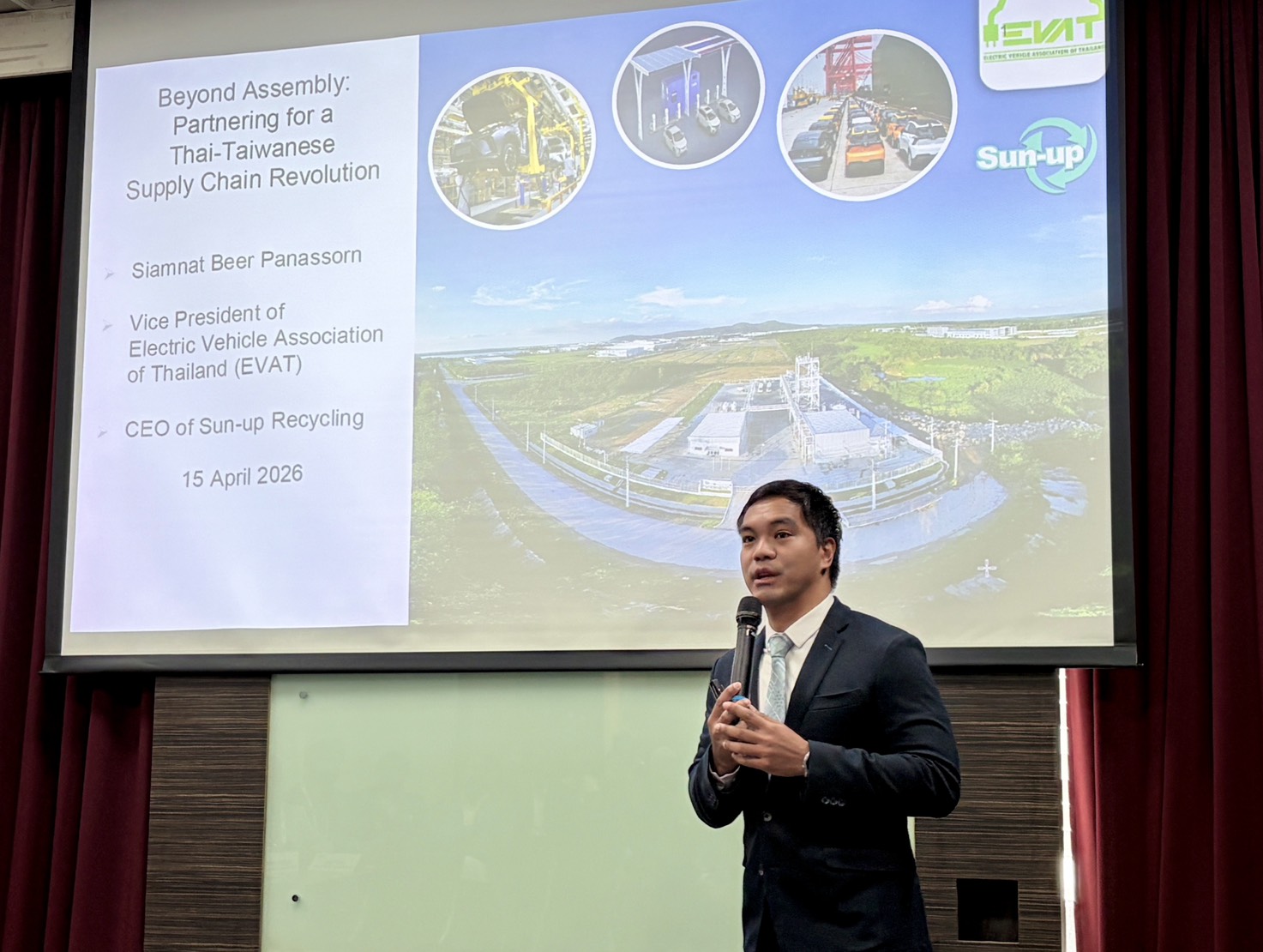
Siamnat Panassorn of the Electric Vehicle Association of Thailand (EVAT) said Thailand’s hardware strengths and Taiwan’s software capabilities could be a strong fit as the EV supply chain becomes more fragmented. (Photo: Wendy Lo)
The word “smart” is being applied to nearly every sector, but in automotive the shift is structural. At the International Smart Automotive Seminar in Taipei on April 15, speakers from Taiwan and Thailand outlined why closer alignment between the two economies is emerging as a key opportunity as supply chains fragment under geopolitics and electrification.
The global manufacturing system has been moving away from the cost-driven logic of “just in time” toward a resilience-focused “just in case” model built on shorter regional supply chains, a shift that has been underway since 2018, said Joseph Ng, associate analyst at Taiwan’s Institute for Information Industry (III).
At the same time, vehicles are evolving beyond software-defined architectures into AI-defined vehicles (AIDVs), adding a layer of integration complexity that no single company can absorb alone.
Unlock the full article to explore three key takeaways:
- Thailand’s electrified vehicles have overtaken internal combustion engines in the domestic market, but the country's supply chain still lacks the software and integration capabilities needed to meet Chinese OEM demands.
- Under the ASEAN-China FTA, Chinese EVs enter Thailand at zero import duty, creating a structural cost disadvantage that Thailand is trying to offset through neutral trade positioning and extensive FTA coverage rather than price competition.
- EV3.5 localization requirements covering battery management systems, traction motors, drive control units, and battery packaging are creating concrete entry points for Taiwanese suppliers, with the “Tier 1.5” co-development model emerging as the strategic frame for Thailand-Taiwan collaboration.