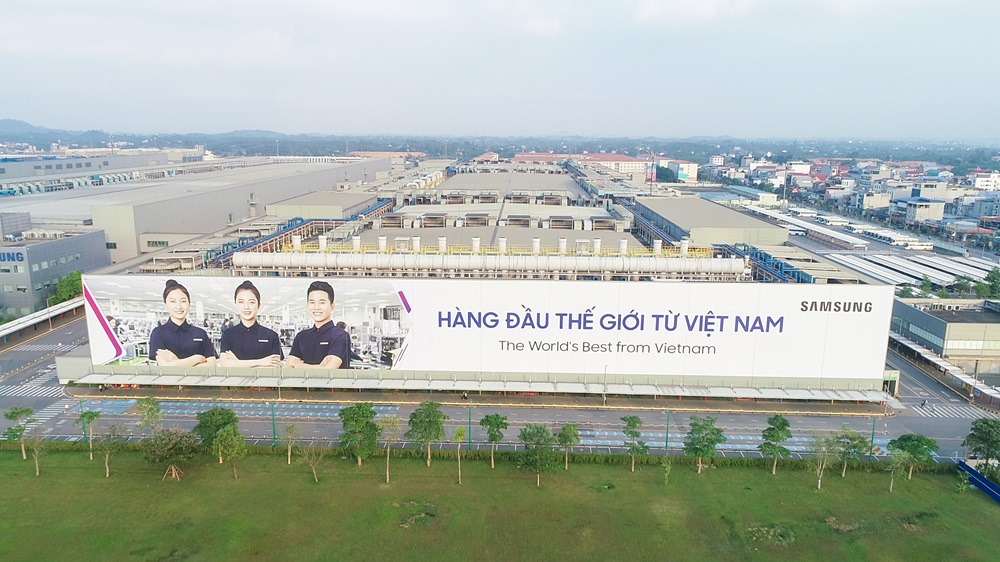
Samsung is seen as one of the first companies in Vietnam expected to adopt the direct power purchase agreement framework. (Image: Samsung)
Vietnam’s power market is moving toward greater liberalization and transparency as the government loosens regulations to let supply and demand play a bigger role in determining electricity prices, a shift aimed at boosting the country’s international competitiveness. The reforms have not only given rise to a direct power purchase agreement (DPPA) framework that could accelerate the energy transition, but will also introduce a two-component electricity pricing mechanism designed to reflect actual power costs more accurately.
In this feature series, RECCESSARY examines the rollout of Vietnam’s two major electricity reforms, market response, and their impact on renewable energy developers, corporate power users, and the national power system.
Vietnam’s direct DPPA framework was finally introduced after years of pressure from foreign companies, particularly U.S. corporations, raising expectations among renewable energy developers and fueling widespread market discussion. Yet actual contract progress has remained slow. Interviews conducted by RECCESSARY with multiple investors and developers found that opaque regulations, limited access to power data, and policy instability remain the biggest obstacles.
According to the Electricity Authority of Vietnam under the Ministry of Industry and Trade (MOIT), more than 60 DPPA contracts had been signed as of early this year. Developers involved include Vietnamese conglomerates such as T&T Group, Bamboo Capital Group, and Trungnam Group. Corporate buyers reportedly include Samsung, Apple, Google, and Heineken. However, public information remains scarce, making it difficult even for industry insiders to track actual developments.
Nguyen Huu Quang, portfolio manager of clean investments at Dragon Capital, told RECCESSARY that to his knowledge, there are currently several small-scale rooftop solar direct supply contracts in operation. However, the partnership between Samsung and TTC is currently the only grid-connected DPPA to date. Beyond this, “for new solar projects, we haven’t seen any project successfully enter a DPPA contract,” he said.
Lack of transparency in EVN charges clouds Vietnam’s DPPA rollout
Vietnam’s DPPA framework includes two models. One is the direct supply model, also known as a physical DPPA, in which power generators transmit electricity directly to customers through private transmission lines. The other is the grid-connected model, where electricity is delivered through EVN’s transmission network and is therefore also referred to as a virtual or financial DPPA.
The application process for grid-connected DPPAs is relatively complex, with cash flow arrangements closely tied to fees charged by EVN. In addition to paying wheeling fees to EVN for use of the grid, corporate buyers must also sign a Contract for Difference (CfD) with power generators. Under the mechanism, generators receive compensation when the market reference price falls below the agreed strike price, but must return the difference when market prices rise above it.
Unlock this article to learn three key takeaways
- Vietnam’s DPPA framework officially took effect in March 2025, but by early 2026 only one grid-connected power purchase agreement (DPPA) project had been completed, with most agreements still limited to small-scale rooftop solar arrangements.
- Developers face three major obstacles: opaque electricity pricing calculations by EVN, limited power data digitalization, and lingering feed in tariff (FiT) disputes that have undermined investor confidence.
- As Vietnam’s DPPA framework is still in its early stages, the lack of historical data and incomplete supporting regulations have dealt a serious blow to short- and medium-term foreign investment appetite.