The region has emerged as a leading solar exporter, helped by Chinese companies’ relocating their production – but US tariffs are beginning to bite
.jpg)
A worker inspects cables at a floating solar power project in Rayong, Thailand. Southeast Asian countries have welcomed investment to produce solar equipment domestically, though this has largely been destined for export to the United States rather than supporting local capacity (Image: Wang Teng / Imago / Alamy)
In little over a decade, Southeast Asia has become one of the world’s top exporters of solar power equipment – a success driven significantly by the relocation of Chinese manufacturers to the region. But now, the sector faces considerable challenges as US tariffs cut off their main export market, intensifying pressure on a previously booming trade.
Ever since finding themselves in the crosshairs of US import tariffs in 2012, Chinese solar manufacturers began shifting their production to Southeast Asia to circumvent trade barriers. More recently, overcapacity and brutal price wars in China’s domestic market have accelerated these international relocations.
The arrival of factories backed by Chinese solar heavyweights such as Trina, Longi, JA Solar and Jinko Solar, among nearly 20 other competitors, has transformed Malaysia, Vietnam, Thailand and Cambodia into world-leading production and export hubs for a range of solar components. Together, these countries account for over 40% of global manufacturing capacity of solar modules outside China, and around 20% of worldwide exports.
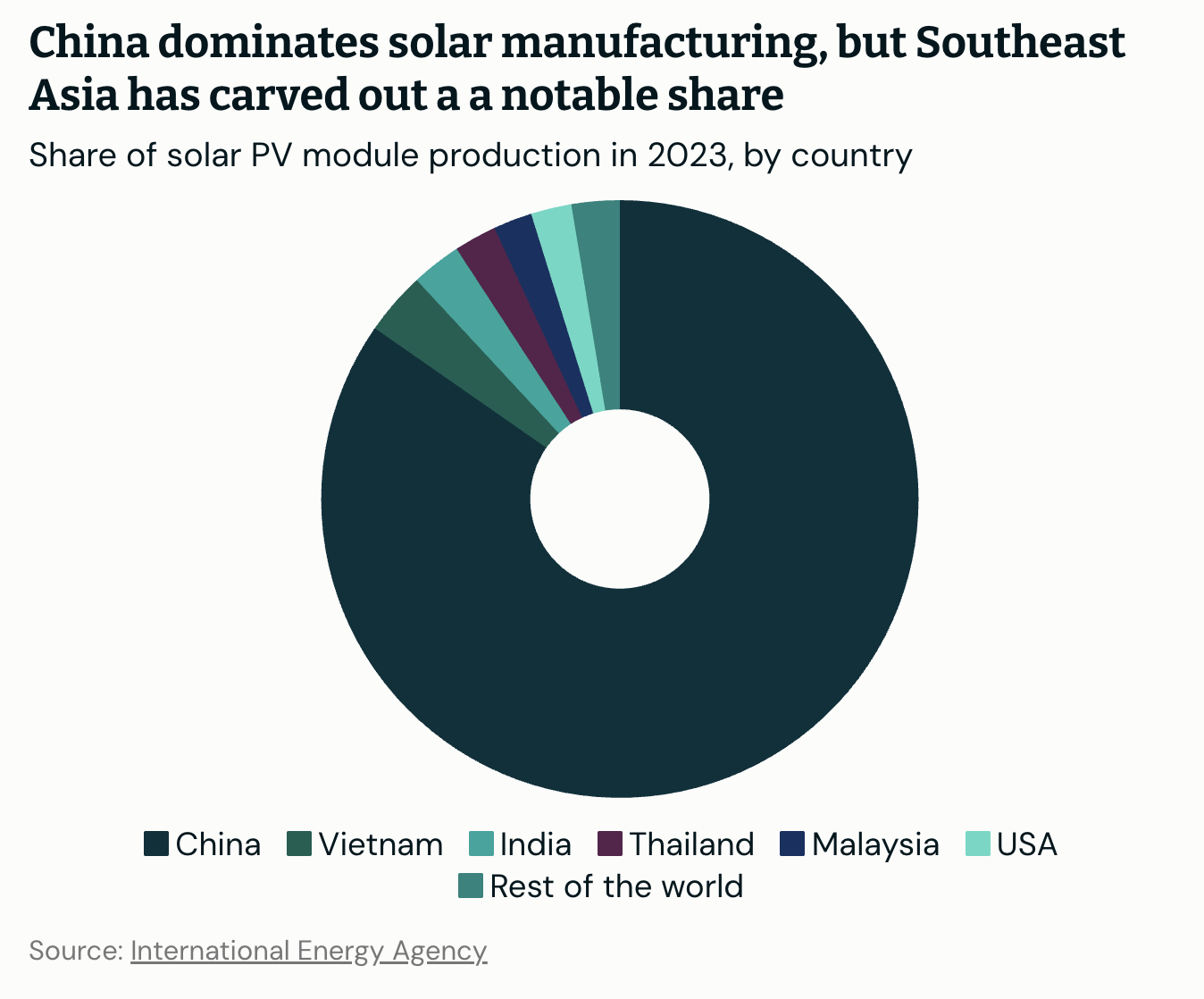
Southeast Asia’s solar exports have primarily targeted the US, with more than 80% of the equipment it imported in the first half of 2024 sourced from Malaysia, Vietnam, Thailand and Cambodia, according to BloombergNEF.
But this successful run is now under threat. In June 2024, then-US president Joe Biden ended a two-year relief on import tariffs for solar panels from the region’s four leading producers, targeting China-linked manufacturers over alleged unfair business practices. Additional levies announced in November prompted several Chinese manufacturers to suspend or scale-back production or shift operations to Indonesia and Laos, which were exempted.