.jpg)
(Image: Pixabay)
At 12.33pm on 28 April, most of Spain and Portugal were plunged into chaos by a blackout.
While the initial trigger remains uncertain, the nationwide blackouts took place after around 15 gigawatts (GW) of electricity generating capacity – equivalent to 60% of Spain’s power demand at the time – dropped off the system within the space of five seconds.
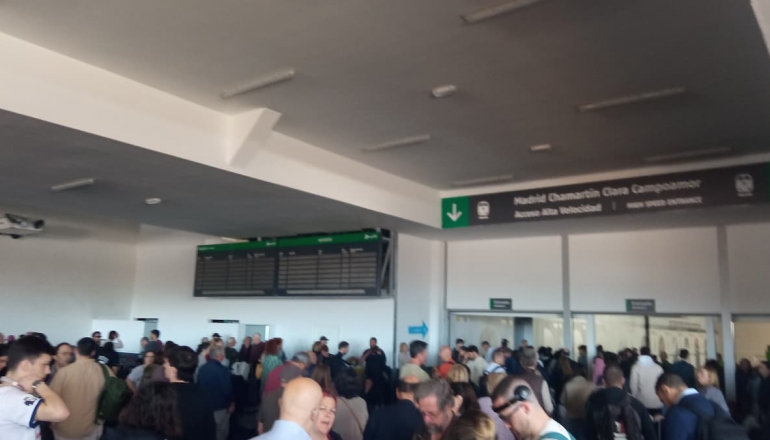
The blackouts left millions of people without power, with trains, traffic lights, ATMs, phone connections and internet access failing across the Iberian peninsula.
on 29 April morning, almost all electricity supplies across Spain and Portugal had been restored, but questions about the root cause remained.
Many media outlets were quick to – despite very little available data or information – blame renewables, net-zero or the energy transition for the blackout, even if only by association, by highlighting the key role solar power plays in the region’s electricity mix.
Below, Carbon Brief examines what is known about the Spanish and Portuguese power cuts, the role of renewables and how the media has responded.
What happened and what was the impact?
The near-total power outage in the Iberian Peninsula affected millions of people.
Spain and Portugal experienced the most extensive blackouts, but Andorra also reported outages, as did the Basque region of France. According to Reuters, the blackout was the biggest in Europe’s history.
In a conference call with reporters, Spanish grid operator Red Eléctrica set out the order of events.
Shortly after 12.30pm, the grid suffered an “event” akin to loss of power generation, according to a summary of the call posted by Bloomberg’s energy and commodities columnist Javier Blas on LinkedIn. While the grid almost immediately self-stabilised and recovered, about 1.5 seconds later a second “event” hit, he wrote.
Around 3.5 seconds later, the interconnector between the Spanish region of Catalonia and south-west France was disconnected due to grid instability. Immediately after this, there was a “massive” loss of power on the system, Blas said.
This caused the power grid to “cascade down into collapse”, causing the “unexplained disappearance” of 60% of Spain’s generation, according to Politico.
It quoted Spanish prime minister Pedro Sánchez, who told a press conference late on 28 April that the causes were not yet known:
“This has never happened before. And what caused it is something that the experts have not yet established – but they will.”
The figure below shows the sudden loss of 15GW of generating capacity from the Spanish grid at 12.33pm on 28 April. In addition, a further 5GW disconnected from the Portuguese grid.
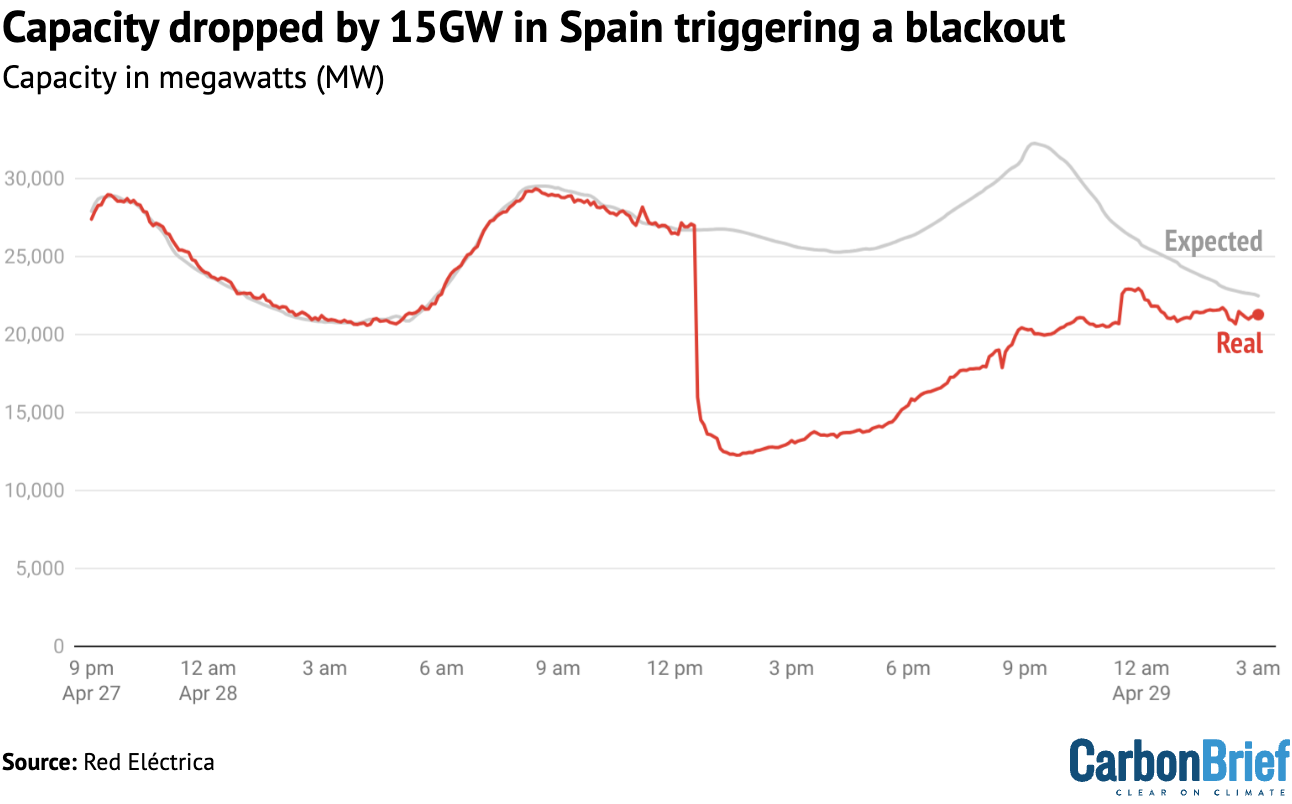
Electricity generation capacity in Spain, megawatts (MW), from 27-29 April, showing the drop in generation. Credit: Red Eléctrica.
The Guardian noted in its coverage that “while the system weathered the first event, it could not cope with the second”.
A separate piece from the publication added that “barely a corner of the peninsula, which has a joint population of almost 60 million people, escaped the blackout”.
El País reported that “the power cut…paralysed the normal functioning of infrastructures, telecommunications, roads, train stations, airports, stores and buildings. Hospitals have not been impacted as they are using generators.”
According to Spanish newswire EFE, “hundreds of thousands of people flooded the streets, forced to walk long distances home due to paralysed metro and commuter train services, without mobile apps as telecommunications networks also faltered”.
It added that between 30,000 and 35,000 passengers had to be evacuated from stranded trains.
The New York Times reported that Portuguese banks and schools closed, while ATMs stopped working across the country and Spain. People “crammed into stores to buy food and other essentials as clerks used pen and paper to record cash-only transactions”, it added.