.jpg)
(Photo: Pixabay)
A global treaty on plastics, which is being touted as the most important environmental treaty since the 2015 Paris Agreement, is set to be negotiated in South Korea over the next week.
At the fifth and final scheduled session of the UN’s Intergovernmental Negotiating Committee on Plastic Pollution (INC-5), member countries hope to finalise and approve the text of the “international legally binding instrument on plastic pollution”.
A successful treaty could have important implications for climate change.
The production, use and disposal of plastics is responsible for around 5% of global greenhouse gas emissions and they are typically made from fossil fuels. Plastics production is expected to be one of the leading drivers of oil demand growth over the coming years.
Measures to reduce plastics use will be a key part of the agenda, as around 90% of emissions from plastics come from production. The negotiations will see countries discuss setting targets, accountability and transparency measures.
Carbon Brief analysis shows that without any agreement to cut plastic production, emissions from plastics could consume half of the remaining carbon budget for limiting warming to 1.5C above pre-industrial levels.
One expert tells Carbon Brief that the best outcome possible for the negotiations is to ratify a global target to limit plastics production, coupled with legally binding national targets.
However, she warns that oil-producing countries are likely to veto any such proposal.
Below, Carbon Brief presents five key charts showing why the plastics treaty matters for climate change.
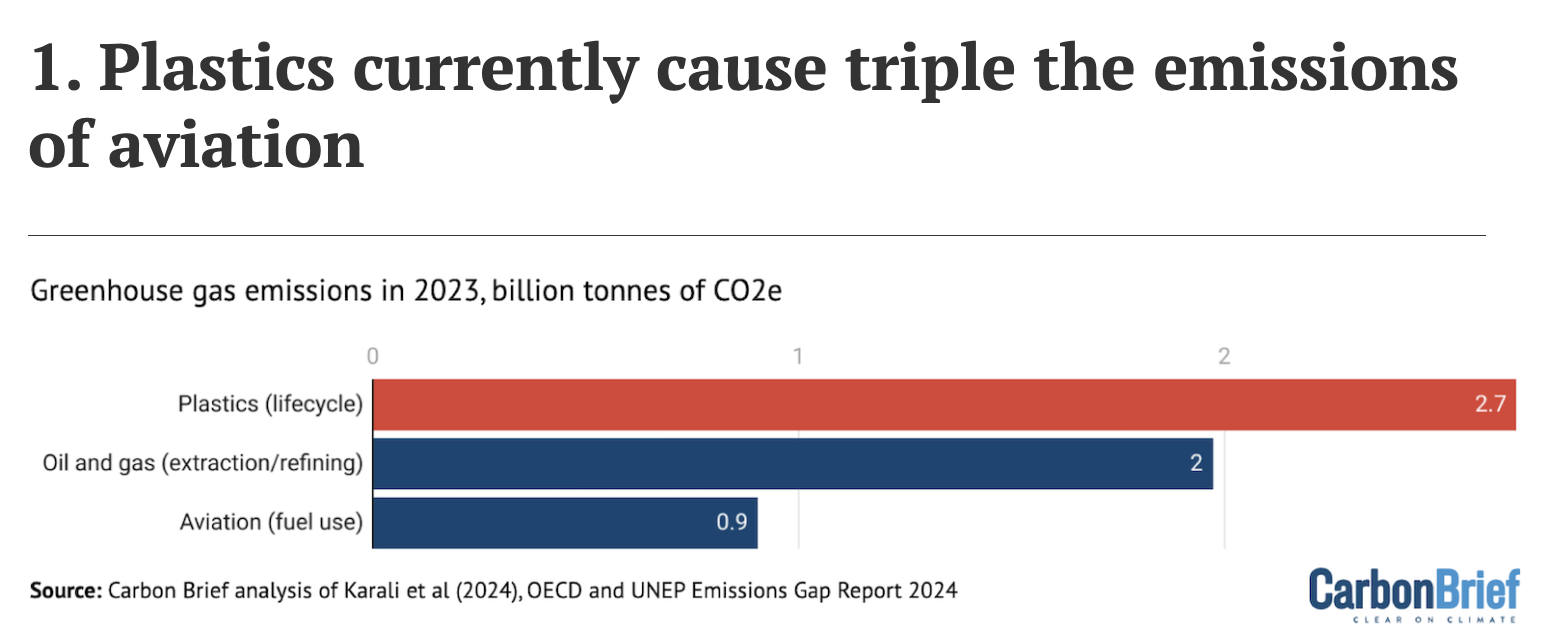
Greenhouse gas emissions in 2023, in billion tonnes of CO2e. Source: Carbon Brief analysis of Karali et al (2024), the OECD and the UNEP Emissions Gap Report (2024). Note that oil and gas (extraction/refining) includes fugitive methane emissions, and aviation only considers emissions from fuel use.
Plastics are a versatile and durable material that have revolutionised industries from fashion to medicine. However, they also cause serious environmental problems.
The most commonly discussed downside of the widespread global use of plastic is the ecosystem damage caused by waste. Even if disposed of safely, the production and disposal of plastics produce greenhouse gas emissions that contribute to global warming.
Carbon Brief calculations suggest that plastic lifecycles generated more than 2.7bn tonnes of CO2 equivalent (GtCO2e) in 2023 – around 5% of global emissions. This is roughly three times more than the emissions produced by aviation, as shown in the graphic above.
Around 90% of emissions from plastics come from production – the process of extracting fossil fuels and converting them into plastics. The world produces around 400m tonnes of plastics every year and this number is expected to grow over the coming decades.
Most plastics are made from fossil fuels, using oil, coal or gas converted into feedstock chemicals. Extracting the fossil fuels needed from underground is directly associated with greenhouse gas emissions, for example due to leaky mines, wells and pipes that contribute to rising methane emissions.