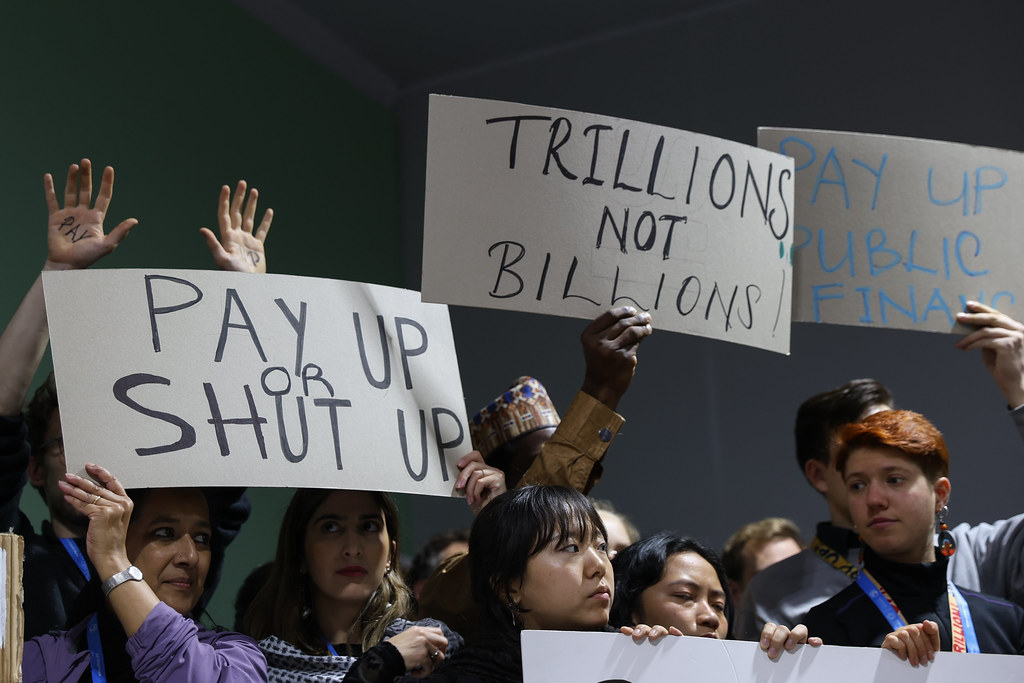
(Photo: UNclimatechange)
At COP29 in Baku, developed-country parties such as the EU, the US and Japan agreed to help raise “at least” $300bn a year by 2035 for climate action in developing countries.
The goal was welcomed by global-north leaders and presented as a “tripling” of the previous target for international climate finance.
Yet it faced a strong backlash from many developing countries, with some branding it a “joke” and “betrayal”.
Closer analysis of the goal and climate-finance data helps to explain this response.
Analysts have shown that the target is achievable with virtually “no additional budgetary effort” from developed countries, beyond already-committed increases.
A combination of pre-existing national pledges and multilateral development bank (MDB) plans will bring climate finance up to around $200bn a year by the end of this decade.
Counting money already being distributed by emerging economies such as China – as “encouraged” under the new goal – could bring the total to $265bn by 2030. This could mean the target is well on its way to being met by that date, with minimal extra effort.
Moreover, as activists and academics have noted, the $300bn target does not account for inflation. When this is factored in, its “real” value could shrink by around a quarter.
The new target has emerged against a backdrop of financial strain and political uncertainty in developed countries.
At the same time, developing countries have stressed that they need climate finance to reach the “trillions of dollars” needed to cut emissions and protect themselves from climate change.
This article looks at three ways in which the $300bn goal could be met with little extra financial effort by developed countries – and provide fewer benefits for developing countries than the figure suggests.
1. Much of the goal will be met with ‘no additional effort’
The $300bn climate-finance target agreed at COP29 in Baku will be met with finance from a “wide variety of sources”, largely coming from developed countries.
This part of the “new collective quantified goal” (NCQG) for climate finance is likely to be made up of public finance provided directly by governments, as well as money from MDBs, specialised climate funds and private finance “mobilised” by public investments.
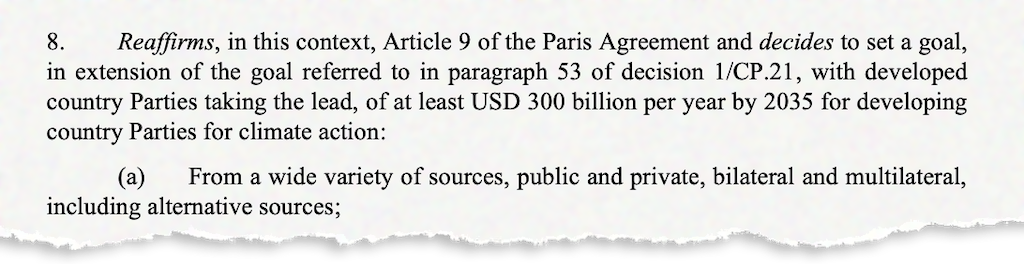
Source: UNFCCC.
The wording of the $300bn goal frames it as an extension of the $100bn target. This was the amount that developed countries agreed in 2009 to raise for developing countries annually by 2020 – a goal that was extended through to 2025 by the Paris Agreement.