.jpg)
(Photo: White House)
Nearly a tenth of global climate finance could be under threat as US president Donald Trump’s aid cuts risk wiping out huge swathes of spending overseas, according to Carbon Brief analysis.
Last year, the US announced that it had increased its climate aid for developing countries roughly seven-fold over the course of Joe Biden’s presidency, reaching $11bn per year.
This likely amounts to more than 8% of all international climate finance in 2024.
However, any progress in US climate finance has been thrown into disarray by the new administration.
Trump has halted US foreign aid and threatened to cancel virtually all US Agency for International Development (USAid) projects, with climate funds identified as a prime target.
USAid has provided around a third of US climate finance in recent years, reaching nearly $3bn in 2023, according to Carbon Brief analysis.
Another $4bn of US funding for the UN Green Climate Fund (GCF) has also been cancelled by the president’s administration.
One expert tells Carbon Brief that more climate funds will likely end up on the “cutting block”.
Another warns of an “enormous gulf” to meeting the new global $300bn climate-finance goal nations agreed last year, if the US stops reporting – let alone providing – any official climate finance.
Carbon Brief’s analysis draws together available data to explain how the Trump administration’s cuts endanger global efforts to help developing countries tackle climate change.
How much did climate finance increase under Biden?
The US is by far the world’s largest economy and biggest historical emitter of carbon dioxide (CO2).
This means that, while it is the fourth-biggest national provider of international climate finance, its overall share is low relative to the nation’s wealth and responsibility for climate change. As a result, the US has long been seen as a laggard in this area.
The US provides 0.24% of its gross national income (GNI) as aid for developing countries, which includes some climate funding. This is the same share as the Czech Republic, a nation with a per-capita GNI three times smaller.
US climate-finance contributions stalled during Trump’s first four-year term as president, when other developed countries were ramping up to meet their target of providing and mobilising $100bn a year for developing countries by 2020.
A shift in focus came when Biden became president in 2021. He established an international climate finance plan to scale up US efforts, in line with US obligations under the Paris Agreement.
Biden also announced that the US would reach $11.4bn in annual climate finance by 2024.
This goal was achieved, according to “preliminary estimates” announced by the US during the COP29 climate summit at the end of 2024. These estimates, which are unlikely to be confirmed by the new administration, are shown in the chart below.
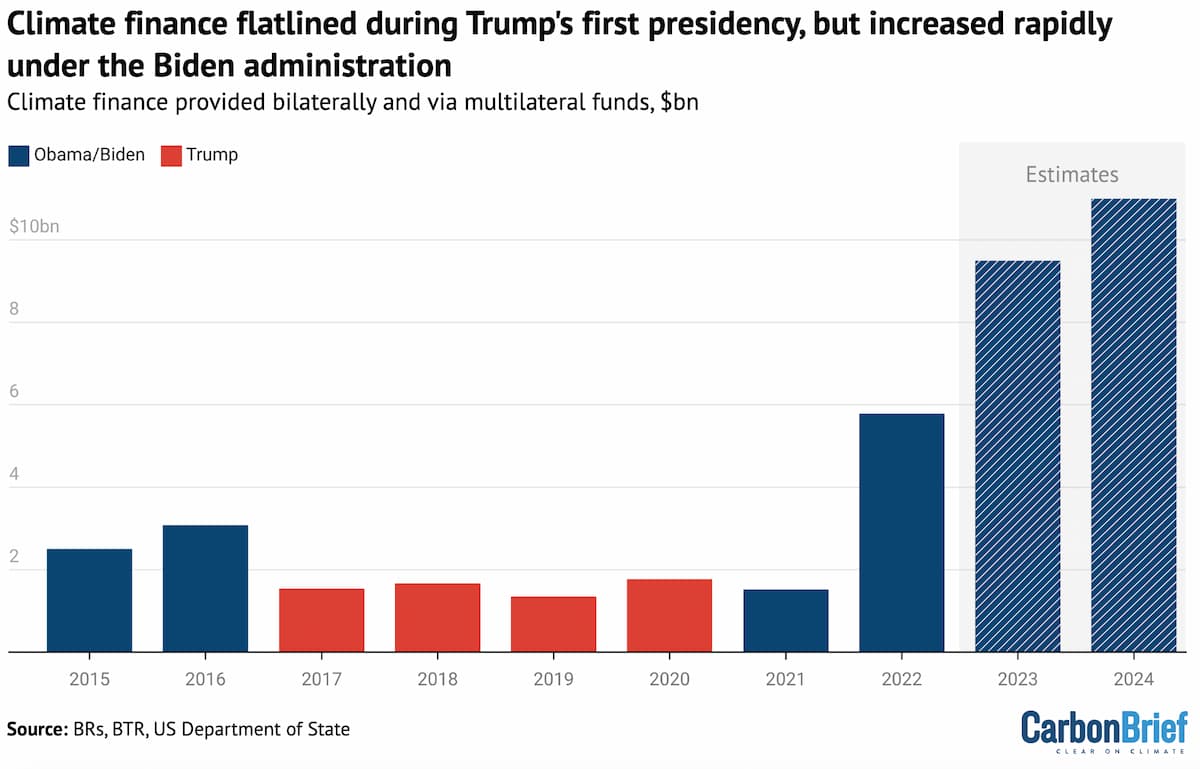
US climate-finance contributions to developing countries, 2015-2024, with Democrat presidencies indicated by blue columns and Trump’s Republican presidency indicated by red columns. Figures for 2015-2022 are based on official figures reported to the UN in biennial reports (BRs) and, for the years 2021 and 2022, the biennial transparency report (BTR). Figures for 2023 and 2024 have only been announced by the Biden administration in media releases, without the underlying data. All years only include bilateral funds and contributions to multilateral funds, not shares of multilateral development bank finance or private finance. Source: BRs, BTR, US Department of State.