A community’s project suggests emissions-reduction work must benefit everybody to succeed, writes Gao Baiyu.
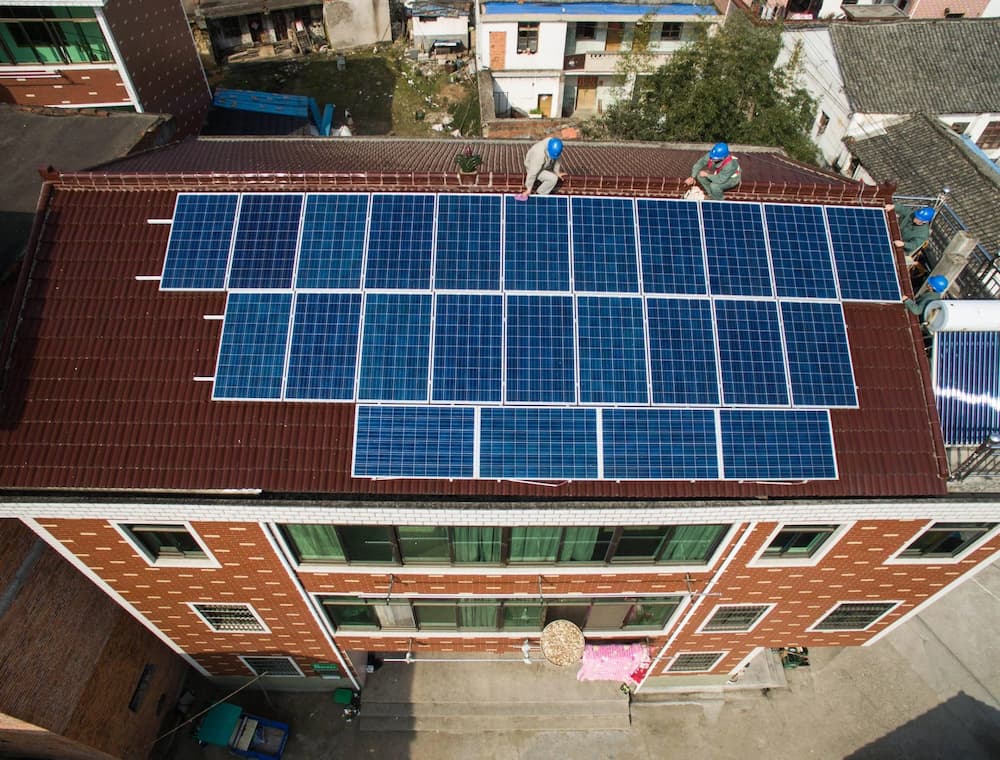
Technicians test solar panels on a residential building in Yiwu, east China’s Zhejiang province. In Hubei province’s Wuhan, residents of Beihu have assigned their rooftop solar rights to a power firm. In return, they get a large discount on their service charge and improvements to their communal rooftop space (Image: Xu Yu / Xinhua / Alamy)
The Jianshe apartment complex in Wuhan’s Beihu subdistrict is a striking juxtaposition of the old and the new. These buildings in central China are of varying heights and some date back to 1987. Three are dotted with solar panels that together cover about 550 square metres – the size of a basketball court.
So far, the 126-kilowatt installation powers amenities including hallway lighting, street lights and LED displays. The plan is to also hook up 19 electric-vehicle chargers, four “smart waste” receptacles and a charging dock for electric bikes.
The Jianshe management body has overseen the installation itself, meaning the power is used in-house and any surplus can be sold back to the grid.
The project has benefitted from the support of a global mayoral network called C40 Cities, which this author works for, as well as the local authorities of both Wuhan and Beihu.
The complex is almost carbon-neutral, but the panels haven’t just cut carbon emissions. They have provided sheltered areas in communal rooftop spaces, among other benefits. The arrangement has worked for the community, individual residents, and the solar-power firm involved. Other old apartment complexes could benefit from similar arrangements, people involved in the project have said.
How does it all work?
Jianshe’s residents have assigned their rooftop-usage rights to an external solar-power company. It is responsible for funding, operating and maintaining the panels, and selling the generated electricity at a profit. In return, the Jianshe management body gets electricity at half the commercial rate – CNY 0.50 per kilowatt hour – lowering the residents’ service charge.