EV owners could profit from two-way charging, but many are wary, and the tech is currently expensive.
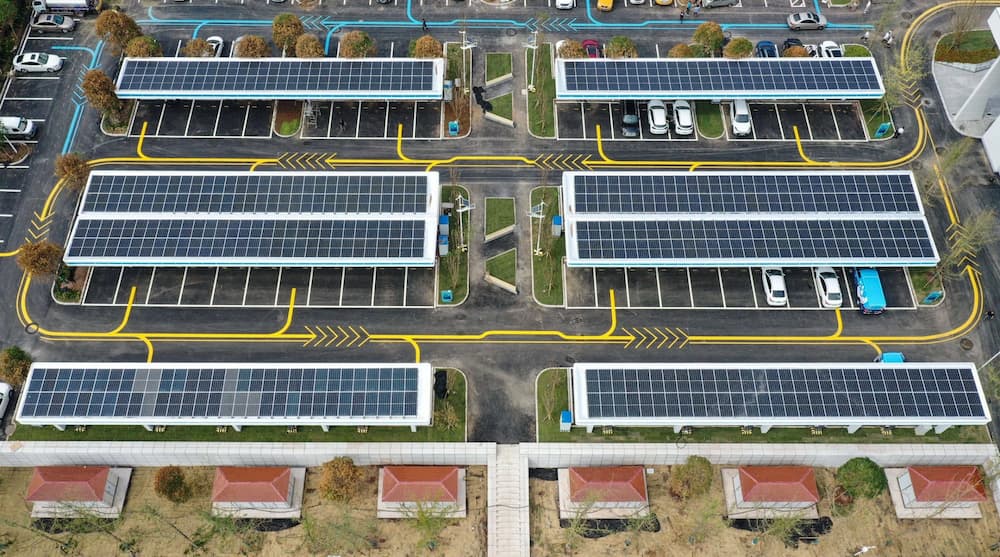
A solar-powered charging station in Yibin, south-west China. Two-way charging could give vehicles like these the potential to stabilise power supplies by discharging stored electricity back to the grid. (Image: Wang Xi / Alamy)
In January, China’s biggest trial of two-way charging took place in Wuxi, Jiangsu. Across 30 minutes, 50 electric vehicles (EVs) discharged almost one megawatt-hour into the grid – enough electricity to meet the needs of 133 households for a day.
Such charging (also known as V2G, vehicle-to-grid) has the potential to contribute to the smoothing out of peaks and troughs in grid electricity demand.
By the end of 2023, China had over 20.41 million “new energy” vehicles on the road, the vast majority of which require electricity. This change is precipitating increasingly large spikes in energy demand, which strain the grid. There is therefore an urgent need for technological and pricing mechanisms that encourage owners to avoid charging at peak times.
As EVs’ share of the auto market expands, the batteries they carry may in fact be able to help meet peak electricity demand and absorb off-peak excess generation. This will become increasingly important as solar and wind power expands, because these energy flows are more difficult to adjust than, say, coal power. The combined battery capacity of all EVs sold in China during 2023 was 388 gigawatt-hours (gWh). In January, the Tsinghua University professor Ouyang Gaoming said the capacity of all EVs on the road in China is expected to exceed 20,000 gWh by 2040. That is equivalent to the current annual electricity demand in China. In the future, the V2G model will play a major role in short-term energy storage, Ouyang added.
EVs could make the grid more efficient and resilient, according to Plug In America. The thinktank has estimated that this extra efficiency and resilience could equate to benefits for the electricity grid of USD 1,867 per EV, based on 154,000 kilometres of driving across eight years.