Over the past 10 years, the global energy transition away from coal has accelerated. The number of countries with coal power under development (pre-construction and construction) has nearly halved from 75 in 2014 to just 40 in 2024.
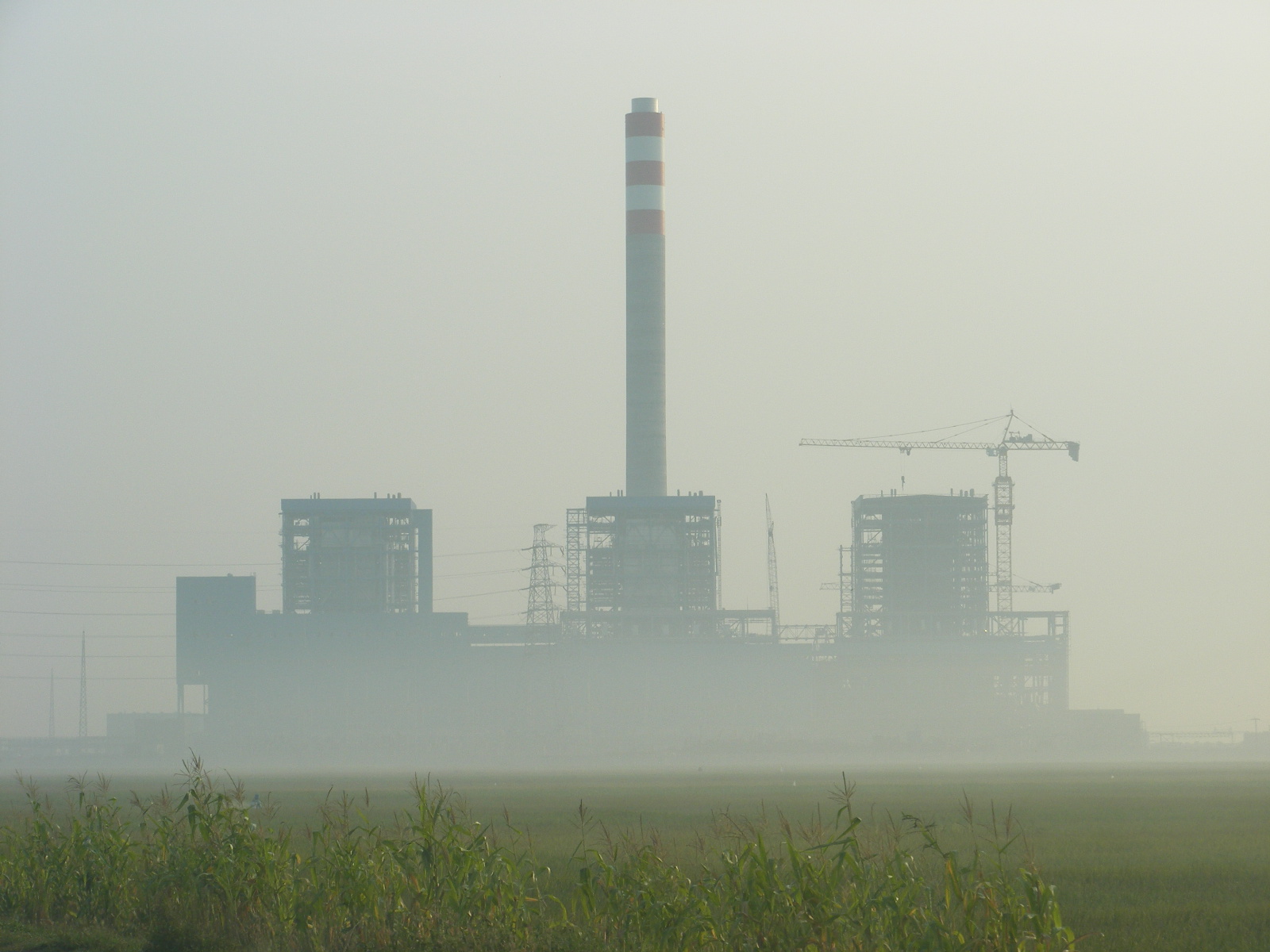
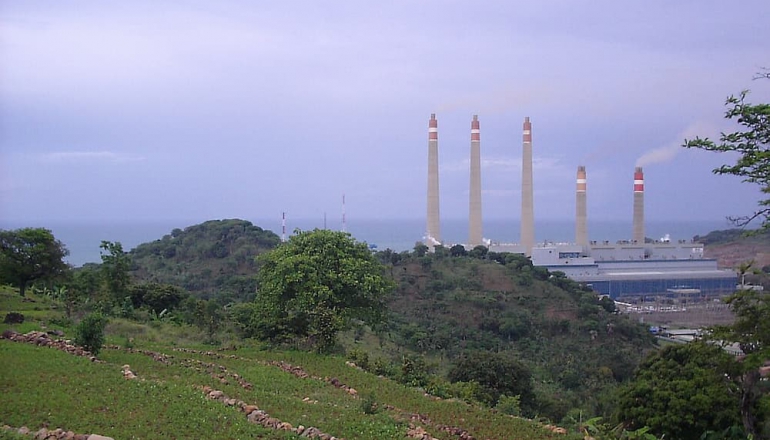
PLTU Indramayu in Indonesia. (Photo: Wikimedia Commons)
In addition, nearly all of the coal-power capacity under development (98%) is now concentrated in just 15 countries, with China and India alone accounting for 86%.
This is according to Global Energy Monitor’s latest Global Coal Plant Tracker (GCPT) results, completed in July 2024. The GCPT catalogues all coal-fired power units 30 megawatts (MW) or larger biannually, with the first survey dating back to 2014.
Despite the concentration of coal-plant development in fewer countries and projections that global coal demand could be peaking, new coal-fired power station proposals continue to outpace cancellations.
In the first half of 2024, over 60 gigawatts (GW) of coal capacity was newly proposed or revived, compared to the 33.7GW that was shelved or cancelled over the same period.
This article details some of the most significant trends driving the continued development of coal across the 15 largest markets, drawing insight from the GCPT, as well as wider context.
Global overview
Over the first six months of 2024, nearly twice as much coal capacity was proposed as was shelved or cancelled, as coal-fired capacity continues to grow globally.
This rebound in proposals is largely due to a resurgence beginning in China in 2022, followed by India in 2024. In fact, as shown in the figure below, almost all (97%) of the new and newly revived proposals in the first half of 2024 are located in China and India.
Additionally, of the 1.8GW of newly proposed capacity in the rest of the world, more than 40% is sponsored by Chinese companies.
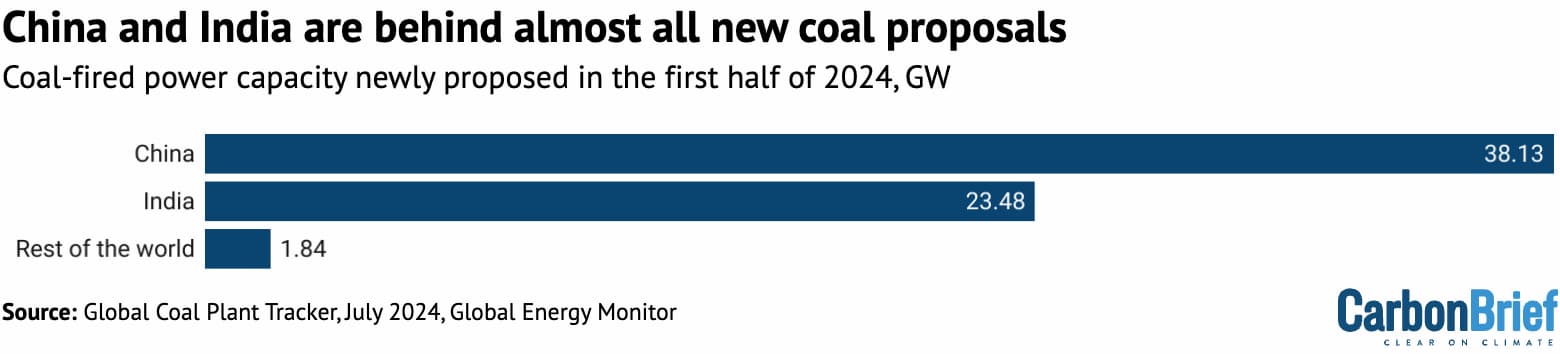
The newly proposed coal-fired power capacity in the first six months of 2024 in GW. Credit: Carbon Brief, based on Global Coal Plant Tracker, GEM.
Our results show that the elimination of new coal plants – a crucial step toward the rapid reduction in coal power use needed to keep global warming below 1.5C – is increasingly dependent on a shrinking number of countries.
The signing of the Paris Agreement in 2015 kick-started momentum in the global shift away from coal. To date, 75 countries have established carbon neutrality goals for 2050 or earlier, and over 100 countries are coal-free or have an established coal phaseout date in 2040 or earlier.
This growing number of commitments has been accompanied by a steep drop in coal capacity under development globally – the amount that has been announced, entered the permitting process, been granted a permit or started construction.
This pipeline of coal under development has declined by 62% compared to a decade ago, from 1,576GW in 2014 to 604GW today, according to the latest data from the GCPT
As shown in figure below, 590GW of that 604GW is concentrated in a handful of countries, dominated by China (70%) and India (16%). The other 14GW (not shown below), or 2% of the total capacity, is spread across 25 countries, each with less than 1.5GW under development.
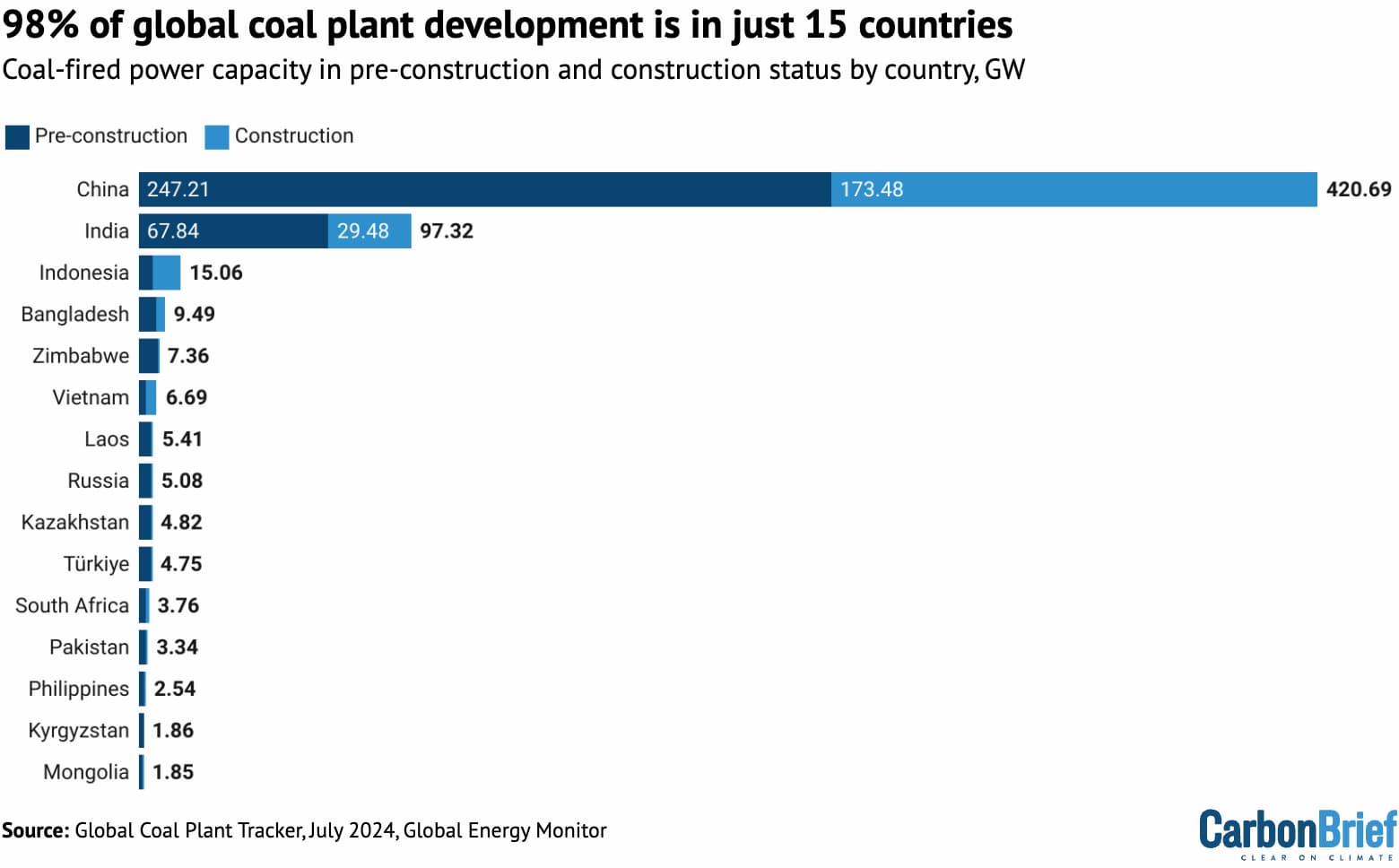
98% of global coal-fired power capacity (GW) in pre-construction and construction is in 15 countries. Credit: Carbon Brief, based on Global Coal Plant Tracker, GEM.
Despite the decline, some countries have not yet set energy transition targets consistent with the Paris Agreement or the UN’s 2023 “acceleration agenda”, which calls for the termination of all remaining coal proposals and a total phaseout of coal power by 2040.
The first global stocktake, drafted at the December 2023 COP28 conference, “urges” the similar but less aggressive global “phase-down of unabated coal power”.
Currently, though, none of the fifteen countries leading continued coal plant development have an established coal phaseout target.
While Indonesia, Vietnam and South Africa have negotiated “just energy transition partnership” (JETP) agreements to transition away from coal, their plans still allow for some growth in coal power.
The JETP agreements have also yet to resolve several thorny issues, such as how to treat “captive” coal plants that supply electricity off-grid, typically to large industrial sites. Increased JETP ambitions could help these countries achieve Paris-aligned emissions reductions.
China is involved in coal development in Indonesia, Zimbabwe, Laos, Kyrgyzstan and Mongolia, including some capacity proposed after China’s 2021 pledge to stop building new coal plants abroad. Apparent exceptions to the 2021 moratorium have emerged for projects designed for captive use or proposed as expansions at existing China-backed projects.
Meanwhile, many new coal proposals in Kazakhstan and Kyrgyzstan have Russian backing.
Several countries, including Bangladesh, Pakistan, the Philippines and Turkey are continuing with plans to develop a backlog of proposed coal plants in the face of counteraction to the fuel, such as local opposition, policy changes, finance moratoriums and other challenges.
The latest developments in each of these 15 countries are detailed below. The countries are listed in order, starting with the largest capacity of new coal under development, in China. Each includes a map that provides a snapshot of the coal-fired power plants under development, for the full data behind each see the GCPT database.
1. China
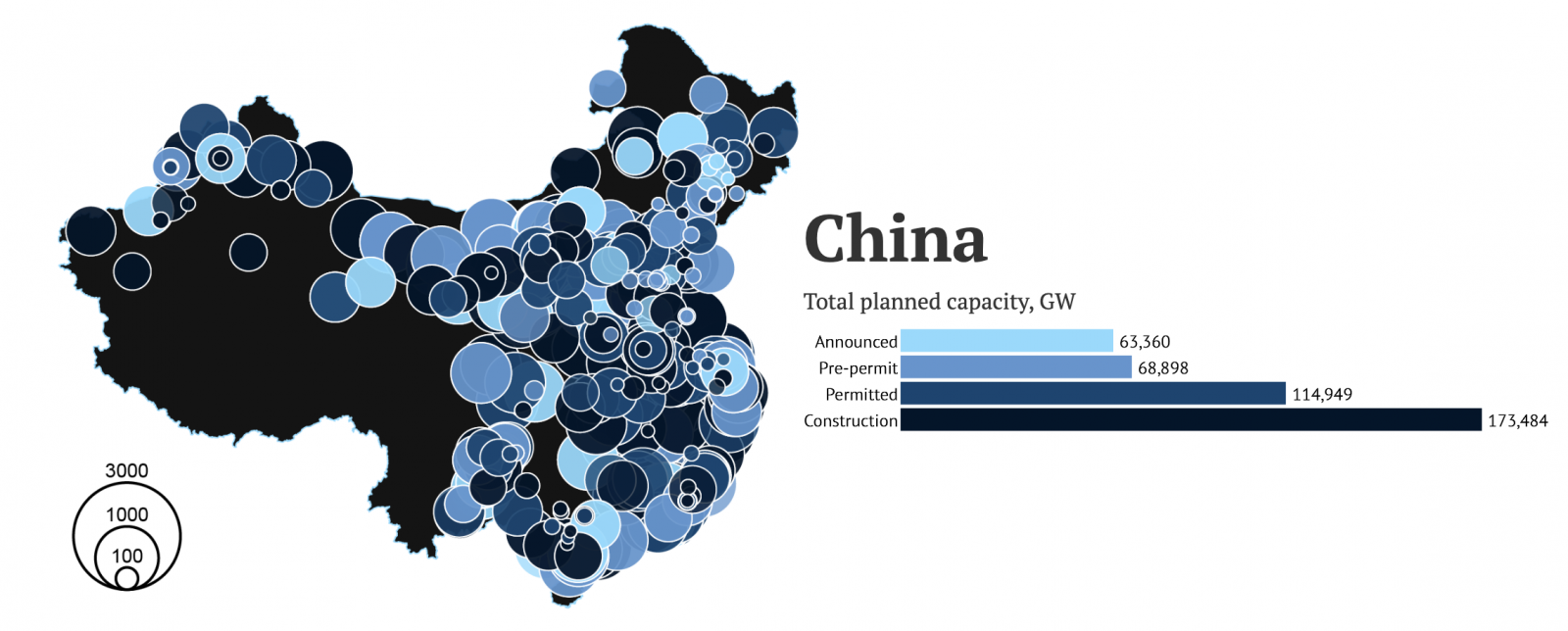
China’s dominance in the global energy landscape is underscored by its enormous coal power capacity.
As of June 2024, the country had 1,147GW of operational coal capacity spread across nearly 3,200 units, representing more than half (54%) of the world’s total operating coal capacity.
For years, China has led coal power development, but the pace of this development showed notable signs of an incoming slowdown in the first half 2024.
Following the recent spate of permitting of coal projects, exceeding 100GW annually in 2022 and 2023, China has made a sudden pivot.
The country drastically reduced approvals for new coal power in the first half of 2024, granting permission to only twelve projects totaling 9.1GW, as shown in the figure below.
The newly permitted capacity is equivalent to just 8% of what was permitted in all of 2023 and 17% of the peak half-year capacity permitted in the second half of 2022.
Notably, some of these permitted projects were expedited. For example, the extension of the Harbin No. 3 power station was initiated in April 2024 and then permitted for construction just two months later.
In 2024, proposals for new and revived coal projects are also showing a downward trend compared to the peak years of 2022 and 2023, with 38.1GW of new and revived proposals in the first half of the year, compared to 60.2GW in the first half of 2023 and 47.8GW in the first half of 2022.
This trend hints at a potential slowdown in new project development, albeit not as pronounced as the permit slowdown.
GEM’s analysis indicates that the deceleration of coal project announcements and permitting is likely the result of China’s massive clean energy deployment. By the end of June 2024, the total grid-connected wind and solar capacity reached 1,180GW, making up 38.4% of the total installed power generation capacity in the country and overtaking coal (38.1%) for the first time in history.