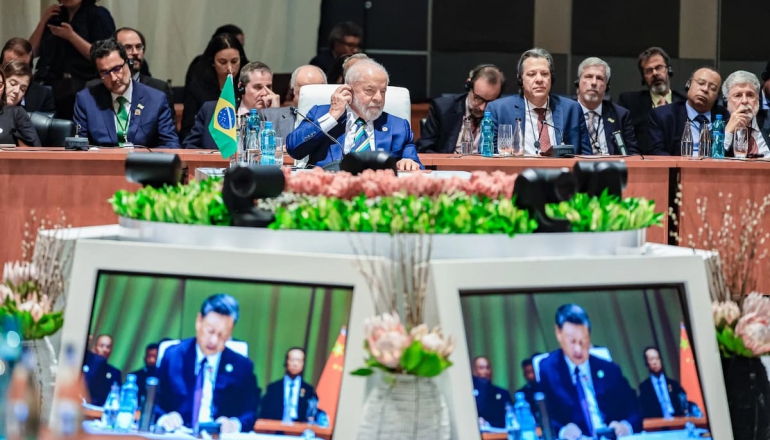
(Photo: UNclimatechange/Vugar Ibadov)
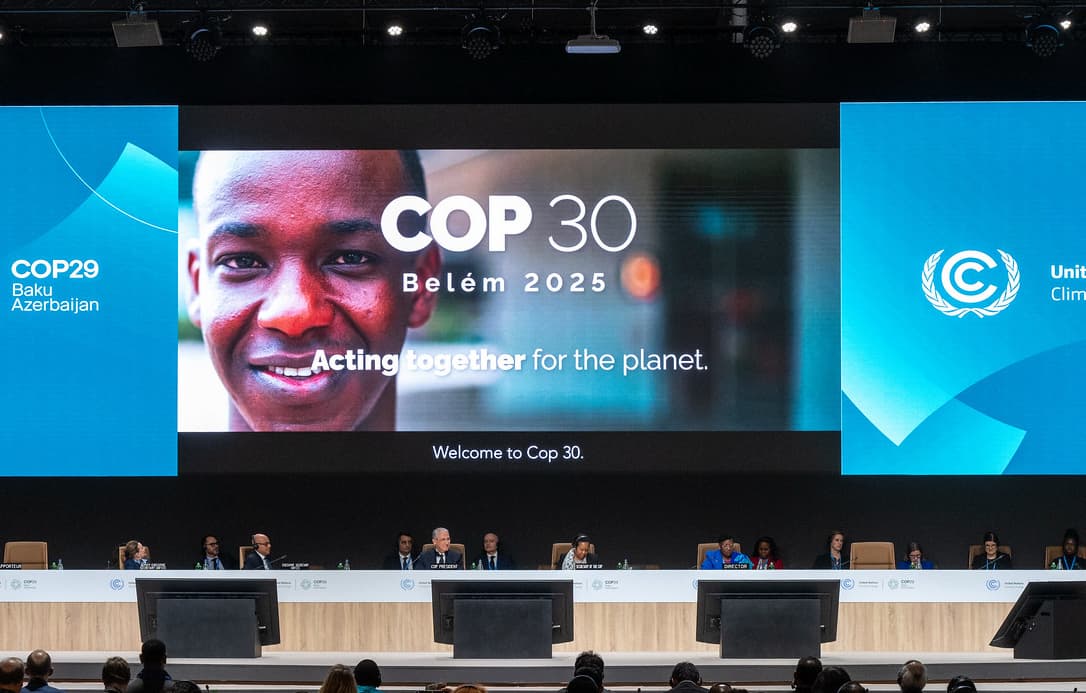
Brazil’s new climate pledge, launched at the COP29 climate summit in Baku, aims to cut greenhouse gas emissions by as much as two-thirds by 2035 compared to 2005 levels.
The new pledge makes Brazil one of the first countries to release its latest plan – known as a “nationally determined contribution” (NDC) – ahead of the February 2025 deadline.
NDCs are updated every five years under the Paris Agreement, with countries outlining how they intend to reduce greenhouse gas emissions as part of global efforts to limit warming.
Brazil is hosting the next UN climate summit, COP30, in November 2025, where NDCs from all around the world will be assessed.
Brazil’s submission is keenly watched as it is one of the largest economies in the world, as well as a top-10 annual and historical emitter. It is also the world’s most biodiverse country, hosting tens of thousands of animal and plant species, with major biomes such as the Amazon and Cerrado.
In order to implement the NDC, Brazil will also be updating its national climate plan, which will include national mitigation and adaptation strategies. These will be broken down into 16 sectoral adaptation plans and seven sectoral mitigation plans, “which are intended to be finalised around the mid[dle of] 2025”.
The NDC sets two headline targets: a “less ambitious” target of cutting emissions to 1.05bn tonnes of carbon dioxide equivalent (GtCO2e) by 2035; and a more ambitious target, which would mean cutting emissions to 0.85GtCO2e by 2035.
These would result in a 59% or 67% reduction in emissions, respectively, compared to 2005 levels.
A 2016 pledge from Brazil set reduction targets of 37% by 2025 and 43% by 2030 – corresponding, respectively, to emissions levels of 1.3GtCO2e and 1.2GtCO2e.
The new targets are “ambitious, but also feasible”, Brazil’s vice-president Geraldo Alckmin told COP29.
The establishment of dual targets is a “confirmation that [Brazil] could do much more” when it comes to its ambition, Claudio Angelo, the international policy coordinator at Brazilian climate NGO group Observatório do Clima, tells Carbon Brief.
A technical note from this group warns that, while other countries – including Brazil – previously included a “band” of targets in their NDCs, the size of Brazil’s target range “creates complications to both analysis and implementation”.
Below, Carbon Brief analyses Brazil’s NDC to identify five key points that will define the country’s emissions trajectory over the next decade.
(Photo: Pixabay)
1. Combat deforestation and restore degraded lands
Since his 2022 election win, Brazil’s president Luiz Inácio Lula da Silva has pledged to reach “zero deforestation” in the country by 2030.