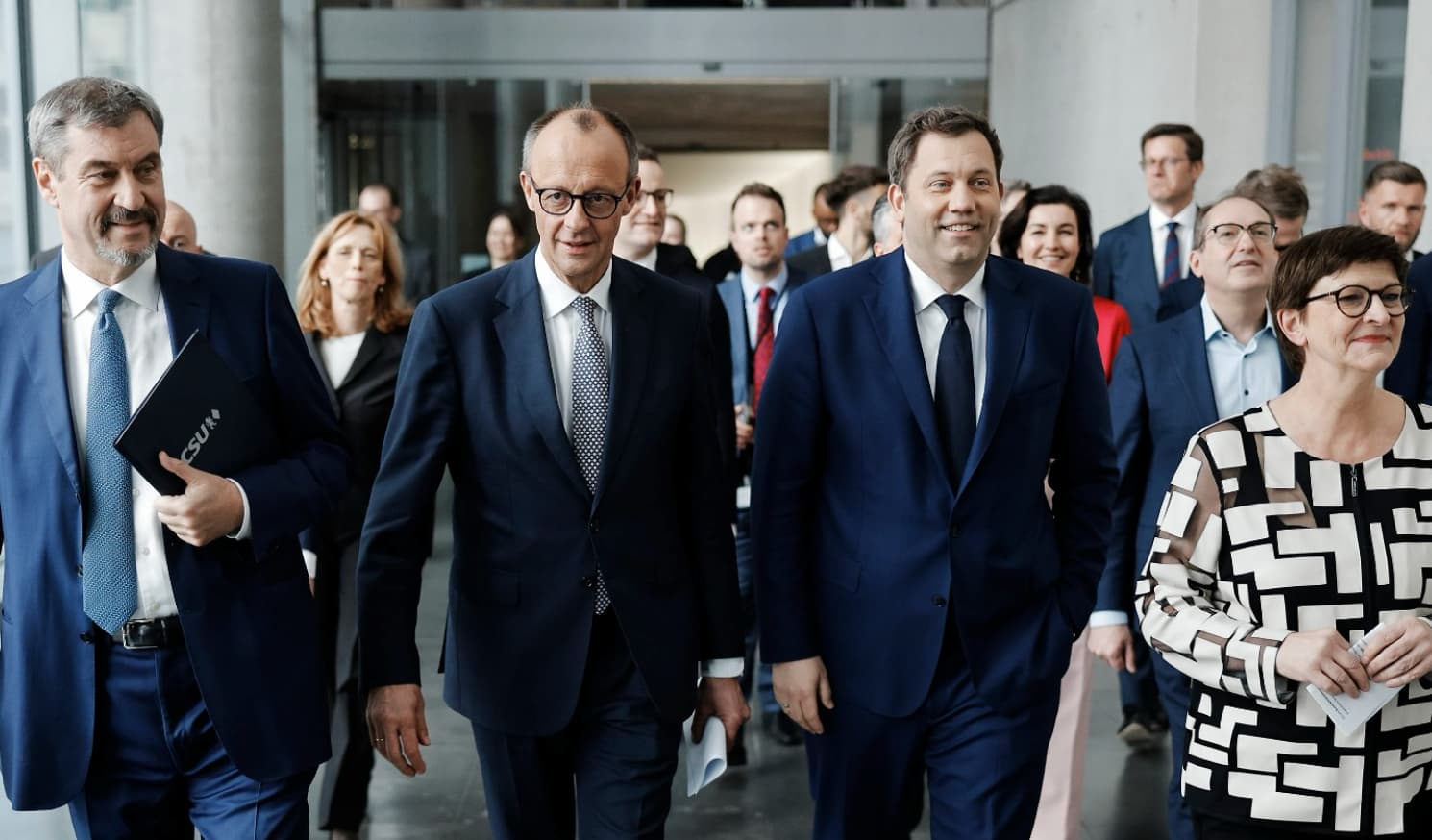
German coalition leaders brief the media after reaching an agreement between their parties on a new government. (Image: Friedrich Merz's facebook)
Since the German election took place in February, which saw the centre-right Christian Democratic Union (CDU) win the most seats, parties have been negotiating to form a new coalition government.
Earlier this week, the CDU reached a deal with the centre-left Social Democratic Party (SPD) to govern Europe’s largest economy and biggest emitter.
Led by Friedrich Merz of the CDU, the government is made up of Lars Klingbeil and Saskia Esken of the SPD, plus Markus Soeder of the CDU’s Bavarian “sister party” the Christian Social Union (CSU).
Following 45 days of negotiations, the new coalition has released a 144-page agreement, detailing their policies and plans for the coming five years of government.
The coalition is set to take over at a time of intense geopolitical uncertainty, which is reflected within the coalition agreement’s focus on a “strong government”.
The agreement places an emphasis on German politics shifting from “climate protection concerns” to “the economy and growth”, with support for “market instruments, technical solutions and reduction of bureaucracy”.
Below, Carbon Brief explains the current state of climate politics in Germany and the path ahead for its new government, including the details laid out in the new agreement.
Read more: Germany's new chancellor faces coalition challenges affecting climate goals
What is the state of climate politics in Germany?
Germany’s previous coalition government collapsed at the end of 2024 when then chancellor Olaf Scholz fired finance minister Christian Linder and announced he would call for a vote of no confidence in his government.
This followed numerous crises within the “traffic-light” coalition – made up of the SPD, the Green party and the Free Democratic Party (FDP) – which had governed since 2021.
Many of these disputes involved climate- and energy-related policies, such as the controversial Building Energy Act, which could have seen oil-and-gas heating systems banned in homes. Despite pushes from the Green party, the law was revised after the FDP argued that it would burden consumers too much with the costs of replacing heating systems.
Scholz lost a vote of confidence in December and an election was announced for 23 February.
As campaigns got underway, several climate- and energy-focused topics became key issues for voters.
Climate change has become an increasingly politically contested issue in Germany. While the CDU, SPD and Green parties all support reaching net-zero by 2045, with interim targets including a 65% cut by 2030, their approaches differ.
The FDP argues that the 2045 target should be pushed back to 2050, to line up with the wider EU target. Meanwhile, the manifesto of the far-right Alternative for Germany (AfD) party repeatedly questions the “supposed scientific consensus” on “man-made climate change”.
Beyond climate targets, home heating continued to be a major political issue in the wake of the 2023 Building Energy Act. The CDU, FDP and AfD all pledged to abolish it, while the Green party pledged to provide additional government support for households.