.jpg)
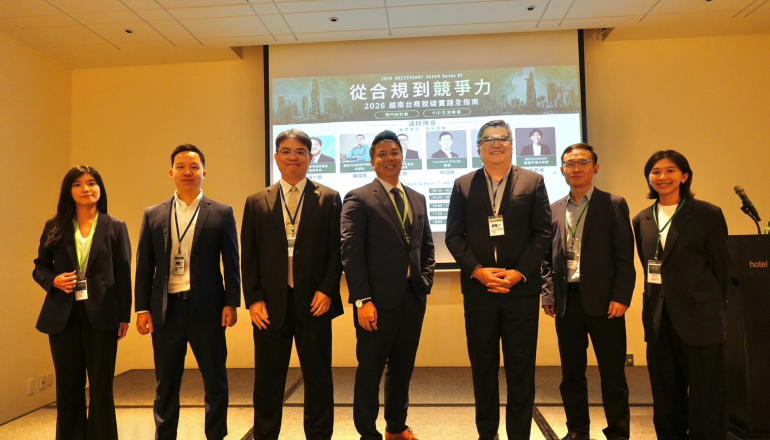
The ESG Service Corporation Association invited experts to share decarbonization strategies for supply chains in Vietnam. (Photo: Boyu Lin)
Vietnam, a critical node in the global supply chain, is at a pivotal decision point in its transition toward sustainability and ESG governance. The ESG Service Corporation Association hosted a forum in Ho Chi Minh City on June 13, featuring the signing of two memoranda of understanding (MOUs) and expert discussions on sustainable value creation, low-carbon manufacturing, and carbon border policies.
Cross-border partnerships aim to unlock synergies
A key highlight of the forum was the signing of two MOUs.
The first, between the Vietnam ESG Service Corporation Association and the Taiwan ESG City Net Zero Breakthrough Association, focuses on strengthening cross-border collaboration. The partnership aims to integrate resources and leverage complementary strengths to advance carbon-neutral technologies, while establishing a platform for international green energy cooperation.
The second agreement, initiated by private enterprises, was signed by InSynerger Technology and C.C. Sustain ESG Solution. It seeks to combine IoT-based platforms with carbon management systems to support businesses in Vietnam across the full decarbonization process from carbon inventory to emissions reduction, enabling data-driven decision-making and long-term value creation.
Chen Chih-Lin, General Manager of C.C. Sustain, noted that companies are facing a dual challenge: improving energy efficiency while adapting to the rapid rise of AI. The partnership aims to deliver integrated solutions by bringing Taiwan’s carbon management expertise to Vietnam. “If you want to go fast, go alone; if you want to go far, go together,” he said, emphasizing collaboration to help Taiwanese firms and local enterprises gain a competitive edge.
Beyond competitiveness: ESG misreporting risks come into focus
In the keynote session, Rebecca Shen, founder of Infinite Dimensions Consulting and managing partner at WHP Law Firm, spoke on “Positive-impact governance and natural capital value creation—from compliance pressure to capital-driven competitiveness.” She stressed that ESG should not be confined to sustainability reports but embedded at the core of corporate governance and strategic decision-making.
Shen also highlighted structural challenges, noting that ESG functions are often assigned to “cost centers” such as HR, legal, or PR departments, limiting companies’ ability to approach ESG from a value-creation perspective.
Shen urged companies to elevate ESG governance to the board and CFO level, particularly in light of IFRS S1 and S2 disclosure requirements. As sustainability data becomes increasingly integrated with financial reporting, failure to align governance structures could expose companies to compliance gaps and even legal risks related to financial misstatements.
Looking at Vietnam, she identified a “triple pressure” on supply chains: consolidated reporting requirements from parent companies, tightening local regulations, and the ripple effects of mechanisms such as CBAM. Even non-listed firms, she noted, will face increasing demands from clients for verifiable data or risk being excluded from supply chains.
She advised Taiwanese businesses in Vietnam to leverage ESG initiatives to strengthen competitiveness. For instance, textile firms can adopt closed-loop water systems to meet anti-greenwashing scrutiny and secure green orders, while electronics manufacturers can deploy microgrids with solar and storage to ensure operational resilience and access green financing.
.jpg)
The session also explored ESG value creation pathways for Taiwanese businesses operating in Vietnam. (Photo: Boyu Lin)
From compliance to strategy: firms urged to act early
Jason Huang, founder and CEO of RECCESSARY and board member of TIVA, analyzed the implications of carbon border policies from a global trade compliance perspective.
He noted that CBAM is not limited to the EU, with countries such as the UK and the US planning similar mechanisms by 2027. Currently, 87 jurisdictions worldwide have implemented carbon pricing systems.
Simulation data suggest that as free allowances decline and penalty mechanisms tighten, carbon prices could rise from €75 today to €147 by 2030. Companies relying on default values instead of verified emissions data may face significantly higher costs.
Huang emphasized that brand requirements from companies such as Nike and Samsung are becoming increasingly stringent, extending beyond basic compliance to detailed Scope 3 emissions data aligned with international frameworks such as SBTi.
“As costs rise, making the wrong choices—such as purchasing non-compliant green certificates—can be even more damaging,” he warned. Such missteps may not only lead to financial losses but also jeopardize business relationships.
He outlined three strategic approaches for Vietnamese manufacturers: passive waiting, minimum compliance, and strategic leadership. Companies adopting a passive stance are likely to face higher carbon costs and weaker bargaining power, while those taking a proactive approach, through data assetization and low-carbon upgrades, can attract premium buyers and gain access to green finance.
From an operational perspective, Polon Chuang, General Manager of InSynerger Technology and board member of TAESCO, highlighted the growing importance of energy management systems (EMS).
He described factories as being under “dual pressure”: externally from carbon tariffs, and internally from rising electricity prices and grid instability. While many companies have installed solar panels, overreliance on intermittent renewable energy can increase the risk of power disruptions.
Chuang likened most factories to a “black box,” lacking visibility into actual energy consumption at the equipment level. Without data transparency, carbon accounting and green electricity procurement lose their foundation. He recommended adopting EMS platforms to connect meters and production equipment, effectively creating a “digital brain” for real-time resource management.
He cited a large hospital in Taiwan as a case study, where the deployment of battery energy storage systems (BESS) enabled a stable power supply, peak shaving, and demand control, significantly improving energy efficiency without compromising operations.
Energy storage, he added, is set to become an “irreversible trend” in Vietnam, alongside solar adoption and government-led efficiency policies, reinforcing the need for integrated energy management solutions to accelerate low-carbon transformation.
.jpg)
The ESG Service Corporation Association held a themed forum that attracted many local Taiwanese companies in Vietnam. (Photo: Boyu Lin)