.jpg)
Country flags from all over the world at COP28. (Photo: Stockholm Environment Institute)
The ability of governments to implement climate policies effectively is the “most important” factor in the feasibility of limiting global warming to 1.5°C, a new study says.
The future warming pathways used by the Intergovernmental Panel on Climate Change (IPCC) suggest that holding warming to 1.5°C is unlikely, but still possible, when considering the technological feasibility and project-level economic costs of reaching net-zero emissions.
However, the new study, published in Nature Climate Change, warns that adding in political and institutional constraints on mitigation make limiting warming to 1.5°C even more challenging.
They find that the most ambitious climate mitigation trajectories give the world a 50% chance of limiting peak global warming to below 1.6C above pre-industrial temperatures. However, adding ”feasibility constraints” – particularly those involving the effectiveness of governments – reduces this likelihood to 5-45%.
The study shows that, thanks to advances such as solar, wind or electric vehicles, “the technological feasibility of climate-neutrality is no longer the most crucial issue”, according to an author on the study.
Instead, he says, “it is much more about how fast climate policy ambition can be ramped up by governments”.
Emissions scenarios
In 2015, almost every country in the world signed the Paris Agreement – with the aim to limit global warming to “well below” 2C above pre-industrial levels, with a preference for keeping warming below 1.5°C.
Since then, most countries have set net-zero targets and many are making progress towards achieving them. However, as the planet continues to warm, some scientists are questioning whether it is still possible to limit warming to 1.5°C, the new study says.
The IPCC’s special report on 1.5°C, published in 2018, included a cross chapter box on the “feasibility” of this temperature limit. The report says there are six components of feasibility that could inhibit the world’s ability to limit warming to 1.5°C, as shown in the image below.
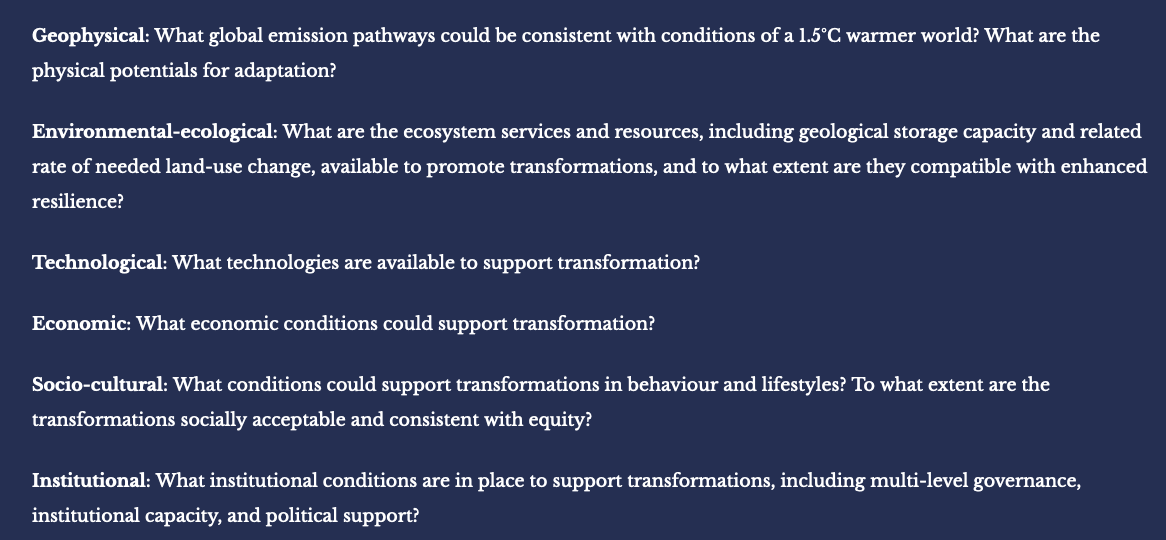
The six components of feasibility that could inhibit the world’s ability to limit warming to 1.5C, according to the IPCC”s special report on 1.5C. Source: IPCC SR1.5, cross chapter box 3.