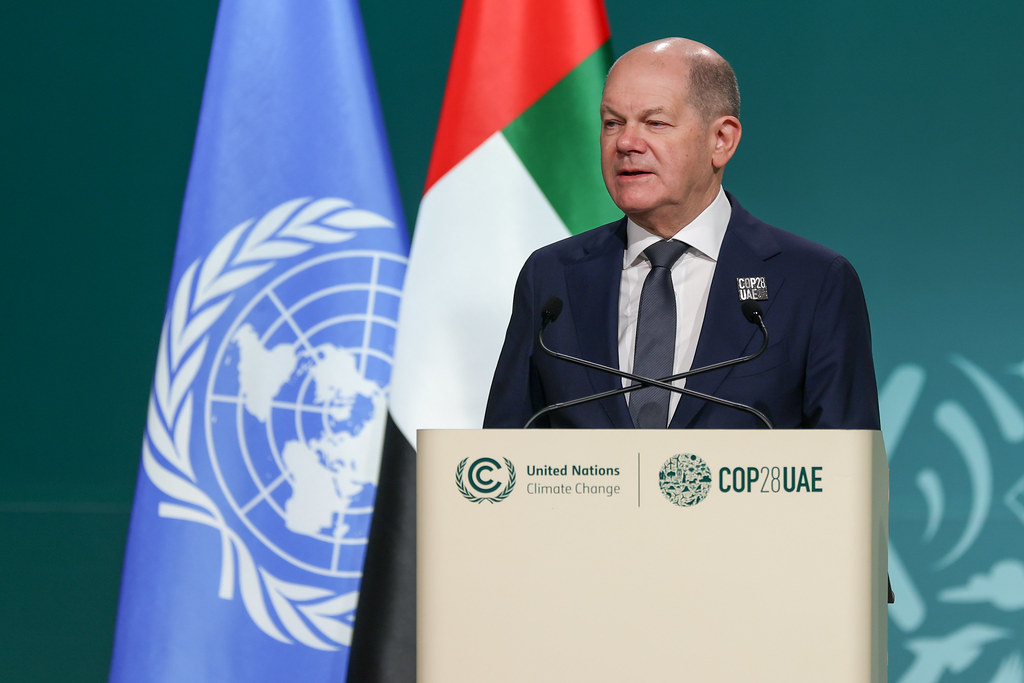
The break-up of Chancellor Scholz's could lead to months of uncertainty for energy transition projects. (Photo: UNclimatechange)
The early end of Olaf Scholz’s coalition government follows a three-year term marked by crises and a deep internal dispute over funding for future climate and energy policies. Despite its noisy demise, the chancellor’s three-party alliance has made significant progress in key policy areas, such as renewables expansion.
But the many funding questions and policy loose ends left behind by the coalition’s collapse will not make the job easier for a new government after the election in February 2025. It faces economic woes, security challenges and mounting costs that could challenge the acceptance of climate policies.
The collapse of chancellor Olaf Scholz’s government in early November suddenly broke the coalition that entered office roughly three years earlier with the commitment to put Germany's policy in line with the targets of the Paris Climate Agreement. The sacking of finance minister Christian Lindner by the chancellor, which cut the three-party alliance’s reign short by more than half a year, will now be followed by snap elections on 23 February. It also left the country with a raft of unfinished policy business.
The break-up of the so-called ‘traffic light coalition’ of Scholz’s Social Democrats (SPD), the Green Party and Lindner’s Free Democrats (FDP) hit the country amidst poor economic forecasts, the looming threat of a recession, and factory closures and mass layoffs in key industries.
It also came against the backdrop of intensifying security challenges related to Russia’s invasion of Ukraine and deep uncertainty over an incoming Trump government and its potentially disruptive stance on trade, defence, and diplomatic conventions anticipated in many European capitals. All of these challenges also require resolute responses in energy and climate policy – but questions over funding ultimately led to the coalition’s early end.
“The coalition’s break-up is threatening much-needed progress in several areas,” Brigitte Knopf, head of think tank Zukunft KlimaSozial, told Clean Energy Wire. Knopf, who also co-chairs the government’s Council of Experts on Climate Change, said that the snap election might exact months of uncertainty and possible U-turns in important policy areas. “It is likely that we are facing a difficult period until about mid-2025, so there will be about half a year of standstill in policymaking,” Knopf warned, arguing that this could take a toll on acceptance of the energy transition and significant planning insecurity for companies preparing decarbonisation investments.