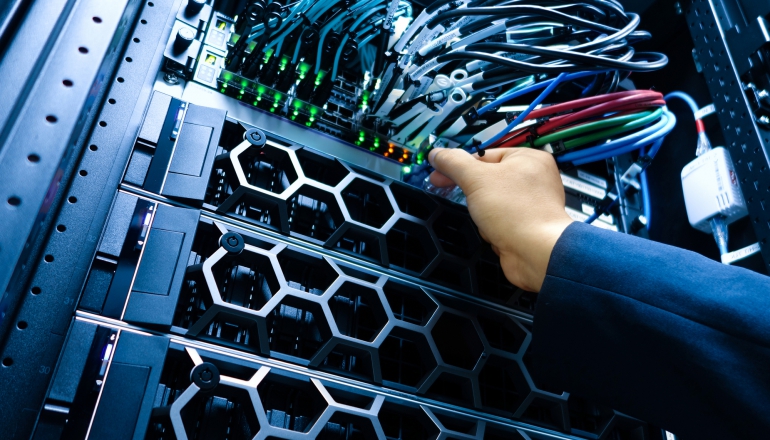
Energy Tech Summit Asia brought together energy and data center players to discuss rising power demand from AI. (Photo: Hsu Tsu-lin)
AI data center investment is surging across Asia, with the sector already accounting for nearly 10% of Malaysia’s electricity demand. The growth is raising a key question: Can the energy transition keep pace with the digital economy?
After seven years in Europe, Energy Tech Summit made its Asian debut in Kuala Lumpur on Sept. 29 and 30, bringing together industry players and investors to discuss AI and energy, climate technology and investment. RECCESSARY was on the ground to report on the latest developments shaping Asia’s energy technology and investment landscape.
With its large population, growing economies and strong industrial base, Asia was the summit’s first destination outside Europe. Energy Tech Summit founder Skaiste Knyzaite said on Sept. 29 that the region’s energy transition is not only about cutting emissions, but also about supporting economic growth and maintaining energy security.
Rising electricity demand from AI and data centers has also made energy an increasingly inseparable part of the AI discussion. The summit’s opening-day panel focused on how Asia can accelerate investment in renewable energy infrastructure to meet that challenge.
Grid constraints and financing emerge as new bottlenecks in Asia’s energy transition
Malaysia aims to raise the share of renewable energy in its installed power capacity to 40% by 2035 and 70% by 2050, said Abdul Rahman Bin Haji Mohamad, deputy minister of the country’s Ministry of Energy Transition and Water Transformation (PETRA). He said the recent LSS PETRA 5 and 5+ large-scale solar programs have allocated around 3.9 GW of capacity, as the country continues to expand renewable energy investment.
But Asia’s energy transition is no longer just about how much renewable capacity can be built. The region also needs to ensure that electricity can reach where it is needed and attract more private capital into the sector.
Bhupesh Kumar, investment director at Singapore’s Temasek, said institutional investors are ultimately looking for projects that can generate predictable, long-term revenue. Key considerations include who the counterparties are, the length of contracts and how risks are allocated. For large investors, whether projects can be replicated and scaled also determines whether capital will continue to flow into the sector.
More challenging than financing, however, is a power grid that is struggling to keep pace with both renewable energy growth and rising electricity demand. Kumar said many Asian markets are actively launching renewable energy tenders, while the expansion of transmission networks has lagged behind.
Data centers and high-tech manufacturing are now adding new loads ranging from tens to hundreds of megawatts. Yet power generation and demand are often located far apart, making the ability to deliver new electricity supply where it is needed a growing bottleneck in the energy transition.
Davis Chong (張俊雄), group CEO and executive director of solar developer Solarvest, said the grid challenge is particularly evident in Malaysia, where data center demand is growing rapidly. Developers currently have limited visibility into congestion at substations and where energy storage is needed. Greater transparency on grid capacity and demand, he said, would allow private capital to be directed more efficiently to where it is most needed.
On energy storage, Masahiro Ito, CEO of Japanese battery company PowerX, said battery costs have fallen significantly over the past 18 months, making solar paired with storage increasingly competitive in some Asian markets.
At the same time, the large swings in electricity demand caused by AI training are creating a new market for energy storage at data centers. In the future, on-site storage could go beyond backup power to help manage loads and support the grid.

Temasek investment director Bhupesh Kumar said lower renewable energy costs alone are not enough to attract investment, as institutional investors also look for stable returns, clear risk allocation and scalability. (Photo: Hsu Tsu-lin)
New power plants can take 7 to 10 years as AI data centers look to unlock capacity from existing grids
As AI data centers expand rapidly, building new large-scale power generation could take seven to 10 years, according to Takeshi Kodama, head of JERA Ventures, the investment arm of Japanese energy company JERA. Data center demand cannot wait that long, he said, making it increasingly important to find ways to free up mo
One option is for data centers to adjust their development and electricity use based on grid conditions. Lan Zhang, director of energy and utilities at Asia-Pacific data center operator AirTrunk, said developers can build in phases based on available grid capacity and adjust expansion timelines accordingly. Batteries and on-site generation can also provide short-term support.
These resources, however, are primarily intended to ensure data center resilience and cannot replace investment in power generation, transmission networks and substations. If flexible demand is to be used more broadly as a grid resource, Zhang said, the amount of adjustable capacity, response time and duration must also be clearly defined.
Another option is to make better use of existing grid infrastructure. Deane Criddle, senior services director at energy equipment and grid technology company GE Vernova, said dynamically adjusting transmission line capacity, rather than relying on traditional fixed ratings, could unlock around 5% to 35% more capacity depending on actual conditions.
Matt Gleeson, vice president of energy transition and water conservation at cloud and enterprise software company Oracle, said AI and automation can further support real-time grid decision-making, provided that sufficiently accurate data is available. But these digital tools can only buy time for the grid. They cannot replace investment in new power generation.
Data centers themselves also need to become more transparent if power supply and demand are to be better aligned. Zhang said the large amounts of capacity requested by data centers are typically not needed all at once, but increase gradually as facilities are built and customers move in.
If operators can give utilities a clearer picture of how much power they will need and when, while also sharing development timelines and expected load growth, utilities can plan more accurately. This would reduce the impact of speculative demand on grid planning and help power infrastructure keep pace with data center growth.

Malaysia’s Deputy Minister of Energy Transition and Water Transformation Abdul Rahman Bin Haji Mohamad visits an energy technology startup booth at Energy Tech Summit Asia. (Photo: Hsu Tsu-lin)