.jpg)
A freight train in the U.K. run on renewable diesel. Replacing red diesel (fossil diesel specifically earmarked for rail or agricultural vehicles) with RD can cut a train’s emissions by “as much as 90%,” according to the industry. But such claims can be erroneous since some feedstocks have high carbon intensity (such as oil palm) over others (like used cooking oil). Image by Rob Reedman via Flickr (CC BY-NC-ND 2.0).
Renewable diesel is a biofuel made from vegetable oils and animal fats touted by proponents as an almost miraculous “drop-in” transition fuel able to drastically cut greenhouse gas emissions while easily replacing fossil diesel in all manner of engines.
But this biofuel’s recent sudden surge in production and rapid expansion in applications is alarming environmentalists, who warn unfettered growth could fuel climate change and tropical deforestation.
Renewable diesel, or RD, can be made from a wide range of feedstocks, including waste vegetable oils, animal tallow, corn, canola (rapeseed), soy and oil palm. The feedstock used, where and how it is produced, and whether forests are felled to make way for biofuel crops, all determine RD’s carbon emissions as compared to fossil diesel.
RD is often manufactured in retooled fossil fuel refineries using complex biochemical and thermochemical technologies requiring lots of energy — adding to its carbon footprint. Chevron, BP, Shell and other major fossil fuel companies are now converting excess refinery capacity to make RD and enter the market in a big way.
A big selling point for renewable diesel is that it is almost chemically identical to fossil fuel diesel — meaning it can be substituted in existing diesel engines, making it a so-called drop-in biofuel. (Biodiesel, by comparison, is made using a far simpler process, not requiring manufacture in an oil refinery and not “drop-in”-ready.) An added advantage, RD can be “upgraded” to produce sustainable aviation fuels (or SAF).
In recent years, renewable diesel production and use has boomed. Global production rose from less than 4 million metric tons in 2014 to 12.45 million metric tons in 2022, jumping to around 23 million metric tons in 2024. This surge could continue in the future, driven by key markets such as the U.S. and EU.
Neste, a Finnish company and the world’s largest renewable diesel producer, estimates that biofuels, including renewable diesel, could replace 1 billion metric tons of fossil fuels in the transport sector alone; the company is currently producing 5.5 million tons of RD annually, known in the industry as HVO (hydrotreated vegetable oil); it aims to sell 6.8 million metric tons in 2026.
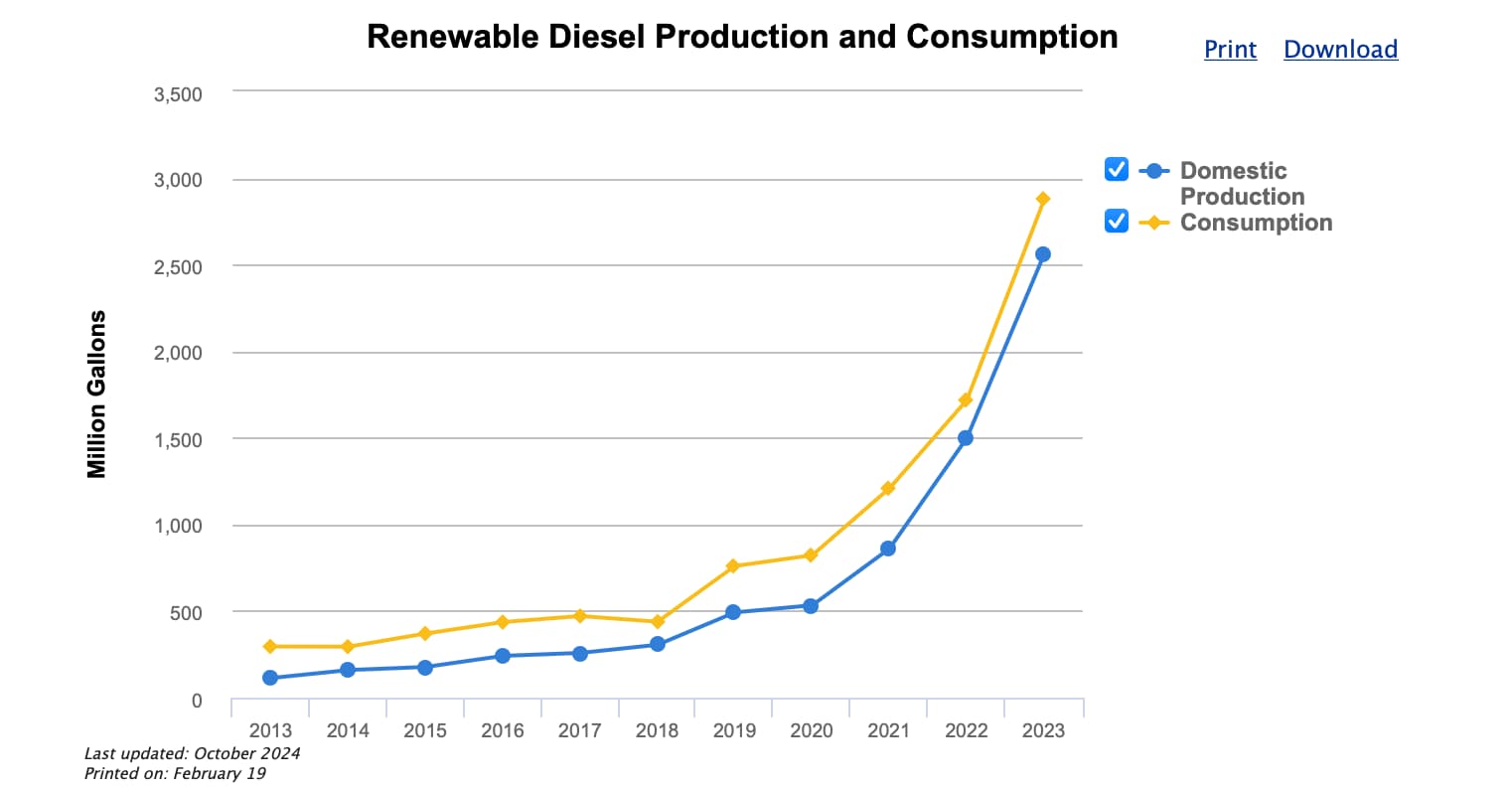
Graph showing U.S. renewable diesel production and consumption, last updated October 2024. RD benefits, according to proponents, include its meeting the same fuel quality specifications of fossil diesel, meaning it can be used as a “drop-in” fuel in existing diesel engines and in refueling infrastructure without the need for retrofits or upfits. The problem, say critics, is that there isn’t enough used cooking oil and inedible animal fats to feed the surging RD industry, meaning other sources must be tapped. Image courtesy of the EIA Monthly Energy Review.
Production surge spurred by incentives
Renewable diesel was originally marketed as a cleaner substitute for fossil diesel in hard-to-decarbonize sectors, especially transportation. The U.N. Intergovernmental Panel on Climate Change has never recommended it for use in power plants or other applications.
However, spurred by government green energy incentives, companies are expanding production and targeting new markets, positioning RD as fuel not only for land transport and SAF, but for transoceanic shipping, power plants, as heating oil, and even as backup fuel for energy-hungry data centers. Among prominent green incentives are the EU’s Renewable Energy Directive, the U.S. federal carbon-reduction policies, and especially California’s Low-Carbon Fuel Standard (LCFS), and biofuel-friendly mandates in Asia.
In the United States, production (largely sourced from soy) was estimated at just 250 million gallons (946 million liters) in 2013. That’s set to top 5 billion gallons (19 billion liters) this year. Elsewhere, companies in Malaysia and Indonesia have announced plans to develop refineries capable of churning out both renewable diesel and SAF, while Brazil has positioned itself to become a major renewable diesel and SAF producer, adding it to its already vast biofuel industry. Canada, too, is racing to hike production.
Industry critics say that without the lucrative government incentives, RD demand would likely be nonexistent.
.jpg)
Marine shipping contributes about 2% of global carbon emissions. The U.N. International Maritime Organization (IMO) wants to achieve net zero by 2050, particularly by upping biofuel use (including renewable diesel), a move some environmental groups oppose. Image by John Fielding via Flickr (CC BY 2.0).
Rapid expansion concerns environmentalists
International marine shipping offers a good example of what could lie ahead: It already releases 2% of global carbon emissions, so the U.N. International Maritime Organization (IMO) is determined to achieve net zero by 2050, mostly by upping biofuel use. A report by Transport & Environment, a coalition of European NGOs, published in February 2025 found that this push could result in up to 44% of shipping energy demand being met by biofuels (including renewable diesel), by 2035, totaling 105 million metric tons annually.