Training projects are benefiting the renewable energy sectors of Belt and Road countries, but expansion will require funding.
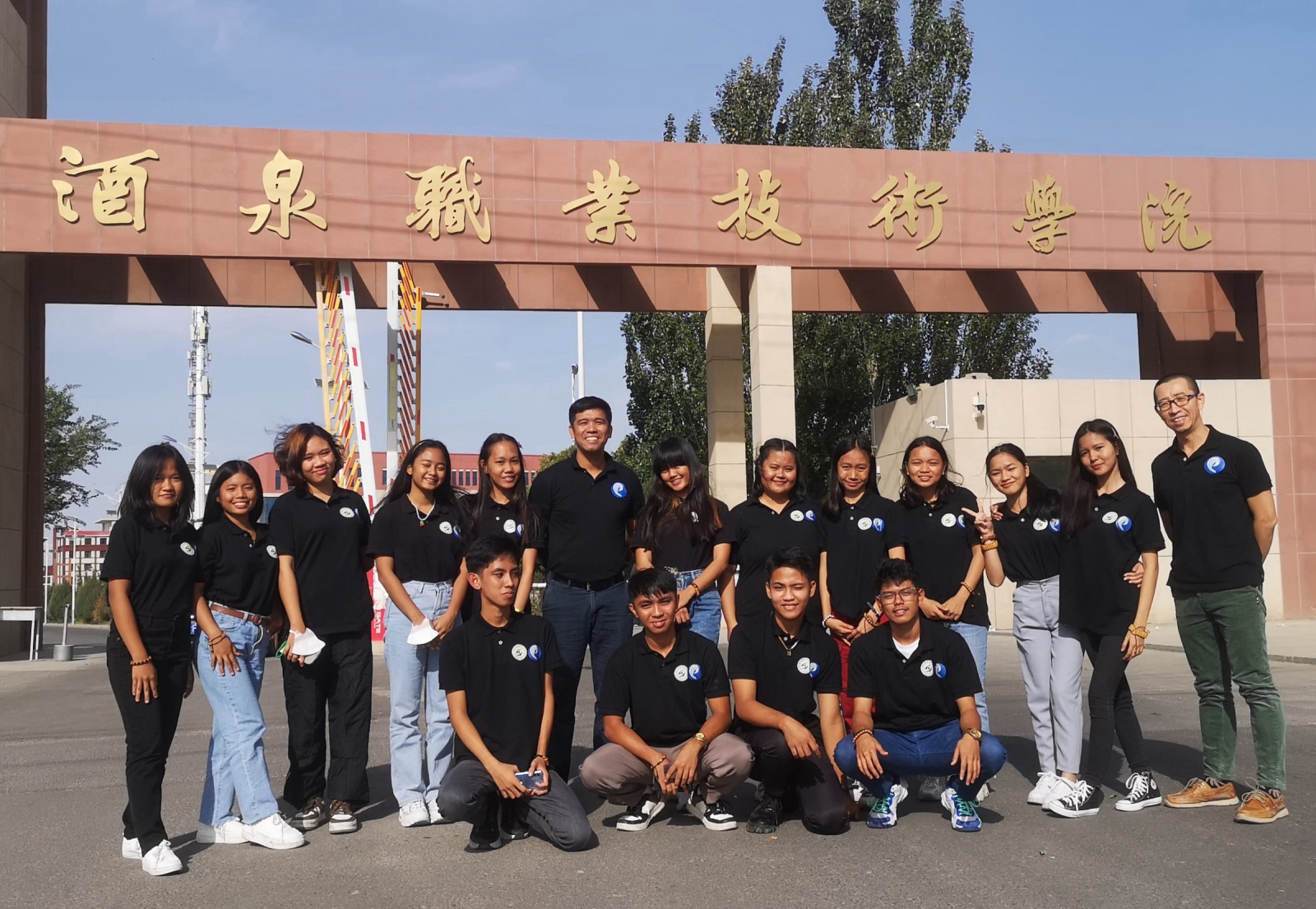
A cohort of “new energy engineering” students from the Philippines outside Jiuquan Vocational and Technical College, in Gansu, north-west China, September 2023 (Image: People of Asia for Climate Solutions)
“In three years, I want to be a renewable energy engineer, using the skills I studied in China to contribute to the energy transition in the Philippines. I want to help solve the climate crisis we are going through,” Princess Agnila said.
Agnila, 18, is among a group of Filipino students in China training to become renewable energy engineers. The three-year scheme was initiated by several environmental organisations based in the Philippines.
China’s global infrastructure programme, the Belt and Road Initiative (BRI), has been running for 11 years. But not many are aware that the country is also engaging with BRI nations on training projects like this.
Studying renewable energy overseas
In the autumn of 2023, 18 Filipino students, with ages ranging from 17 to 22, came to China to start a course in “new energy engineering” at Jiuquan Vocational and Technical College in Gansu province.
Four of them, including Princess Agnila, are from Tacloban. It was one of the first cities to be hit by the devastating Typhoon Haiyan in 2013, so they know first-hand the gravity of the climate crisis.
The Philippines comprises over 7,000 islands, which makes the country particularly vulnerable to disasters such as typhoons and flooding. But many of those islands are rich in wind and sunshine, making them suitable for wind and solar power development.
The country has been putting laws and policies in place to encourage such development. In 2021, its Department of Energy published a 2020-2040 National Renewable Energy Program, with the target for renewable energy to have at least a 35% share of the power generation mix set at 2030, and 50% by 2040.
Over 350,000 renewable energy jobs could be created in the Philippines by 2030, according to think-tank IEEFA (the Institute for Energy Economics and Financial Analysis). That figure is based on a per-megawatt employment rate for the different forms of renewable energy; for example, constructing a geothermal power project requires 25 employees per megawatt.