The development of the global carbon market has received widespread attention. Carbon Forward Asia held on March 7 and 8 in Singapore gathered industry experts and scholars to discuss the current market situation and future trends. Participants from Singapore, Malaysia, China, South Korea, and the EU focused on two major topics: the development of carbon markets in the Asia-Pacific region and the future of the global voluntary carbon market.
Divergence in Southeast Asia's carbon pricing systems
Globally, the carbon market in the Asia-Pacific region is gradually maturing, but the carbon-related mechanisms in Southeast Asia remain quite fragmented. Unlike the EU Emissions Trading System (EU ETS), Southeast Asia has developed its own rules for carbon pricing. Table 1 outlines the implementation status of carbon pricing tools in various regions, including Emissions Trading Systems (ETS), carbon taxes, and carbon trading.
Table 1: Carbon Pricing Tools in Southeast Asia
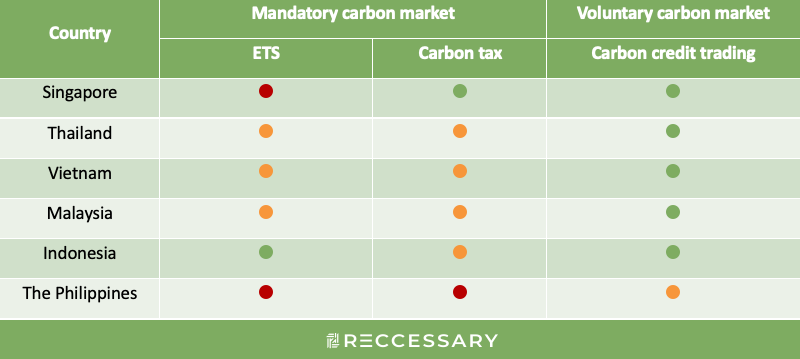
Reviewing Southeast Asia's carbon pricing mechanisms reveals that each country adopts slightly different strategies. Indonesia, as one of the world's top ten greenhouse gas emitters, is the first country in the region to establish an ETS. Compared to government-led mandatory carbon markets, voluntary carbon markets, primarily focusing on carbon off