Indonesia’s plan to export renewable electricity to Singapore could mark a turning point, but only if it can resolve deep domestic contradictions between energy security, fossil fuel subsidies, and an uneven energy transition at home.
.jpg)
Indonesia has agreed to export 3.4 GW of clean electricity to Singapore by 2035. (Image: iStock)
Singapore, as a country with limited land and natural resources, is highly reliant on imported electricity supply, from which around 95% of Singapore's electricity comes from imported natural gas. Although Singapore’s energy dependency is high, the country has set an ambitious energy transition plan, which it plans to import up to 6 GW of low-carbon electricity by 2035. This opens great opportunities for neighboring countries, including Indonesia, to become a clean energy supplier to Singapore.
On the other hand, Indonesia has enormous renewable energy (RE) potential such solar power (207.8 GW), hydro (75 GW), bioenergy (32.6 GW), micro-hydro (19.3 GW), and wind (60.6 GW). To be exact, Indonesia’s RE export potential to Singapore already has a huge modality, with Batam and the Riau Islands region as one of the most strategic locations due to its proximity to Singapore.
Moreover, the floating solar power plant project at the Duriangkang Reservoir, with a capacity of up to 2.2 GWp, is projected to support electricity exports to Singapore. This renewable energy potential could leverage Indonesia’s position to assist Singapore’s achievement targets in renewable energy, while also offering reciprocal benefits between the countries.
Economic and strategic gains from power exports
Recently, Indonesia has agreed to export 3.4 GW of clean electricity to Singapore by 2035. This agreement offers double benefits. From a fiscal perspective, this agreement could result in USD 30 billion to USD 50 billion in investment in solar panel generators and USD 2.7 billion in the manufacture of solar panels and batteries. The agreement also has the potential to open 418 thousand new jobs in manufacturing, construction, operations, as well as maintenance of solar panels and batteries.
From a non-fiscal perspective, these exports can strengthen Indonesia's role in ASEAN renewable energy achievements and unlock opportunities for technology transfer and institutional capacity building through cooperation with Singapore as a regional technology and financial hub.
On the other hand, the Riau Islands, as a strategic province for exporting clean electricity to Singapore, have huge potential for integrating renewable energy sources within its existing energy mix formulation, including solar and wind. According to IESR’s research regarding the potential technical capacity of renewable energy in Indonesia, the Riau Islands possess 20.49 GWp to 25.83 GWp of the solar panel technical potential, while the wind technical potential of this region is roughly between 36.2 MW and 300.7 MW, especially the wind power that has a specification of 50 m hub height.
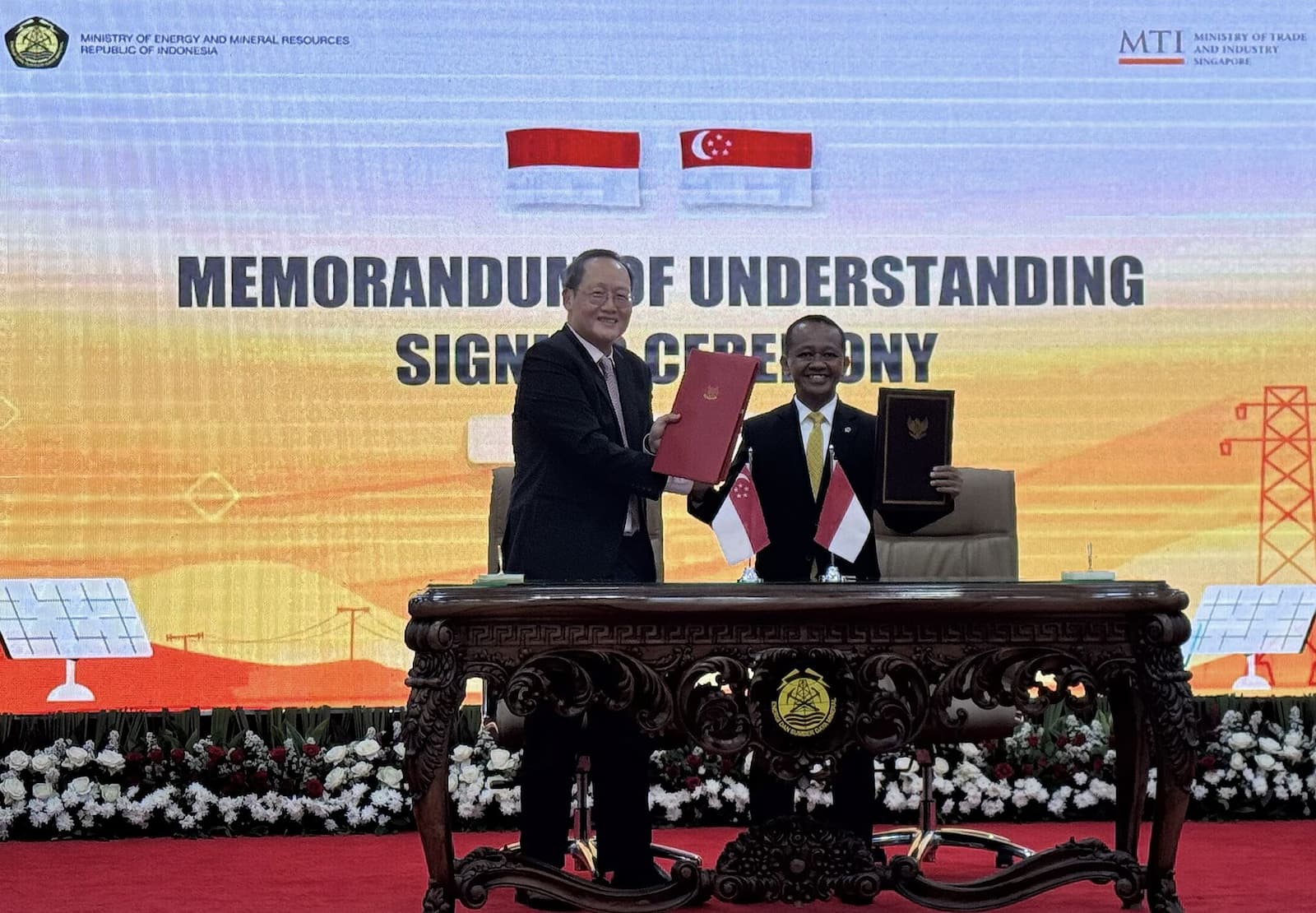
Indonesia's Minister of Energy and Mineral Resources, Bahlil Lahadalia (right), and Singapore’s Second Minister for Trade and Industry, Tan See Leng (left), signed a pact on the export of clean electricity, in Jakarta on June 13, 2025. (Image: Tan See Leng)
The leverage of this province becoming a strategic region for clean electricity export planning also stems from its designated areas, which are close to busy international shipping lanes. This is institutionalized by the free trade areas policy, making the region more attractive to receive additional FDI and energy-intensive industries. The privilege of this policy includes five year land rental waiver, relaxed regulations on industrial zone licensing, the tax holiday and exemption on several taxes and fees imposed on export facilities. In addition, the region also provides more affordable labour costs, with the amount of minimum wage in this province roughly between IDR 3.6 million (or approximately USD 215 to 220 in Lingga Regency) and IDR 4.9 million (or USD 290 to 295 in Batam City).
However, the realization of RE exports faces some challenges, ranging from existing policies to domestic electricity access and renewable energy mix progress.
Domestic energy security as a policy priority
The regulation of exporting clean electricity lies with the new national energy policy that was recently enacted on 15 September 2025. The policy states that the export of energy is allowed, while the policy also emphasizes fulfilling domestic needs as an obligation before exporting energy abroad. The energy export could be undertaken by a state-owned company or a business entity that is appointed by the government.
Hence, a member of the National Energy Council, a state institution chaired by the President and responsible for planning and formulating the national energy policy, stated that the electricity export should be implemented by utilizing power grids owned by the State Electricity Company (PLN). This requirement is grounded in concerns over energy security and state control: if exports were conducted directly by power plant developers without relying on PLN’s grid, Indonesia could lose the ability to intervene during periods of domestic electricity shortages.
In such situations, electricity initially allocated for export should be redirected to meet domestic demand, a safeguard that would be difficult to enforce without PLN’s involvement. Thus, securing domestic energy security becomes the highest priority over other potential policies like the export of renewable energy plans.
This energy security priority places renewable energy exports within the constraints of PLN’s broader operational mandate. As the sole off-taker and distributor of electricity in Indonesia, PLN is mandated to prioritize the lowest-cost power supply to maintain affordability and accessibility for domestic consumers. In practice, this mandate continues to favor fossil fuel–based generation, which remains cheaper than most renewable energy sources. Basic cost-of-supply figures illustrate this disparity: electricity generated from geothermal power plants costs up to USD 0.062 per kWh, while solar power can reach as high as USD 0.300 per kWh. By comparison, coal-fired power plants incur a significantly lower cost of up to USD 0.045 per kWh.
Why renewables struggle to compete on price
The affordable price of fossil fuel energy stems from several policies that fabricate more competitive prices for this energy. One of the supportive policies for fossil fuel energy is the domestic market obligation policy that requires coal producers to supply domestic power plant needs at a maximum price of USD 70 per ton and at least 25% of their output domestically for power plants at a capped price, regardless of prevailing international coal prices and international demands. This price ceiling and certain demands substantially reduce fuel input costs for coal-fired power plants and enable PLN to procure coal-based electricity at below-market rates.
As a result, the cost comparison between fossil fuel and renewable energy becomes structurally distorted. Renewable energy projects must fully internalize capital expenditure, financing costs, and technology risks, while coal-fired power generation benefits from indirect subsidies embedded in fuel pricing, infrastructure legacy advantages, and regulatory protection. These asymmetries undermine the commercial viability of renewable energy projects and weaken their competitiveness in PLN’s procurement decisions, even when renewables offer long-term benefits such as price stability, emissions reductions, and lower exposure to global commodity shocks.
This policy-induced price distortion presents a critical challenge for Indonesia’s ambition to scale up renewable energy, including export-oriented projects targeting regional markets such as Singapore. As long as fossil fuel electricity remains artificially cheap in the domestic market, PLN’s mandate to prioritize low-cost supply will continue to limit renewable energy uptake if the electricity export is only allowed by utilizing PLN’s infrastructure.
Artificially low domestic fossil fuel prices and PLN’s infrastructure monopoly continue to hinder renewable energy growth under its low-cost mandate. (Photo: PLN)
Insufficient domestic supplies
As stipulated in the recent national energy policy, domestic energy demands must be fulfilled first. Hence, this requirement is a considerable challenge that determines the progress of Indonesia’s plan to export clean electricity. The Riau Island Province, as a proximity region of the renewable electricity supplier to Singapore, remains undersupplied in electricity distribution to several islands in the region. Although the percentage of households that have received 24-hour electricity is 98.19% as of April 2025, there are several islands that remain unable to access electricity. In this year, 38 inhabited islands remain that have no electricity access.
This case presents negative comments regarding the electricity export plan. As stated by the Center of Economic and Law Studies (Celios), a think-tank based in Jakarta, the government should prioritize villages and regions that have no adequate 24 hour-electricity access first, instead of executing the electricity export plan. As a consequence, the electricity export ambition is ensnared in a fundamental policy challenge. Although this plan projects large investment potential, exporting clean electricity risks being framed as politically and socially contentious when communities in proximity to export infrastructure remain underserved.
This includes the danger that export projects are perceived as benefiting foreign markets while domestic consumers continue to rely on unreliable energy sources. Such perceptions could undermine public support, deter investment, and ultimately stall Indonesia’s broader energy transition agenda.
Stagnation in the domestic renewable energy transition
Besides the insufficient domestic electricity supply, the progress of the renewable energy mix in Indonesia remains stalled, which becomes a contentious issue when the government plans to export clean electricity to Singapore instead of developing more ambitious domestic renewable energy achievements. The coal still dominates the primary energy mix in Indonesia with a percentage of 40.37%, followed by the fossil fuel oil up to 28.82%, and natural gas around 16.17%. Meanwhile, the renewable energy progress remains the least progress compared to other renewable energy sources with a percentage of 14.65% in 2024.
This progress is still below the target of the previous renewable energy mix target, which aimed for a 23% renewable energy mix in 2025. Hence, this achievement ultimately led to a revision of the renewable energy mix target through the revision of the national energy policy. The renewable energy mix target set in the revised Government Regulation is 19% to 23% by 2030, as stipulated in the new national energy policy.
This case also presents critiques that the failure to achieve previous renewable energy mix targets should be used as a reflective evaluation to find the right renewable energy mix targets, rather than decreasing the target. Therefore, this phenomenon also signals the government's lack of commitment to providing stable renewable energy policies, which is affecting investors’ interests in supporting domestic renewable energy development.
Strategy to address underserved electricity areas and domestic renewable energy progress
Ultimately, Indonesia’s renewable energy export policy is not solely determined by the cross-border infrastructure readiness, but by the country’s ability to address unequal domestic renewable energy access for all and the attainment of renewable energy mix targets. The development of community-based renewable power plants in remote areas that are not electrified by PLN’s power grids is a potential solution that can address these obstacles.
The practice has been demonstrated by the development of a minihydro powerplant in Tepian Terap village, East Kutai Regency. The expensive electricity access in this village encouraged citizens to create a renewable energy initiative that was financed by the Village Funds program, a central government program from the national state budget that aims to reduce poverty and unequal development progress. The renewable powerplant management was handed over to the village-owned enterprise (BUMDes) in that village, with a very affordable tariff of approximately USD 6.01 per ampere.
Therefore, the potential of the village funds program as a financial source for community-based renewable energy initiatives should be balanced by strengthening its governance and monitoring schemes due to corruption practices in this program. Moreover, capacity building programs to improve village stakeholders’ ability in managing village funds with good governance principles are also essential, reflecting the majority of villages’ status in Indonesia are developing villages.
Besides the option of village funds as the funding source for the community-based renewable energy, business entities can also play a pivotal role as investors. Several best practices of direct investment schemes to two startups, Xurya and Sun Energy, that already got the total investments up to USD 53.7 million, were initiated by venture capital. However, a considerable challenge that hinders investors from investing more capital into community-based renewable projects is unsupportive policy circumstances that make them remain wait and see. They perceive investment schemes into community-based renewable projects remain risky, so proposing regulatory support with consistent policies and tax incentives should be implemented as signals that the government can handle investment risks of community-based renewable projects and prioritize the development of renewable energy in Indonesia.
Moreover, the public-private partnerships (PPP) using the availability payment scheme can fund community-based renewable projects. By providing guaranteed periodic payments, the government signals long-term commitment, reducing risk perceptions for financial institutions and enhancing project bankability and performance.
On the other hand, the government can begin to strategically embed clean electricity export provisions within the ongoing revision of the Electricity Law currently under deliberation in Parliament. The revised law or its derived regulations could introduce explicit export conditionality mechanisms that mandate meeting minimum domestic renewable energy supply obligations before export approval is granted. This may include reserving a defined share of renewable electricity capacity to serve priority regions and national demand, ensuring that export contracts are authorized only after domestic energy security and equity considerations are fulfilled.
Accordingly, Indonesia should pay more attention to solving the underserved electricity areas and domestic renewable energy progress as these issues can appear as hindering factors that prevent Indonesia from implementing the plan of exporting renewable electricity abroad. Without serious strategies to accelerate renewable electrification efforts and provide adequate renewable energy access for all remote areas, the electricity export plan risks losing its legitimacy and support from stakeholders.
This column is a collaboration between RECCESSARY and Muhammad Arief Virgy. All rights reserved. Reproduction without permission is strictly prohibited.
Have insights on energy or carbon issues? Share your perspective with us! Send your submission to reccessary@gmail.com for a chance to be featured. Submissions may be edited for clarity and style.
