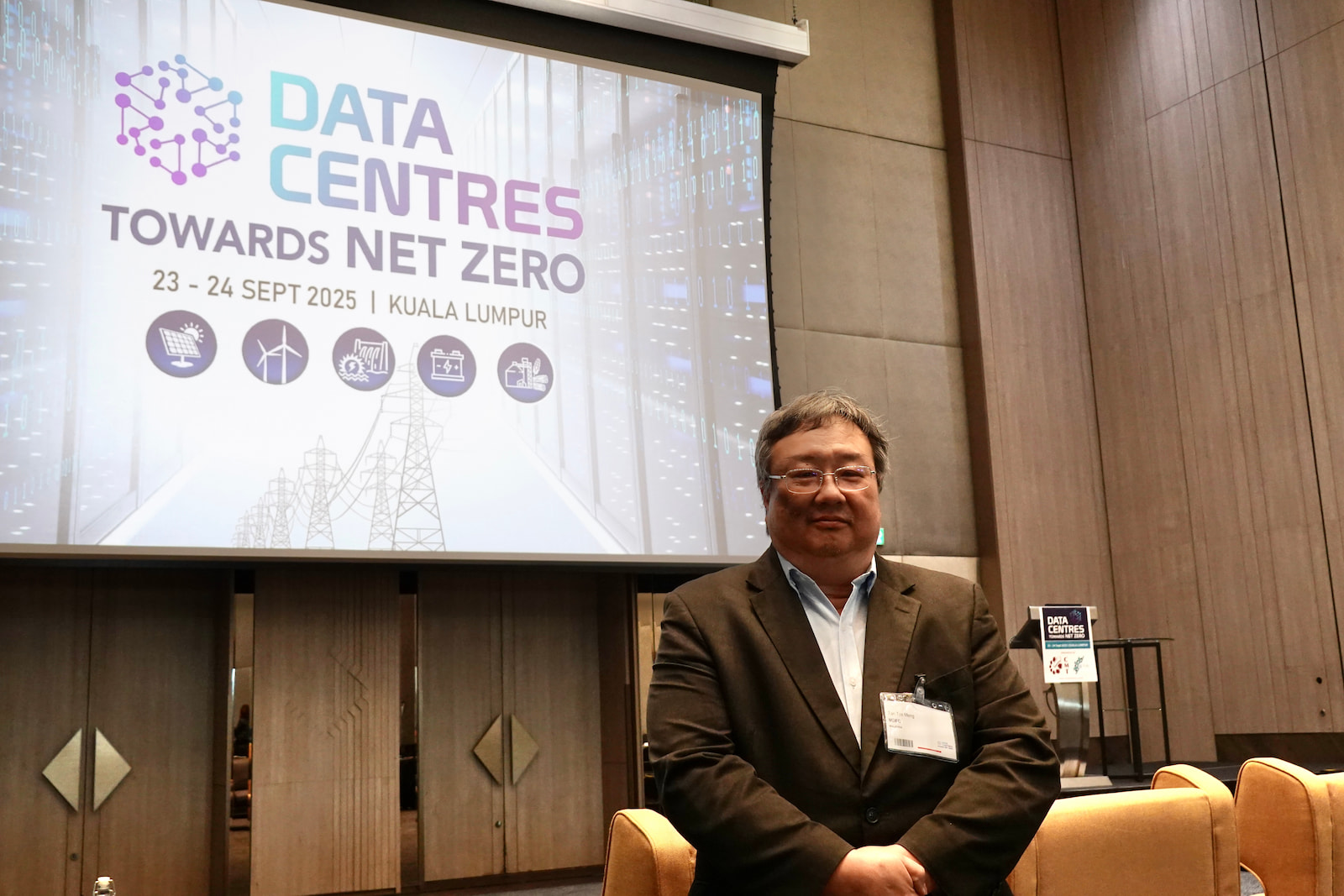
Tan Tze Meng, former Malaysia Digital Economy Corporation (MDEC) data center expert, attended the “Data Centres toward Net Zero” conference held in Kuala Lumpur this September. (Photo: Hsu Tsu-lin)
Malaysia is emerging as a key hub for AI data centers in Southeast Asia, but the energy-intensive nature of the AI industry is putting pressure on the country’s decarbonization efforts. In an interview with RECCESSARY, former Malaysia Digital Economy Corporation (MDEC) data center expert Tan Tze Meng, who brings decades of experience in the ICT sector, shares insights on how Malaysia is navigating the balance between economic growth and sustainability in the AI race.
Sustainable Data Centre Framework delayed by inter-agency hurdles
According to real estate consultancy Cushman & Wakefield, Malaysia is leading ASEAN in data center capacity, with 529 MW under construction as of the second quarter of 2025. While the country is capitalizing on the AI boom, the rapid expansion is intensifying pressure on its energy and water resources. In response, the government is preparing to introduce a Sustainable Data Centre Framework, originally developed by the MDEC under the Ministry of Digital, to provide clearer guidance for foreign investment.
Tan Tze Meng, who served at MDEC for over 18 years, noted that the framework is built on two core sustainability pillars. The first focuses on strengthening the economic dimension of the sector. Malaysia is looking to enhance data security by adopting high-standard backup infrastructure, inspired by Estonia’s data embassy model in Luxembourg. At the same time, the country is aiming to improve international connectivity by attracting more direct submarine cable landings, in a bid to reduce its heavy reliance on Singapore.