.jpg)
(Image: iStock)
Hydrogen has long been hyped as the “Swiss army knife” of the energy transition, but today – despite billions in investment – it largely remains limited to niche industrial applications.
In a new review article, published in Nature Reviews Clean Technology, we look at where hydrogen could plausibly become competitive – and the applications where it is unlikely to ever be a viable solution.
For each use case, the review looks at the cost and carbon emissions of using hydrogen relative to alternative solutions, identifying the barriers which stand in the way of uptake.
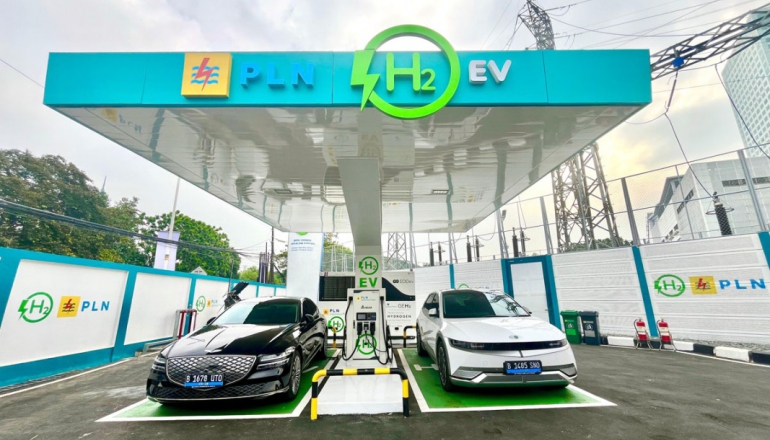
For example, high-profile applications, such as home heating and fuelling cars, are still widely promoted, but are failing to take off.
Fundamentally, this is because hydrogen is an inefficient and costly option in these cases, with Ferraris globally outselling all makes of hydrogen fuel-cell cars combined.
Finally, the review looks at the current state of government hydrogen policy around the world, plus the ways that its potential could be maximised in the future.
Stuck in the starting blocks
Hydrogen’s versatility means it has been proposed for many applications, from laptops to aeroplanes, along with a succession of bizarre novelties, such as the hydrogen-powered ride-on robotic horse.
However, global production has grown more slowly than was projected by oil companies, NGOs and academics over the last 50 years. As shown in the chart below, production has only grown by around 3% per year since the 1970s – far short of expectations.
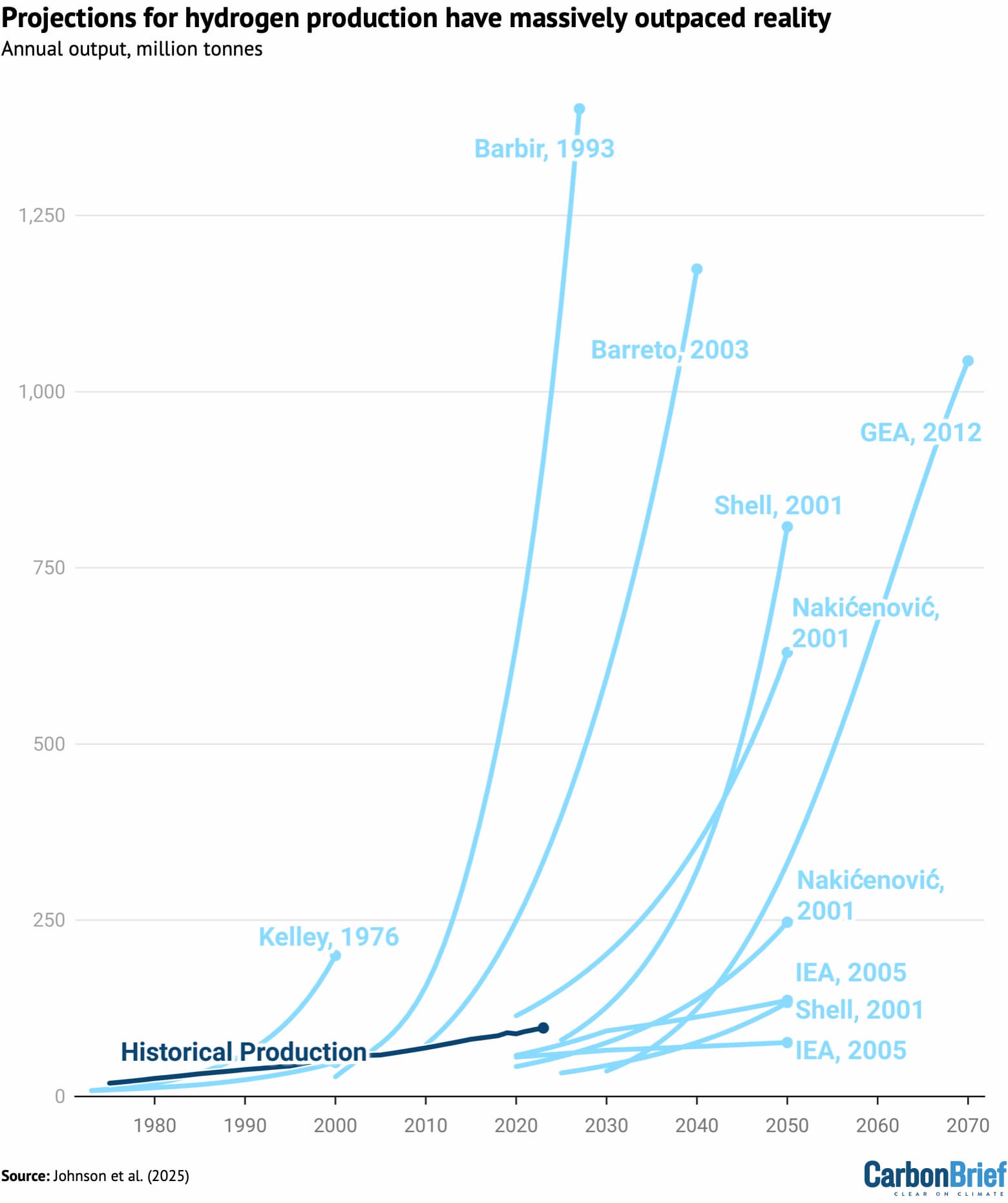
Hydrogen projections from oil companies, NGOs and academics from 1970, running up to 2070, against actual historical production, million tonnes per year. Source: Johnson et al. (2025) using data from various sources.
Hydrogen is not always the best option for decarbonising and several high-profile use cases are struggling to gain traction, despite decades of investment.
Many of these, such as home heating and cars, are now being electrified at an extremely rapid rate, with hydrogen unlikely to ever catch up.
For example, electric heat pumps have outsold gas-fired boilers in the US since 2022. In the UK, the then-Conservative government cancelled what would have been the world’s largest hydrogen heating pilot. And oil-and-gas giant Shell has closed all of its hydrogen filling stations in the UK and the US.