Background and overview
MSCI ESG Ratings, developed by MSCI Inc., is an evaluation framework designed to assess companies based on ESG factors. The origins of this rating system can be traced back to early pioneers in ESG investing, including KLD Research & Analytics, founded in 1988, as well as Innovest Strategic Value Advisors and RiskMetrics Group.
In 2010, MSCI announced the acquisition of RiskMetrics Group for around USD 1.55 billion. Prior to this acquisition, RiskMetrics had already acquired two leading ESG research firms, Innovest Strategic Value Advisors and KLD Research & Analytics.
This consolidation provided MSCI with substantial industry expertise in ESG evaluation. Its rating framework places particular emphasis on risk exposure and risk management, enabling the assessment of a company’s ability to manage financially material ESG risks over the long term.
The role of MSCI ESG Ratings in ESG ETF construction
MSCI ESG Ratings serves as a key input in the construction of ESG-focused exchange-traded funds (ETFs). As one of the most widely tracked benchmarks in the global ETF market, MSCI’s ESG data is used by index providers to construct ESG indices, which are then replicated by asset managers through ETF products.
MSCI integrates its ESG rating data into a range of ESG index series, forming the basis for both stock selection and weighting methodologies. Representative examples include:
- MSCI ESG Leaders Index: Includes only the top 50% of companies within
- MSCI ESG Focus Index: Applies an optimization approach to increase exposure to higher-rated companies while reducing exposure to lower-rated ones, while maintaining a risk-return profile similar to the broader market.
As ESG ratings are scaled through large ETF capital flows, their influence extends beyond information assessment and increasingly shapes capital allocation across markets.
- Global market: One of the largest ESG ETFs in the US market, the iShares ESG Aware MSCI USA ETF (ESGU), tracks an index constructed using MSCI ESG rating data.
- Taiwan market: The largest ESG ETF in Taiwan, Cathay MSCI Taiwan ESG Sustainability High Dividend Yield ETF (00878), tracks the MSCI Taiwan ESG Sustainable High Dividend Select 30 Index. Constituents are required to have an MSCI ESG rating of at least BB, after which the top 30 stocks are selected based on dividend scores.
MSCI ESG Ratings coverage and methodology
MSCI ESG Ratings covers more than 17,000 issuers and over 990,000 securities globally, making it one of the most widely used frameworks for institutional investors in sustainable investment decision-making.
MSCI applies a standardized seven-point rating scale, translating company scores into letter grades similar to credit ratings. The ratings are determined on a relative, industry-specific basis, meaning that each company is evaluated against its global industry peers. The scale is divided into three categories, comprising seven rating levels in total:
- Leaders (AAA, AA): Companies that demonstrate strong performance in managing the most material ESG risks and opportunities relative to peers. These firms typically exhibit robust governance structures and effective risk mitigation practices.
- Average (A, BBB, BB): Companies with ESG performance that is broadly in line with industry peers, or that show strength in certain areas but weaknesses in others.
- Laggards (B, CCC): Companies that underperform relative to peers in managing ESG risks and may face significant unmanaged risks, increasing the likelihood of adverse financial impacts.
The distribution of MSCI ESG ratings generally follows a normal pattern, with most companies concentrated in the BBB and BB categories. Ratings are reviewed on a regular basis and may be adjusted in response to major controversies, such as industrial accidents or corporate misconduct.
MSCI ESG Ratings scoring framework and methodology
MSCI ESG Ratings are derived through a structured and standardized process. Based on the current methodology (2024 version), the evaluation framework can be divided into three stages and seven sequential steps.
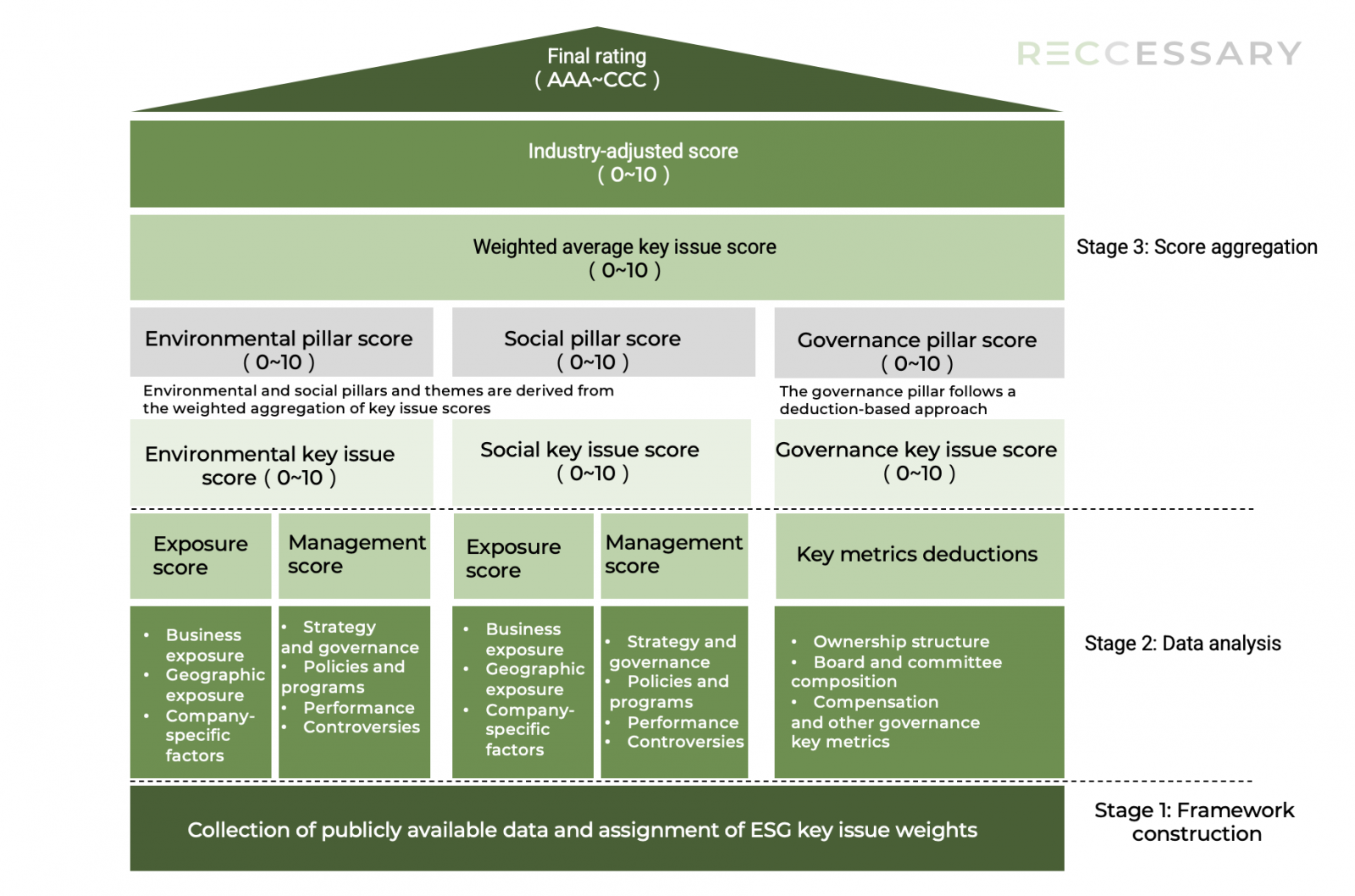
Figure. MSCI ESG Ratings scoring framework[1]
Stage 1: Framework construction
1. Identification of ESG key issues: The rating process begins with an assessment of industry-specific risks and opportunities. Based on the Global Industry Classification Standard (GICS®), two to seven environmental and social key issues are selected for each sub-industry from a pool of 33 key issues. As an exception, the governance pillar is assessed for all companies.
2. Assignment of key issue weights: Weights are assigned to each key issue based on the magnitude of its impact on the environment or society, as well as the expected time horizon over which risks and opportunities may materialize. These weights typically range from 5% to 30% of the total score. The governance pillar has a minimum weight of 33%. Assignment of key issue weights: Weights are assigned to each key issue based on the magnitude of its impact on the environment or society, as well as the expected time horizon over which risks and opportunities may materialize. These weights typically range from 5% to 30% of the total score. The governance pillar has a minimum weight of 33%.
State 2: Data analysis
3. Assessment of exposure and opportunities: This step evaluates the extent to which a company is exposed to specific ESG risks. MSCI considers three dimensions: business exposure (such as revenue and asset distribution), geographic exposure (including regulatory and environmental conditions in operating regions), and company-specific factors.
4. Assessment of risk management: This step evaluates a company’s ability to manage identified risks. Indicators are grouped into three categories: strategy and governance, policies and programs, and performance. In addition, controversies are incorporated at this stage, with significant incidents resulting in score deductions.
5. Evaluation of the governance pillar: Unlike the environmental and social pillars, governance is assessed using a deduction-based approach. Each company starts with a score of 10, from which points are deducted based on weaknesses in key areas such as ownership structure, board composition, compensation, accounting practices, business ethics, and tax transparency.
Stage 3: Score aggregation
6. Calculation of key issue scores and weighted averages: Individual key issue scores (ranging from 0 to 10) are derived by combining exposure and management scores. These are then aggregated with the governance pillar score using predefined weights to produce the Weighted Average Key Issue Score (WAKIS).
7.Industry adjustment and final rating: The WAKIS is normalized against industry peers to generate the Industry-Adjusted Score (IAS), ranging from 0 to 10. Based on the IAS, companies are assigned a final rating on a seven-point scale from AAA to CCC.
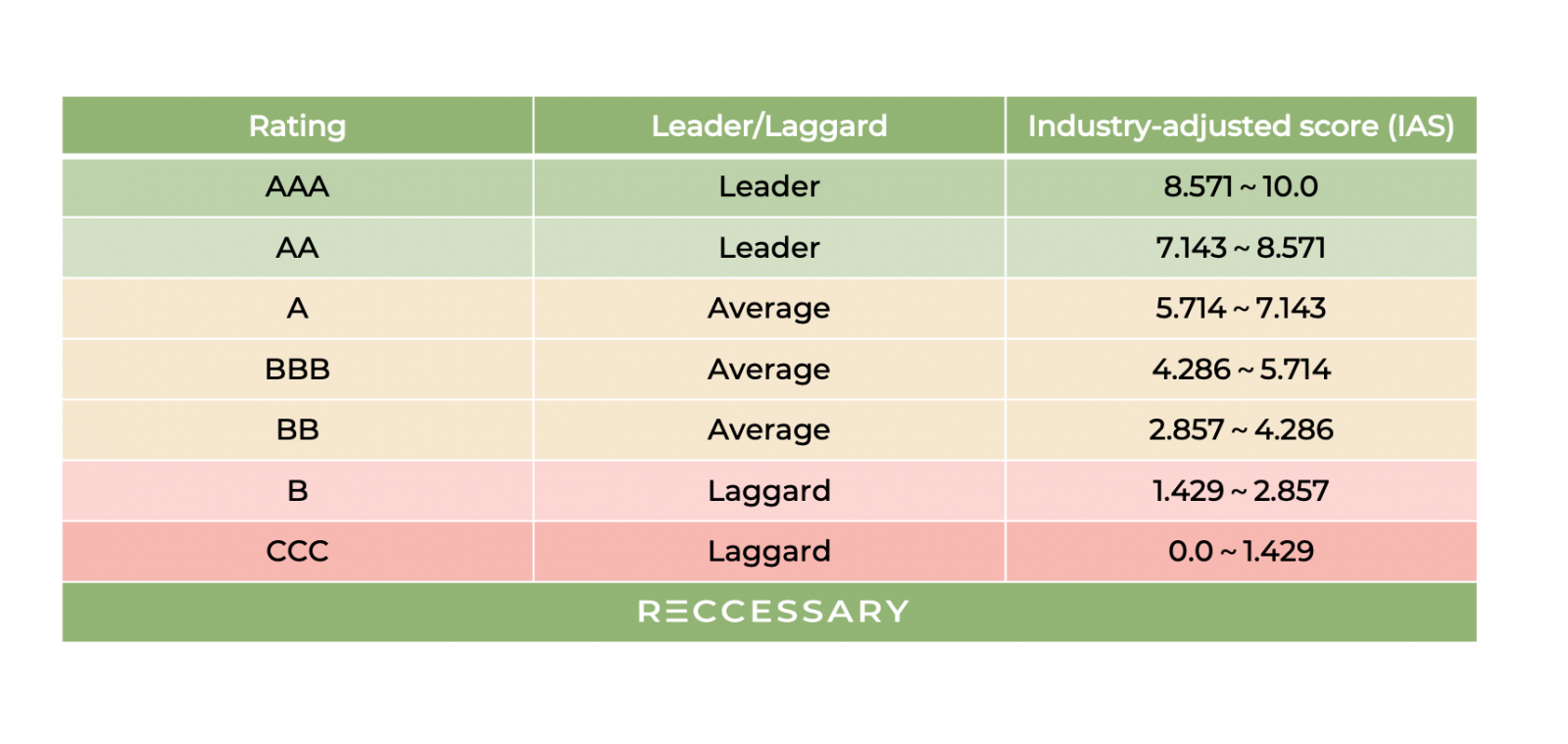 Table. Mapping of Industry-Adjusted Score (IAS) to rating categories[2]
Core principles of MSCI ESG Ratings
MSCI ESG Ratings has established a leading position in global financial markets, driven by two core principles.
- Financial materiality: A central feature of MSCI’s methodology is its ability to translate ESG risks into financially material risks. The framework is designed to identify potential ESG-related risks and opportunities faced by companies, while helping investors avoid firms that may be exposed to downside risks due to environmental regulation, labor disputes, or governance failures.
- Independence and objectivity: MSCI ratings are primarily based on publicly available information and third-party data, as assessed by analysts, rather than relying solely on company-disclosed questionnaires. Even in the absence of direct corporate disclosure, MSCI assigns ratings based on available information, ensuring a high degree of independence and objectivity.
Source
[1][2] MSCI ESG Ratings Methodology、MSCI ESG Ratings
Update:2026/3/19
