.jpg)
Regulation and sustainable finance are two key pillars of the global response to climate change. (Photo: iStock)
Taiwan’s green financing and investment has surpassed USD 166 billion, providing greater financial support for companies pursuing a low-carbon transition. Transition finance can help reduce the financial barriers to decarbonization, but many small and medium-sized enterprises (SMEs) still struggle to access green funding because they lack essential emissions data and a clear decarbonization pathway.
As Taiwan’s green finance market continues to expand, the next challenge is ensuring that funding reaches SMEs.
Regulation sets the direction as green finance supports the transition
Since the Paris Agreement, regulation and sustainable finance have emerged as two key pillars of the global response to climate change. Regulation sets the direction for the transition, while finance helps steer changes in corporate activity.
Tino Chen (陳厚儒), founder of Visionscycle, noted that the financial sector is highly regulated in most countries, giving governments considerable influence over financial institutions. Regulators can require them to assess whether their lending supports climate resilience, adaptation or emissions reduction efforts.
Financial institutions also pay close attention to climate issues and decarbonization, not only because of their substantial Scope 3 emissions. Chen said another key consideration is “ensuring that loans can be repaid.” Companies that fail to manage climate risks, transition risks or the impact of carbon pricing may face greater business risks, which in turn could increase the risk of default for financial institutions.
Sustainable finance has therefore evolved beyond corporate commitments and long-term aspirations into a matter of economic and strategic importance. Cathy Lee (李介文), senior executive vice president at Deloitte Taiwan, said low-carbon technologies such as solar and wind power were once promoted primarily for their ability to reduce greenhouse gas emissions. Today, the rationale has broadened to include energy independence and national energy security.
Finance also plays an important role in advancing low-carbon technologies. Chen noted that many national climate targets expect new low-carbon technologies to play a greater role after 2030. Many of these technologies already exist, but bringing down their costs will require deployment at a much larger scale.
As ESG has expanded to cover a broader range of issues, it has also given rise to a wider range of financial instruments. Blended finance, for example, is used in markets around the world for projects involving nature conservation or human rights, which often carry high upfront risks and long payback periods.
Lee explained that public funding, local philanthropic foundations or family offices can provide the initial capital and absorb some of the early-stage risk. This lowers the investment barrier for conventional financial institutions to participate later, helping mobilize larger pools of private capital for sustainability projects with significant social value.
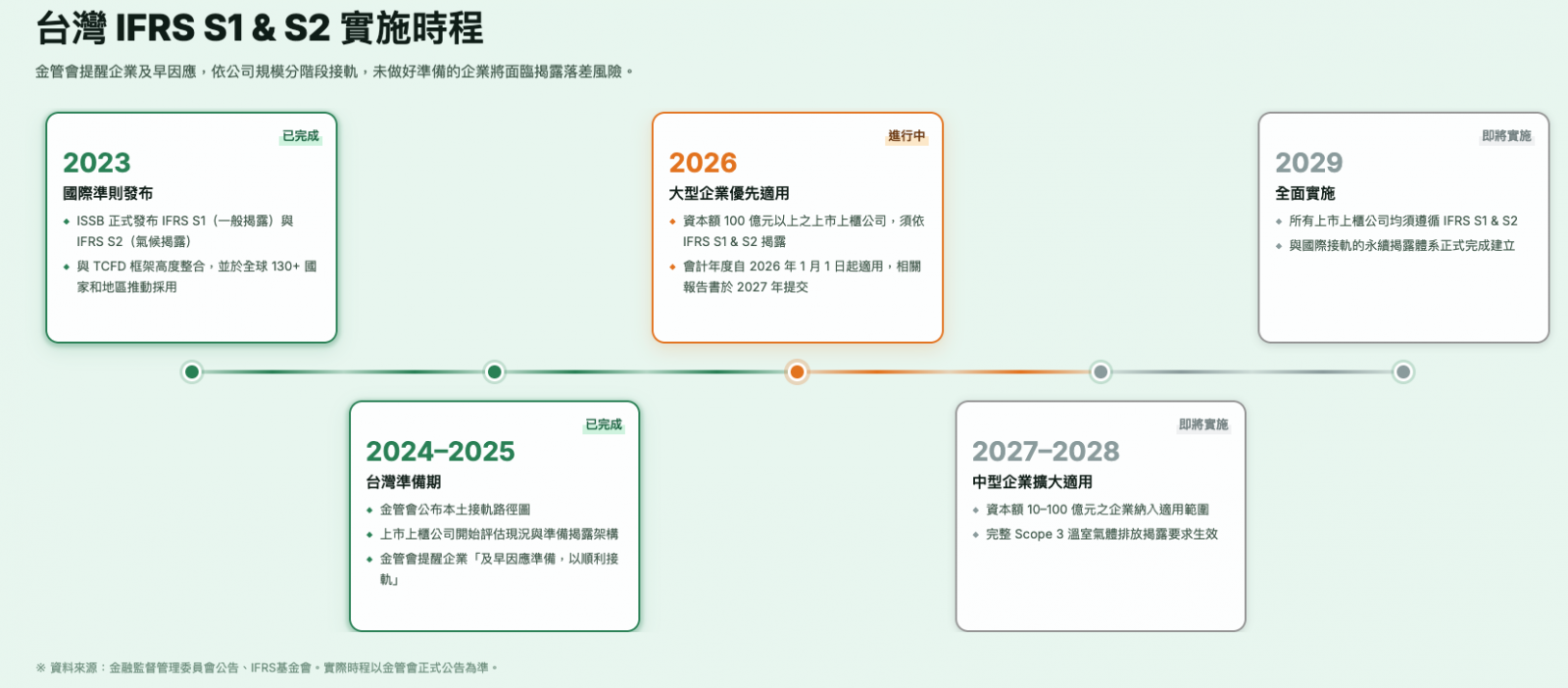
Taiwan’s IFRS S1 and S2 implementation timeline. (Source: Taiwan Sustainable Taxonomy website)
Green finance tops $166 billion, but data gaps hold SMEs back
Driven by both policy and supply chain pressures, Taiwan’s green finance market has expanded significantly. The Financial Supervisory Commission (FSC) has set a target of around USD 188 billion in green financing and investment by 2030. As of the end of May 2026, the total had already surpassed USD 166 billion.
Of that amount, around USD 70 billion came from sustainability-linked loans (SLLs), while green loans accounted for about USD 68 billion. The figures show that lending tied to corporate sustainability performance has become a major financing tool for supporting corporate transition in Taiwan.
Green finance has also moved well beyond its earlier focus on advocacy, philanthropy and activities such as beach cleanups. Chen pointed to Taiwan’s launch of the Green Stock Designations this year. The system is based on the Sustainable Economic Activities Reference Guidelines issued by the FSC, Ministry of Environment, Ministry of Economic Affairs and other government agencies. It requires listed companies to assess the share of their revenue generated from green activities that meet the guidelines’ criteria.
Green finance can lower the financial barriers companies face in pursuing a low-carbon transition. But access to funding still depends on whether they can provide objective data and a concrete transition plan.
Lee noted that more than 500 listed companies in Taiwan have paid-in capital of less than USD 157 million, alongside a much larger number of SMEs. These companies face two major obstacles when seeking green finance: insufficient data and difficulty articulating a credible transition story
Many of Taiwan’s large companies have been responding to supply chain pressure to cut emissions for years. Their early start, combined with greater financial and human resources, has given them more capacity to conduct greenhouse gas inventories. Accurate emissions data also matters because errors can directly affect carbon fees and financing rates. SMEs, by comparison, face a much tougher situation.
Lee said SMEs often lack even basic carbon inventory data, while many are also unable to provide digital records of electricity consumption and energy efficiency.
She recalled that some banks were previously willing to renegotiate loan terms and offer better interest rates if a company committed to preparing and publishing a sustainability report. Today, however, sustainability performance is much more closely tied to the cost of financing. Broad commitments are no longer enough. When applying for credit, companies need to provide concrete data and evidence that their performance is being monitored.
Lee also noted that SMEs often struggle to articulate a clear decarbonization pathway. Purchasing low-carbon equipment, for example, is only one factor banks consider. More important is whether a company can demonstrate the emissions reductions achieved after the investment, supported by data that allows performance to be compared over time.
As the scope of ESG continues to expand, the sustainability risks companies are expected to address are also broadening beyond renewable energy and decarbonization to include human rights and nature-related risks. For now, however, these remain largely additional considerations rather than core requirements.
Chen noted that data on nature-related risks such as floods and droughts is still more readily available among large companies. SMEs will eventually need to build up more of this data as well, enabling financial institutions to better assess their transition risks.
SMEs need clear transition pathways to secure green finance
Taiwan’s green finance market is still largely driven by large companies. Expanding access to SMEs will require narrowing the information gap between businesses and financial institutions. Lee suggested that Taiwan could draw on Japan’s approach to transition finance, where the government has developed clear decarbonization roadmaps for high-emitting industries such as steel and chemicals based on available technologies and their technical feasibility.
Lee said such industry guidance could give SMEs a clearer basis for developing their transition plans, while saving banks from having to devise their own assessment criteria. This could significantly speed up the process of matching companies with financing.
Taiwan is also expanding its own sustainability guidance. The FSC released the second edition of its Sustainable Economic Activities Reference Guidelines at the end of 2024, with coverage expected to gradually extend to more industries.
Chen also said companies need to change their mindset. Rather than relying on past success, business owners should take the initiative in shaping their own sustainability strategies and identify the issues that bring the most tangible benefits to their businesses, instead of simply responding to regulations or government policy.
A recycling company, for example, could explore how to evolve into a circular economy business, Chen said. Such a shift could align with policy priorities, improve access to financing and open up new business opportunities.
Under current regulations, SMEs are not yet subject to Taiwan’s carbon fee, but that does not mean they will be unaffected. “The wave will keep moving forward. Even if the impact is not direct, they could still feel it indirectly,” Chen said.
SMEs should therefore take stock of where their raw materials come from and prepare for costs related to carbon fees, the Carbon Border Adjustment Mechanism (CBAM) and carbon taxes to be passed along supply chains. Keeping their sustainability information up to date can also help businesses remain flexible and responsive as these pressures evolve.
