First week of Baku talks marked by low turnout of leaders, Argentina’s withdrawal, and a gulf between blocs’ demands on a new finance goal
.jpg)
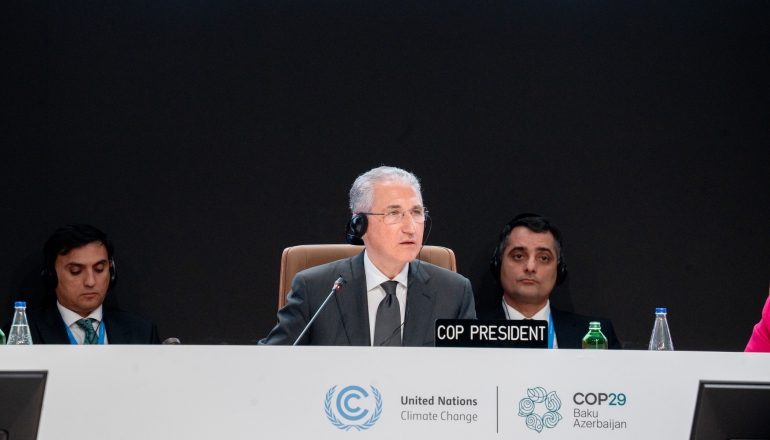
COP29 president and Azerbaijan’s Minister of Ecology and Natural Resources, Mukhtar Babayev, speaks at the opening plenary in Baku. Earlier, Azerbaijan president Ilham Aliyev said that oil and gas are “a gift from God” and questioned criticism of his country’s dependence on fossil fuel production and exports (Image: Kamran Guliyev / UN Climate Change, CC BY-NC-SA)
COP29, the United Nations climate change summit, opened this week in Baku, Azerbaijan. With the smell of oil wafting from the city’s nearby refineries, representatives from nearly 200 countries will try to agree on a new goal for financing emissions reductions and climate change adaptation around the world.
In 2009, developed countries pledged that by 2020, they would collectively mobilise USD 100 billion per year to support climate action in developing countries. This target was only met for the first time in 2022, according to the Organization for Economic Cooperation and Development (OECD).
The new target that countries are aiming to adopt at COP29 will replace this USD 100 billion figure. But after the summit’s first week of talks, there is still a gulf between the positions of developed and developing countries on where the so-called New Collective Quantified Goal (NCQG) should be set, with first drafts of the summit’s finance text leaving multiple options open.
The G77 plus China, a negotiating group of developing countries that includes most Latin American nations, called for USD 1.3 trillion to be the new annual commitment from developed countries, and for this to feature specific funds for emissions reductions, adaptation, and loss and damage. In addition, the group is demanding that such financing should increasingly arrive in the form of grants rather than loans, so as not to generate further debt for already strained economies.
Similarly, the Independent Association of Latin America and the Caribbean (AILAC), a negotiating group of eight Latin American countries, called for a dedicated percentage of the agreed financing goal to be allocated towards the region. Other blocs outside of Latin America have made the same request, with some even putting numbers on their suggested shares: the 39-strong Alliance of Small Island States (AOSIS) is asking for at least USD 39 billion a year.