Meteorologists say emergence of a strong El Niño climate phenomenon is increasingly likely this year, as ocean temperatures in June reached a record high.
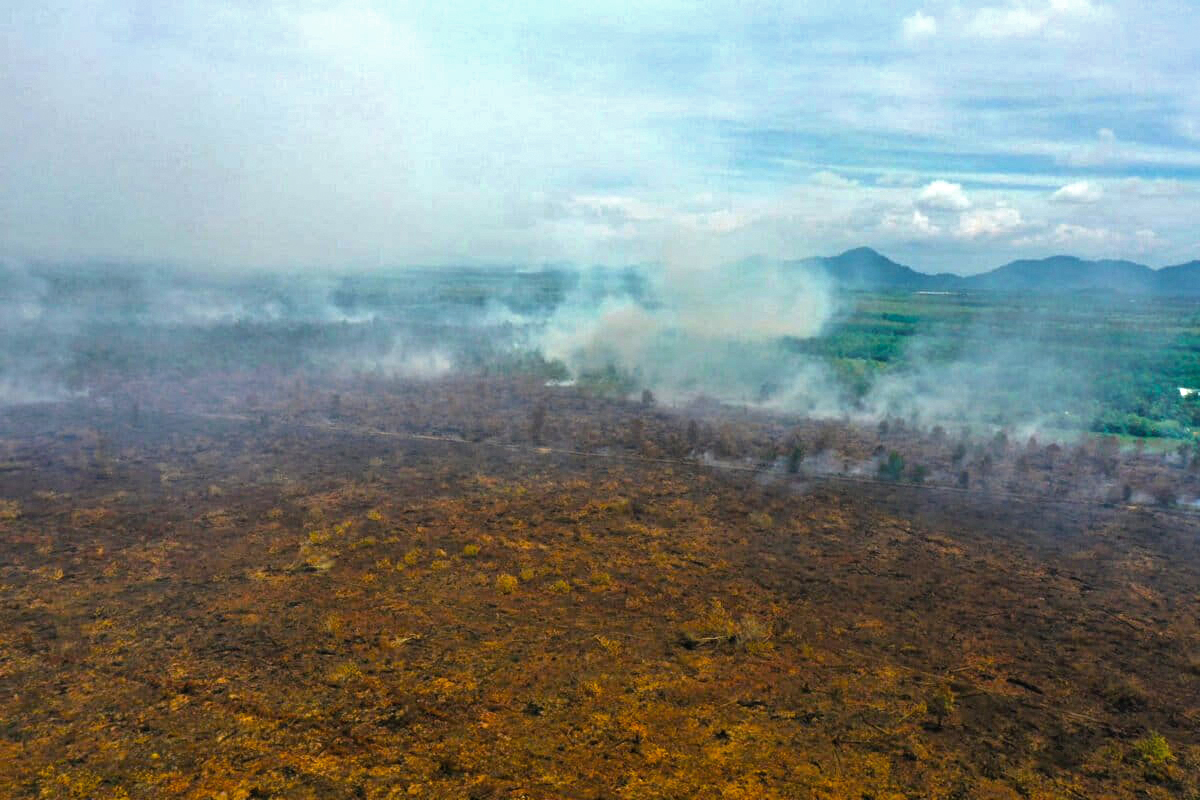
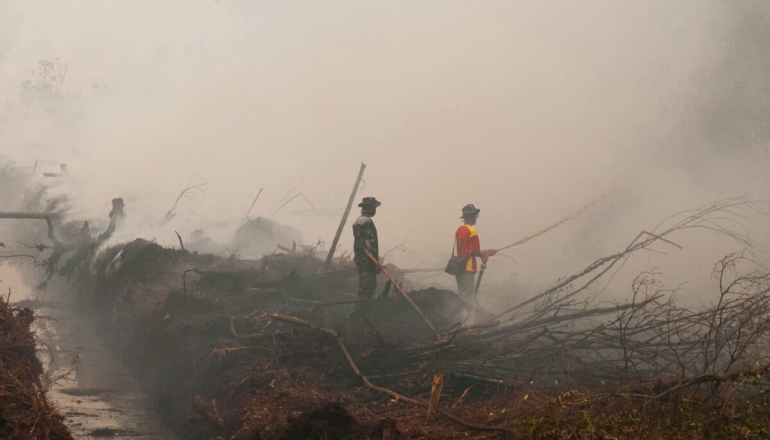
Forest and land fires in West Kalimantan in April 2026. Image courtesy of Walhi West Kalimantan.
An emerging El Niño risks fueling devastating wildfires on peatland areas in Borneo earmarked by Indonesia’s government about six years ago for a flagship food estate program, environmentalists have warned. The warning comes as Indonesia braces for heightened fire risk during the current dry season.
“What we are most concerned about is the rice paddy cultivation activity that is being carried out on peatlands,” said Janang Palanungkai, who runs the Central Kalimantan office of Indonesia’s largest environmental group, Walhi.
Central Kalimantan is one of five Indonesian provinces on Borneo, a forested island twice the size of Germany shared by Brunei, Indonesia and Malaysia.
Indonesia’s meteorology agency, the BMKG, and the U.S. National Oceanic and Atmospheric Administration (NOAA) have both determined that a strong El Niño is likely this year.
An El Niño is declared when equatorial Pacific Ocean temperatures remain more than 0.5° Celsius above average for several months. This warmer surface water sets off a global chain of climatic reactions, including hotter and drier conditions over Indonesia, which is home to the world’s largest tropical peatlands.
“There is a 50% to 60% chance of a moderate El Niño starting mid-year, and the 2026 dry season is predicted to be drier than usual,” the BMKG’s Ardhasena Sopaheluwakan said in mid-June.
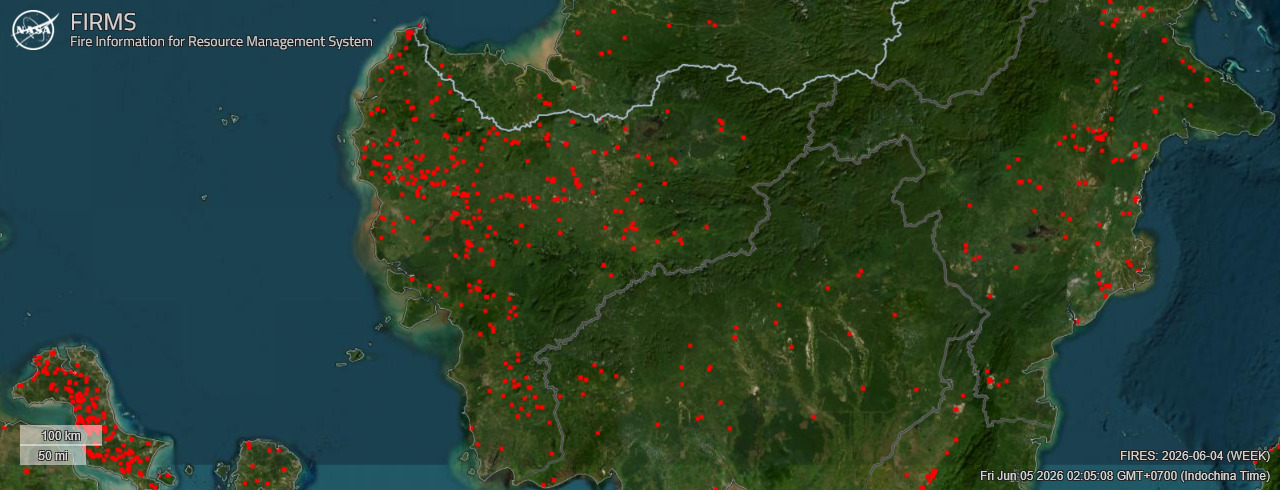
Satellite imagery from NASA’s FIRMS (Fire Information for Resource Management System) shows the distribution of hotspots in the West Kalimantan region leading up to June 5, 2026. Red dots indicate fire locations detected across various areas, with the highest concentrations. Image courtesy of FIRMS.
Fire hazard
Previous El Niño events, such as in 1998 and 2015, triggered lasting public health and environmental disasters in Indonesia as delayed rains allowed fires on carbon-heavy peatlands to burn for months.
Researchers said the fires in 2015 may have caused around 100,000 premature deaths in Indonesia, Malaysia and Singapore. Greenpeace, a global collective of independent campaigning groups, called these wildfires “man-made ecological disasters.”
“Each province has different dynamics,” said Putra Saptian, a campaigner at Indonesia-based peatland nonprofit Pantau Gambut. “Some are driven by national strategic projects while others are agro-extractive.”
In 2020, then-president Joko Widodo said Indonesia would convert hundreds of thousands of hectares on Borneo, much of it peat landscapes, for food production operated by state enterprises.
Environmentalists in Indonesia say this year will test the resilience of this land-use change to wildfires, should a strong El Niño extend the period of hot and dry conditions.
Janang said the expansion risked repeating the mistakes of the 1990s Mega Rice Project, which drained peat domes in Central Kalimantan and left the landscape vulnerable to devastating fires in the strong 1997–98 El Niño.
“This is what then raises concerns about major forest and land fires,” Janang said.
Kitso Kusin, a forestry academic at Palangka Raya University in the capital of Central Kalimantan province, said the Mega Rice Project marked a turning point in peatland fires in the province by cutting large canals through peat domes, leaving them increasingly inflammable during dry seasons.
This fundamentally altered the hydrology of the peat landscape, Kitso added.
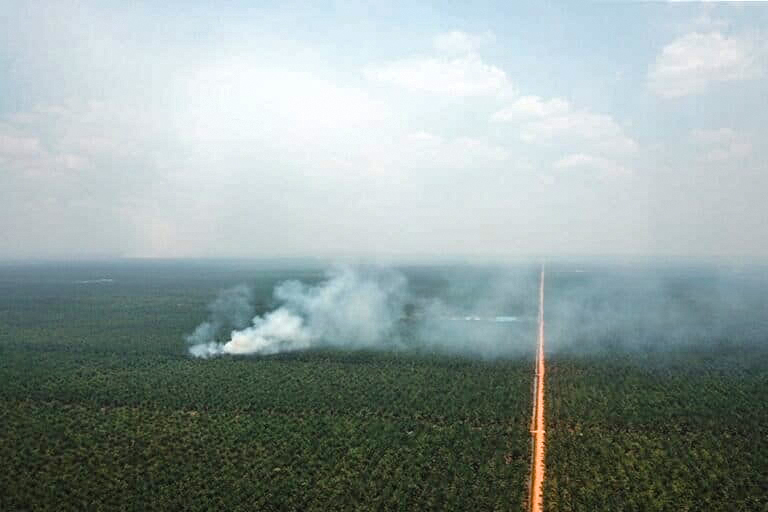
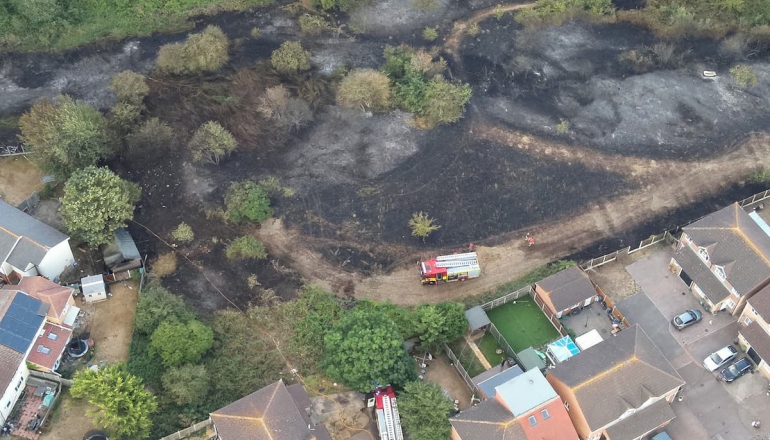
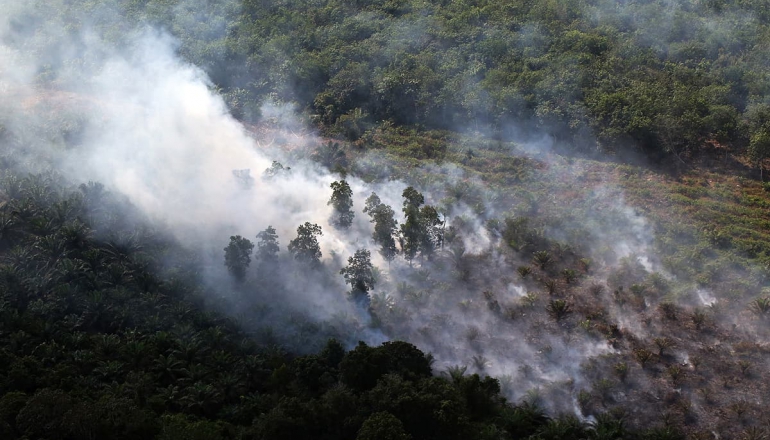
Forest and land fires in 2024 at a palm oil plantation concession in South Kalimantan Province. Image by Walhi Kalsel for Mongabay Indonesia.
Janang estimated wildfires have increased by around 20% year on year through June, and that the emergence of El Niño could worsen the situation on the ground in the coming months.
The government planned to develop more than 80,000 hectares (197,684 acres) of rice fields in Central Kalimantan province alone by 2025 as part of the overall food estate project. Walhi says much of the expansion is taking place on peatlands, increasing the fire risk as landscapes in the province are drained for agriculture.
Indra Syahnanda, Walhi’s campaign lead in West Kalimantan province, said conversion of almost 3 million hectares (7.4 million acres) of peatlands from protected forest to cultivation, enabled by permits issued by district governments, has heightened wildfire risks across the western part of Borneo.
“We’ve found many protected areas that should have been protected that were converted into cultivation areas,” Indra said. “Something has gone wrong with peatland management.”
In South Kalimantan province, civil society organizations say law enforcement has responded weekly to reports of fires on plantation concessions. Walhi said police acted against only one of seven companies it reported over fires in 2025, according to the group’s South Kalimantan director, Raden Rafiq. South Kalimantan provincial police could not be reached for comment.
“Firm action is often taken more against communities clearing land for their livelihoods,” Raden said, “while companies experiencing repeated fires don’t receive the same treatment.”
NOAA has since forecasted a 63% chance this year’s El Niño will reach “very strong” intensity, further inflaming the risk of drought and fires. The U.S. forecaster is using a newer index this year, which has greater precision to measure El Niño.
In June, meteorologists recorded the hottest average ocean temperatures since records began.
Author: Rendy Tisna
This article was originally published on Mongabay under the Creative Commons BY NC ND licence. Read the original article.