The region must strengthen grids and clean energy capacity to incorporate AI for efficiency, experts say. But in China, the technology is no silver bullet for decarbonising energy systems

An unmanned drone deployed to inspect transmission lines in Nanjing, east China. Such technology is also increasingly being used in Southeast Asia (Image: State Grid Jiangsu Electric Power Co., Ltd. / Xinhua / Alamy)
An autonomous drone whizzes across a vast solar farm in Thailand, a few days after a typhoon barreled over the site. Working like an X-ray, the drone takes electroluminescence images of the panels. An AI-based analytics engine then spots cracks and other defects.
The technology can inspect 5,000 modules per hour, claims its developer, the Singapore startup Quantified Energy. It helps protect the farm’s yield and bankability by weeding out underperforming panels, says CEO and co-founder Yan Wang.
Meanwhile, on Indonesia’s remote Sumba island, AI has been deployed to balance the renewables and storage needs of microgrids by predicting and adapting to monsoon patterns, cutting reliance on backup diesel generators.
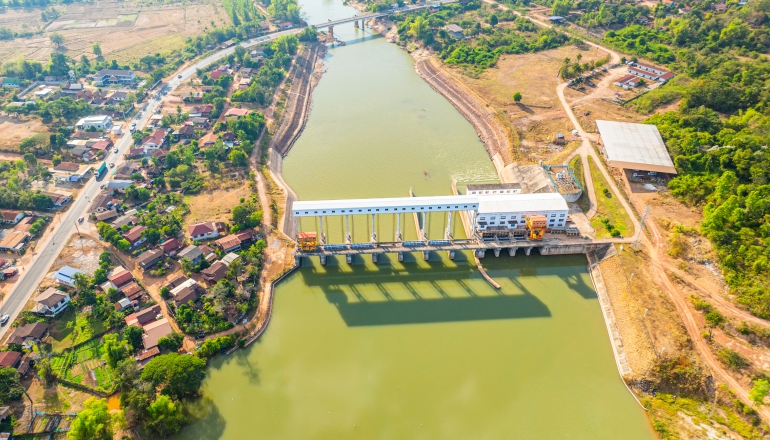
And in Vietnam, its national utility is using AI-based sensors instead of people to monitor equipment at Son La, Southeast Asia’s largest hydroelectric power plant, reducing workers’ exposure to high-pressure tanks and high-voltage equipment.
In recent months, AI has made gloomy headlines in the region, with protests against the environmental impacts of data centres in Johor. The southern Malaysian state is the epicentre of Southeast Asia’s boom of hyperscalers, large companies rapidly expanding such facilities. But the technology is also central to a different story: how to squeeze more renewable energy into power systems under increasing strain from spiking demand, extreme weather and oil price volatility sparked by the conflict in West Asia.
Southeast Asia is one of the world’s most fossil-fuel-dependent regions. But the region’s share of variable renewable energy – that is, solar and wind – could reach 42-47% by 2045, up from around 5% in 2025, according to reports from the Asean Centre for Energy and think-tank Ember respectively. Across the region, AI is already being applied to varying degrees in power systems: from simple predictive equipment maintenance and usage forecasting, to ambitious attempts to optimise entire grids.
But experts Dialogue Earth spoke to caution against overreliance on AI as a magic bullet, and note that efficiencies it creates will not necessarily translate to cleaner grids. They also consider China’s growing presence in Southeast Asia’s clean energy ecosystem and what this might entail for the incorporation of AI into power grids.
Aiding efficiency
AI is also being used long before renewable projects come online. Gurin Energy, an energy storage company specialising in solar and wind projects in Southeast Asia, uses it to speed up the complex technical and financial modelling that determines projects’ viability and bankability before capital is committed.
For the Singapore-headquartered company, AI has cut modelling work that previously might have taken years to a few months, while improving the accuracy of yield and revenue forecasts, says its electrical engineering manager Luqman Kamal. Even a 0.1% difference in a forecast can translate into millions of dollars in revenue, he notes.
Gurin is developing an AI-based sensitivity analysis tool to plan where best to deploy solar and wind farms at speed, avoiding expensive, congested or environmentally fragile sites. The faster viable projects can move through development, the sooner they can attract capital, explains Kamal, who is developing the tool.
Beacon Venture Capital is a Thailand-based corporate venture fund that invested in Quantified Energy, whose technology is being deployed in Thailand by solar installer Onnex. Thanapong Na Ranong, a managing partner at Beacon, notes that more start-ups have emerged that deploy AI to improve efficiency of solar photovoltaic systems. This development, combined with generation costs continuing to fall, means Southeast Asia can expect growth in solar adoption, he says.
“We assessed what it costs a solar operator to hire the company [Quantified Energy] to detect defects against the losses those defects would otherwise cause. And we found out that the latter cost is higher,” Thanapong tells Dialogue Earth.
However, Krongkamol Deleon, Beacon’s investment principal, noted the scarcity of deep-tech start-ups in the region, meaning companies building products and services based on substantial or complex research. She explains that apart from Singapore, Southeast Asian countries generally lack the ecosystem that allows deep-tech research conducted in universities to be commercialised.
The last layer, not the first
Still, the potential for AI to drag Southeast Asia’s patchwork of power systems through the energy transition is considerable. Ember estimates that by 2035, widespread adoption of AI could cut up to USD 67 billion from the region’s energy bill and reduce CO2 emissions by nearly 400 million tonnes.
But AI’s ability to make electricity systems more efficient does not automatically translate into cleaner grids, experts warn.
The technology itself is spectacularly resource intensive. Data centres are mushrooming in Singapore, Johor and Indonesia’s Batam island, while the computing infrastructure needed to run increasingly sophisticated AI models is burdening grids. In Johor, Southeast Asia’s fastest-growing data centre hub, such facilities suck up just under a quarter of end-user electricity – a proportion expected to rise to 40% by 2035, according to analysis by consultancy Wood Mackenzie. In July, Thailand tightened rules for AI data centres amid concerns of pressure on the country’s power system and water resources.
For all its efficiency potential, AI cannot build the transmission lines, renewable power plants or batteries needed to transform Southeast Asia’s creaking power systems.
In Indonesia, the region’s largest energy market, AI could potentially improve grid resilience and forecast solar output to help integrate rooftop solar. But solar currently accounts for only a small share of the country’s electricity generation, notes Ember.

A substation in a solar farm in East Bali, Indonesia (Image: Amazing Aerial / Alamy)
Indonesia’s fragmented electricity system – the archipelago has eight major transmission grids and more than 600 smaller networks – remains overwhelmingly dependent on fossil fuels, notes Fabby Tumiwa, CEO of the Institute for Essential Services Reform, a Jakarta-based think-tank.
He says AI-driven efficiency gains – such as reducing electricity use or consolidating computing workloads – barely make a difference to the climate impact of a power system still heavily reliant on coal.
“AI is the last layer – not the first,” Tumiwa says. “Sequencing it ahead of the grid build is where a lot of ‘AI will help Indonesia leapfrog’ rhetoric goes wrong.”
One of AI’s biggest potential contributions to Southeast Asia’s energy transition could come from the same data centres that are driving much electricity demand.
Tumiwa points to research showing that AI data centres can be controlled to adjust their electricity consumption in real time according to grid conditions. This could make it easier for power systems to absorb variable renewable energy, delay costly grid upgrades, and reduce curtailment – which is when wind and solar generation must be shut down due to insufficient demand or transmission capacity.
“On a fragmented, congestion-prone, coal-heavy grid, this is worth more to Indonesia than to almost any developed grid,” he says.
Indonesian policymakers should therefore incentivise data centre operators to make their electricity demand flexible, he argues. Incentives should be tied to measurable benefits for the grid rather than simply requiring companies to “use AI” for optimisation of all sorts.
A similar tension exists in Malaysia. Better forecasting and grid optimisation could help the country use variable renewable electricity more efficiently, says Christina Ng, co-founder of the non-profit Energy Shift Institute. But ultimately, she notes, AI cannot itself create the infrastructure needed to expand renewable capacity. “AI may make the existing power system more efficient without fundamentally changing its dependence on fossil fuels.”
What can Southeast Asia learn from China?
China offers Southeast Asia a glimpse of what an AI-enabled energy transition could look like, although its approach will not be easy to replicate.
The country’s “AI Plus” initiative positions AI as a tool for transforming the economy, including the energy system. Its latest Five Year Plan, for the 2026-2030 period, signals the potential for AI to address problems such as grid volatility and renewable energy curtailment.
However, Elizabeth Frost, a China analyst at the Centre for Research on Energy and Clean Air, warns that AI-driven productivity gains in fossil-fuel production could offset some of the gains for clean energy. For instance, state-owned China Energy Investment Corp’s use of AI has cut wind turbine maintenance time by 60%, but also lifted the efficiency of coal mining by five times above the national average, using computer vision and machine learning to operate heavy equipment remotely.
China is increasingly linking its digital and clean energy strategies. A 2025 policy requires new AI data centres in regions considered to have significant computing infrastructure to use at least 80% renewable energy. It has encouraged operators to locate facilities near clean power sources. Meanwhile, the “East data, west compute” strategy directs data centre development and non-urgent, data-heavy computing tasks – such as AI model training, background data analysis and long-term storage – from the power-constrained east to massive new data centres in the wind- and solar-rich west of the country.
Though some Southeast Asian governments have begun taking steps towards clean energy mandates for data centres, the region still relies largely on incentives, green energy procurement and energy efficiency standards.
Southeast Asia’s energy systems are also becoming increasingly exposed to Chinese technology. China is the region’s largest public funder of clean energy projects, investing over USD 2.7 billion in renewables between 2013 to 2023, according to Zero Carbon Analytics.
China’s growing presence in Southeast Asia could help bring AI-based energy technologies, potentially reducing costs and helping utilities integrate more renewable power.
Member states of the Association of Southeast Asian Nations (Asean) have been actively encouraging tech sharing through platforms like the Asean Digital Ministers’ Meeting, which forged a joint AI Industry Innovation Center and Digital Academy with China earlier this year. China has also pursued bilateral AI ties with Malaysia and Cambodia. Facing geopolitical pushback in the west, Chinese tech firms are likely to see Asean as a welcoming market.
But for Southeast Asia to make productive use of AI, the region needs the infrastructure that makes the technology useful. Reliable weather sensing and monitoring infrastructure in solar and wind power plants should be a priority, says Ember analyst Pham Lam. This will give lenders more confidence in project yields and help to secure plants’ future cash flows, he says.
Cybersecurity and data governance will also be critical, particularly as electricity systems become more interconnected as the Asean power grid linking all member states begins to graduate from myth to reality. While AI hubs such as Singapore and Malaysia have relatively strong safeguards, lower-income Asean countries have weaker digital capabilities, which could expose regional power trading to unwanted risks, warns Lam.
There is also a risk of a widening digital divide. Several Asean countries, including Singapore, Malaysia and Vietnam, rank high in AI readiness and have power sectors capable of adopting China’s AI tools. But smaller and poorer power systems in countries such as Cambodia, Laos, Myanmar and Timor-Leste lack the data, computing infrastructure and technical capabilities needed to deploy AI as rapidly.
Chinese investment and technology could narrow that gap. The bigger challenge, Lam says, is scaling these applications from individual use cases to system-wide deployment.
A utility can deploy an AI tool relatively easily. But applying AI to grid-wide dispatch optimisation or cross-border coordination requires much greater institutional, regulatory and digital maturity, which much of the region is still developing, he notes.
Any increase in Chinese technology in Southeast Asian grids invariably raises questions over whether the region could become too reliant on its northern neighbour’s AI as it digitises, warns Lam. The priority, he says, should be technology access combined with interoperability, local capability-building and the ability to operate systems independently.
Author: Robin Hicks
This article was originally published on Dialogue Earth under the Creative Commons BY NC ND licence. Read the original article.