A new study from Southeast Asia finds the combined pressures of global warming and habitat degradation could send forest understory heat levels soaring within the next three decades, potentially exposing species to unprecedented levels of thermal stress.
.jpg)
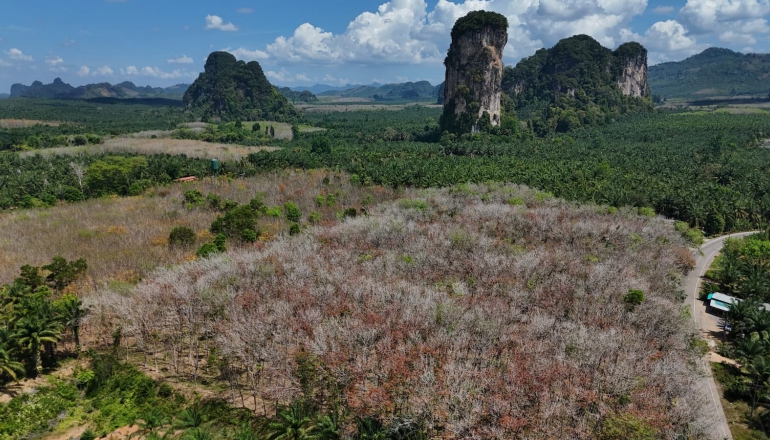
The research team set up dataloggers in forests across Southeast Asia to measure temperature 15cm above the forest floor. Image courtesy of Eduardo Maeda.
Forest canopies create the conditions for an extraordinary diversity of life to thrive. By casting shade and retaining moisture in the air and soil, they generate cool and stable understory environments. In the tropics, this regulating effect is particularly crucial for countless species that otherwise would be unable to survive in the extreme heat of surrounding open landscapes.
However, forest scientists are increasingly concerned that the combined pressures of global warming and habitat degradation could undermine forests’ critical thermal buffering capacity.
New research from Southeast Asia predicts forests across the region will experience unprecedented peak temperatures over the next three decades. Heat levels beneath the canopy could hit new highs even within currently intact ecosystems by 2050, the study found, potentially exposing forest-dwelling animals, plants and fungi to severe levels of heat stress.
“Our findings show that climate change is not only warming the atmosphere globally, but also reshaping the local conditions that species experience inside forests,” said Erone Ghizoni Santos, who led the study while he was a Ph.D. student at the University of Helsinki in Finland.
The scale of the projected warming surprised even the researchers, Santos said, and feeds into concerns from conservationists about how species will cope with future environmental conditions. Even modest increases in forest understory temperatures could be enough to push some species beyond their physiological tolerance.
“Many tropical species already live close to their thermal tolerance limits,” Santos told Mongabay. “Additional warming inside forests could affect survival, reproduction, behavior, and species interactions, particularly for organisms adapted to cool understory conditions.”
Species that are unable to move to cooler habitats or with limited ability to regulate their temperature behaviorally or physiologically are likely to be impacted the most, Santos said.
In terms of regional patterns, the study models indicated forests at higher altitudes across the region, including in mountainous parts of Myanmar and Laos, might escape the brunt of future thermal stress. This could be due to the overall cooling influence of elevation, Santos and his colleagues suggested in the study.
Conversely, the models predicted lowland areas of northern Cambodia, southeastern Indonesia, and the island of Borneo will experience the strongest increases in temperature. Without sincere action to curb development pressure and greenhouse gas emissions, forests in these areas could see peak daytime temperatures increase by as much as 4° C (7.2° F) above baseline levels, according to the study.
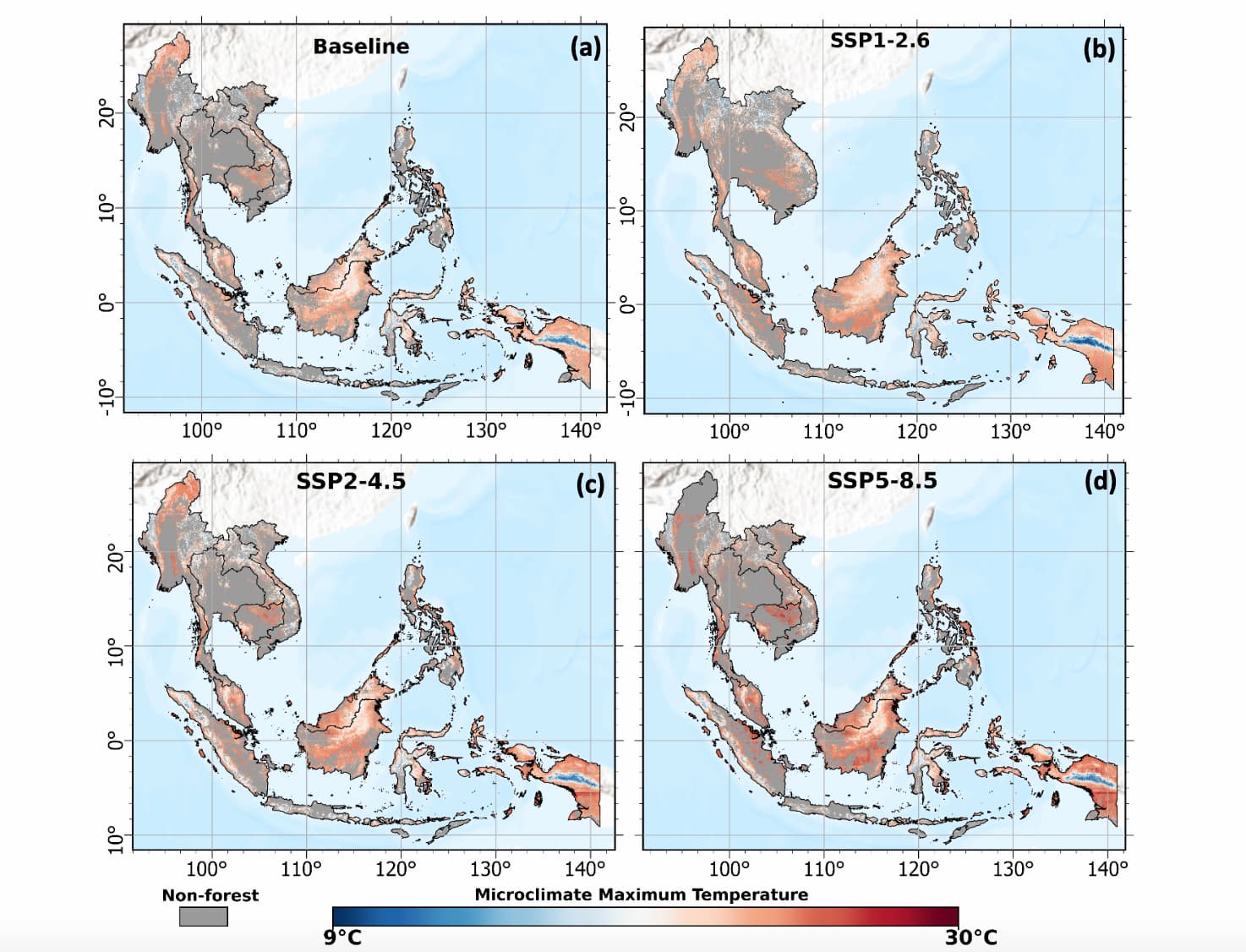
Peak forest understory temperatures across Southeast Asia. Baseline levels (a); under Global Climate Research Programme (GCRP) low emissions climate scenario (b); under GCRP moderate mitigate climate scenario (c); and under GCRP high emissions climate scenario (d). Map from Santos et al. (2026) via Creative Commons (CC BY 4.0).
Cascading effects of microclimate shifts
While the findings ultimately underscored the need to curb global fossil fuel emissions to mitigate future warming, the research team said their findings can help guide conservation action.
They recommended policymakers and conservation practitioners adopt a spatial prioritization approach to shore up forests against future thermal stress across the region.
Micro-refugia areas, such as upland forests, where temperatures are likely to remain stable despite overall warming of surrounding areas should be prioritized for conservation, Santos said. “These areas will remain relatively cooler despite rising global temperatures.”
Intact forests, which provide stronger thermal buffering and may also serve as climate refuges for biodiversity, should also be protected, he said. In addition, vulnerable regions expected to undergo significant future warming could benefit from conservation attention to restore forest structure and enhance landscape connectivity.
Vivienne Groner, an Earth system scientist at Imperial College London who wasn’t involved in the study, said the “scale and consistency” of the new study’s approach deepens the understanding of how forest microclimates are likely to shift under future climate change.
“Tropical forest microclimate data are still quite sparse, particularly across Southeast Asia, where many forests are remote and difficult to access,” Groner said. “By establishing a systematic network of field measurements across a large geographic area, the study helps close a major data gap.”
Ultimately, however, the impacts of changing forest conditions are likely to extend beyond individual species. The effects will “cascade throughout ecosystems,” she said, affecting food availability, water cycles, decomposition and nutrient cycling processes and the capacity of forests to store carbon. “Over time, this could reduce ecosystem resilience and the services these forests provide.”
Groner said that while the study offers important insights into how forest temperatures could shift across the region, a fuller picture of how forest species will be affected will require studies that examine additional microclimate factors, such as humidity, wind, solar exposure, and physical feedbacks within ecosystems.
“There is real potential to link this rich [thermal] microclimate dataset with ecological and physiological research,” she said, “helping to bridge the gap between environmental change and ecosystem responses.”
Author: Carolyn Cowan
This article was originally published on Mongabay under the Creative Commons BY NC ND licence. Read the original article.