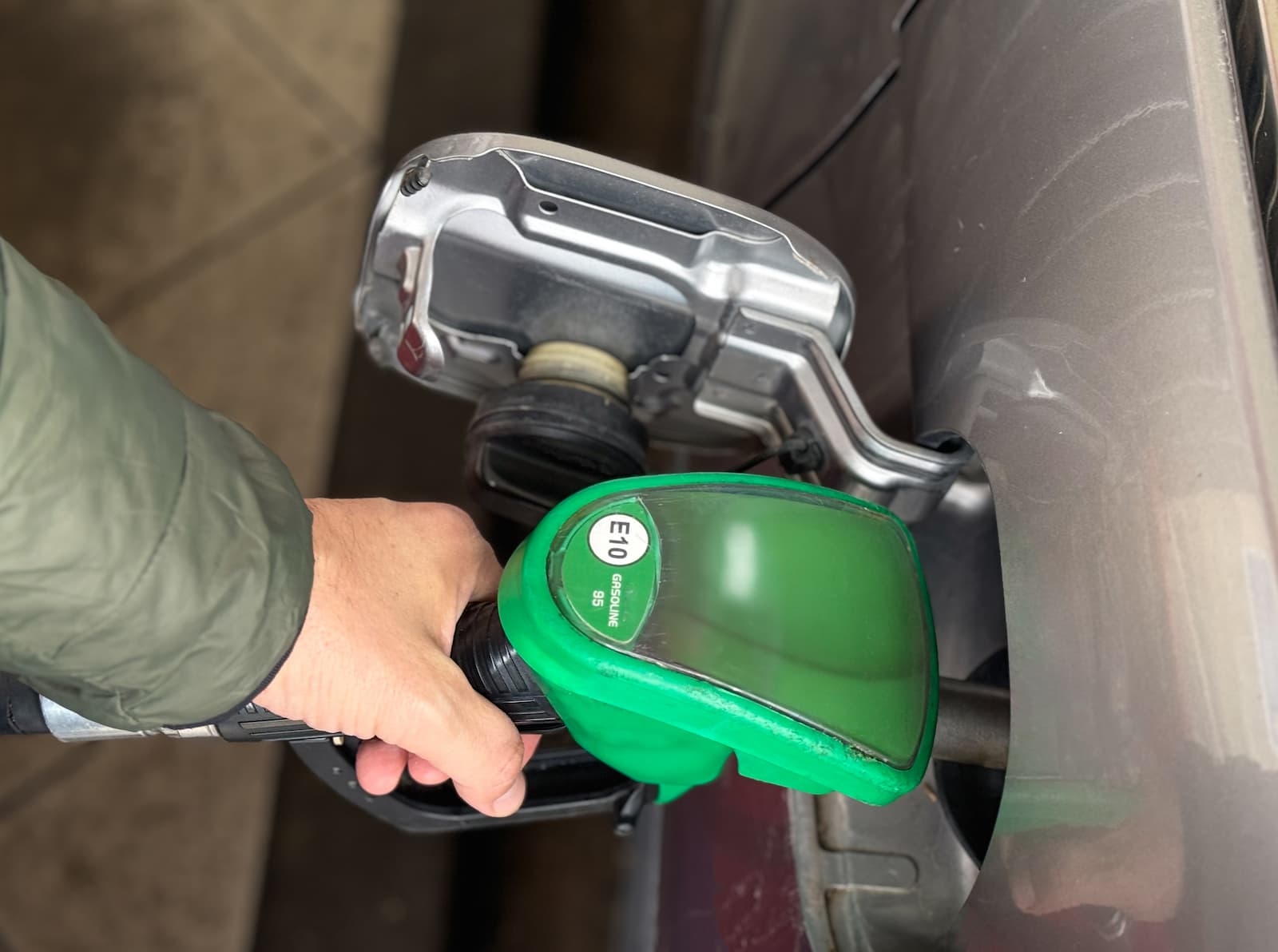
Gasoline-powered vehicles will remain on the road for years to come. Taiwan needs to strengthen its low-carbon fuel policies alongside vehicle electrification. (Photo: iStock)
Editor’s note: Decarbonizing Taiwan’s transportation sector requires more than vehicle electrification. Existing gasoline and diesel vehicles, along with aviation, will also need lower-carbon fuels. How Taiwan can build a transition pathway from E3 and E10 to sustainable aviation fuel (SAF) deserves attention. In this second article in the “New Opportunities for Sustainable Fuels” series, Pei-Chang Wen, Director of the Second Research Division at the Chung-Hua Institution for Economic Research, examines how Taiwan can use E10 to build a market and connect it with the development of SAF.
When it comes to Taiwan’s energy transition, government policy and public attention often focus on renewable energy, natural gas and electric vehicles. Yet another category of energy is used in large quantities every day but still lacks a clear transition pathway: liquid fuels such as gasoline, diesel and jet fuel.
Taiwan has a clear direction for reducing transportation emissions through electrification. This mainly addresses emissions from new vehicles and vehicle replacement, including the goal of fully electrifying city buses by 2030 and expanding electrification among commercial vehicles such as trucks and taxis.[1] However, with a large fleet of existing gasoline vehicles expected to remain on the road for many years, there is still no nationwide timeline for gradually reducing the carbon intensity of gasoline itself.
In other words, Taiwan’s transportation decarbonization policies have made significant progress in answering the question of what types of vehicles we should switch to in the future. But there is still room to strengthen policies on the fuel side to address another equally practical question: what lower-carbon fuels can the gasoline vehicles already on the road use?
After Nearly 20 Years, E3 Has Yet to Gain Widespread Use. Can E10 Finally Go Mainstream?
In fact, Taiwan is not new to low-carbon liquid fuels. In 2007, the Ministry of Economic Affairs launched the “Green Government Vehicle Pilot Program,” introducing E3 gasohol, gasoline blended with 3% bioethanol, in Taipei.[2] The program was later expanded into the 2009 “Gasohol Promotion Program for the Taipei and Kaohsiung Metropolitan Areas,”[3] with plans at the time to implement E3 nationwide.[4]
Nearly 20 years later, however, the market for E3 remains very limited. CPC Corporation currently supplies E3 gasoline at only 14 gas stations in Taipei and Kaohsiung. In terms of supply, CPC’s 2026 business plan estimates gasoline production at around 9.28 million kiloliters, but plans to purchase only 96 kiloliters of ethanol for E3 blending.[5] The huge gap between the two figures shows that E3 has remained more of a policy demonstration than a mainstream fuel option.
This year marks a noteworthy turning point. On June 9, the Ministry of Economic Affairs revised national standards CNS 12614 and CNS 15109, raising the maximum ethanol content in fuel to 10%.[6] This formally opens the door for E10.
But setting a national standard does not automatically create a market. Moving from E3 to the lower-carbon E10 will require addressing several issues: supply targets, the compatibility and upgrading needs of gas station storage and distribution systems, vehicle compatibility, feedstock planning, including how imports and domestic production should be balanced, and clear policy signals that give businesses the confidence to invest for the long term.
In other words, the key question is no longer simply whether gasoline can be blended with 10% ethanol, but whether the government is ready to move gasohol beyond a long-running demonstration policy and toward a market strategy at scale.

CPC currently supplies 95-octane unleaded gasoline blended with 3% ethanol (E3) at 14 locations. (Photo: Wikimedia Commons, CC BY-SA 3.0)
With a 5% SAF Blending Target by 2030, Taiwan’s Supply Chain Must Keep Up
By contrast, Taiwan has accelerated its efforts to promote SAF in recent years. In 2025, SAF was supplied for the first time at Taoyuan, Songshan and Kaohsiung airports, with annual consumption reaching around 5,900 metric tons. Domestic companies have also used existing refinery equipment and used cooking oil to produce SAF through co-processing. It would therefore be inaccurate to say that Taiwan has no SAF industry at all.[7]
The real question is whether the supply chain can mature quickly enough to keep up with policy targets.
The SAF Decarbonization Flagship Action Plan approved by the Executive Yuan requires Taiwan-based airlines to use SAF for at least 5% of their total fuel consumption on international routes by 2030. Yet the same plan sets 2032 as the target year for stable domestic SAF production. Technologies such as converting non-food crops and agricultural waste into ethanol, and then processing that ethanol into SAF, are still at the stages of technology development, pilot production and validation.[8]
In other words, Taiwan has set demand targets for airlines first, and is now building the upstream feedstock supply, processing capacity and certification systems needed to meet them.
This policy approach is not unreasonable, but it raises an important industrial challenge. If Taiwan’s low-carbon liquid fuel market lacks sufficient scale, upstream suppliers will find it difficult to invest in new bio-based feedstocks, ethanol fermentation, storage and logistics, and conversion facilities solely for the aviation market. This is why E10 and SAF should be considered within the same policy framework.
E10 and SAF Do Not Have to Develop Separately: Ethanol Can Connect the Low-Carbon Fuel Supply Chain
E10 and SAF do not have to be two parallel lines. Globally, the alcohol-to-jet (ATJ) pathway offers a way to convert ethanol or isobutanol into aviation fuel. The International Civil Aviation Organization (ICAO) also lists ethanol as one of the feedstocks that can be used for ATJ.[9] ATJ SAF is likewise consistent with the technology development pathways outlined in Taiwan’s SAF flagship plan.
Gasohol therefore does not have to be seen as just a vehicle fuel policy. From an industrial development perspective, E10 and SAF do not have to be treated as separate decarbonization pathways. They could instead be different applications of the same low-carbon liquid fuel supply chain, serving different markets at different stages.
Moving from E3, which has been in the demonstration stage for nearly 20 years, to E10 would increase the use of renewable fuels in the existing gasoline market and help reduce emissions from vehicles already on the road. More importantly, it would create more stable demand for fuel ethanol, giving Taiwan a basis for gradually developing its capabilities in feedstock procurement, domestic bioethanol production, fuel blending, storage and logistics, quality testing, and sustainability certification.
As ATJ and other SAF technologies and business models mature, these capabilities could then extend into the aviation fuel market.
By establishing a market for E10 first and then extending ethanol production, feedstock supply and refining capabilities to SAF, Taiwan could move from buying low-carbon fuels to building its own low-carbon fuel industry. Rather than expecting the market to suddenly produce large volumes of SAF within just a few years, this approach better reflects how supply chains develop and industrial investment builds over time.
Of course, E10 is not a cure-all. If Taiwan relies heavily on imported ethanol with high lifecycle carbon emissions, or if its production leads to problems such as land-use change and competition with food production, the emissions benefits could be significantly reduced. Policy should therefore go beyond achieving a 10% blend. It should also establish lifecycle carbon standards for fuel ethanol, sustainability requirements for feedstocks and a certification system.
After nearly 20 years of promoting E3, the question is no longer whether to continue demonstrating it, but whether E3 can move on to the next stage. Using E10 to build a market and then connecting it with SAF may be a practical way for Taiwan to complete the missing piece of its low-carbon liquid fuel policy and turn emissions-reduction needs into industrial opportunities.
Taiwan’s next stage of transportation decarbonization should not rely solely on replacing gasoline vehicles with electric vehicles. Electrification is a long-term shift in the vehicle fleet, while low-carbon liquid fuels can help reduce emissions from existing vehicles and aviation during the transition.
References
[1] Third Phase Action Plan for Greenhouse Gas Emissions Reduction in the Transportation Sector (Approved Version), February 2026. Lead agency: Ministry of Transportation and Communications; cooperating agencies: Ministry of Environment, Ministry of Economic Affairs, and Ministry of the Interior.
[2] “Guidelines for Subsidies under the Ministry of Economic Affairs’ Green Government Vehicle Pilot Program.” Repeal order issued on April 11, 2025.
[3] “Guidelines for Subsidies under the Ministry of Economic Affairs’ Program to Promote Gasohol in the Taipei and Kaohsiung Metropolitan Areas.” Originally issued on July 2, 2009; last amended on May 20, 2025.
[4] Overseas Trip Report: Seminar on Bioethanol Transportation, Storage and Management. Issuing unit: Keelung Storage and Transportation Office, Oil Products Marketing Division, CPC Corporation. Travel dates: November 22–27, 2009; report date: January 25, 2010.
[5] Ministry of Economic Affairs, 2026 Annual Business Plans for State-Owned Enterprises under the Ministry of Economic Affairs: Business Policies, Production and Sales Targets, and Major Investment Objectives. Ethanol procured by CPC Corporation is used for blending E3 gasohol; the 2026 figure is an estimate.
[6] Announcement on the Establishment, Revision and Withdrawal of National Standards of the Republic of China (CNS). June 9, 2026.
[7] “SAF Takes Off for Sustainable Aviation: Taiwan-based Airlines Use SAF in Taiwan for the First Time.”
[8] Executive Yuan, “Sustainable Aviation Fuel (SAF) Flagship Action Plan for Carbon Emissions Reduction (Approved Version).”
[9] International Civil Aviation Organization (ICAO), “SAF Conversion Processes.”
This article was contributed by Pei-Chang Wen, Director of the Second Research Division at the Chung-Hua Institution for Economic Research.
Have insights on energy or carbon issues? Share your perspective with us! Send your submission to reccessary@gmail.com for a chance to be featured. Submissions may be edited for clarity and style.
