.jpg)
While the DPPA framework offers clear strategic advantages for Vietnam’s energy sector, limited adoption persists amid pricing complexities and systemic implementation barriers. (Photo: iStock)
To achieve the ambitious socio-economic development targets, Vietnam urgently requires a secure, reliable and increasingly green energy supply. As the country accelerates industrial expansion and global economic integration, ensuring the sustainable availability of competitively priced renewable electricity has become a strategic priority - particularly given Vietnam’s abundant wind and solar resources. In parallel, Vietnam is advancing its electricity market toward a more competitive, transparent, and efficient electricity market, while maintaining energy security and power system stability.
Within this context, the Direct Power Purchase Agreement (DPPA) framework established under the Decree 57/2025/ND-CP, dated on 3rd March 2025, represents a significant milestone in Vietnam’s ongoing electricity market reform. The introduction of DPPA mechanism not only facilitates direct green power procurement between renewable energy generators and large consumers but also signals a structural shift toward greater market liberalization and private-sector participation in the power sector. There are two models of DPPA in effect:
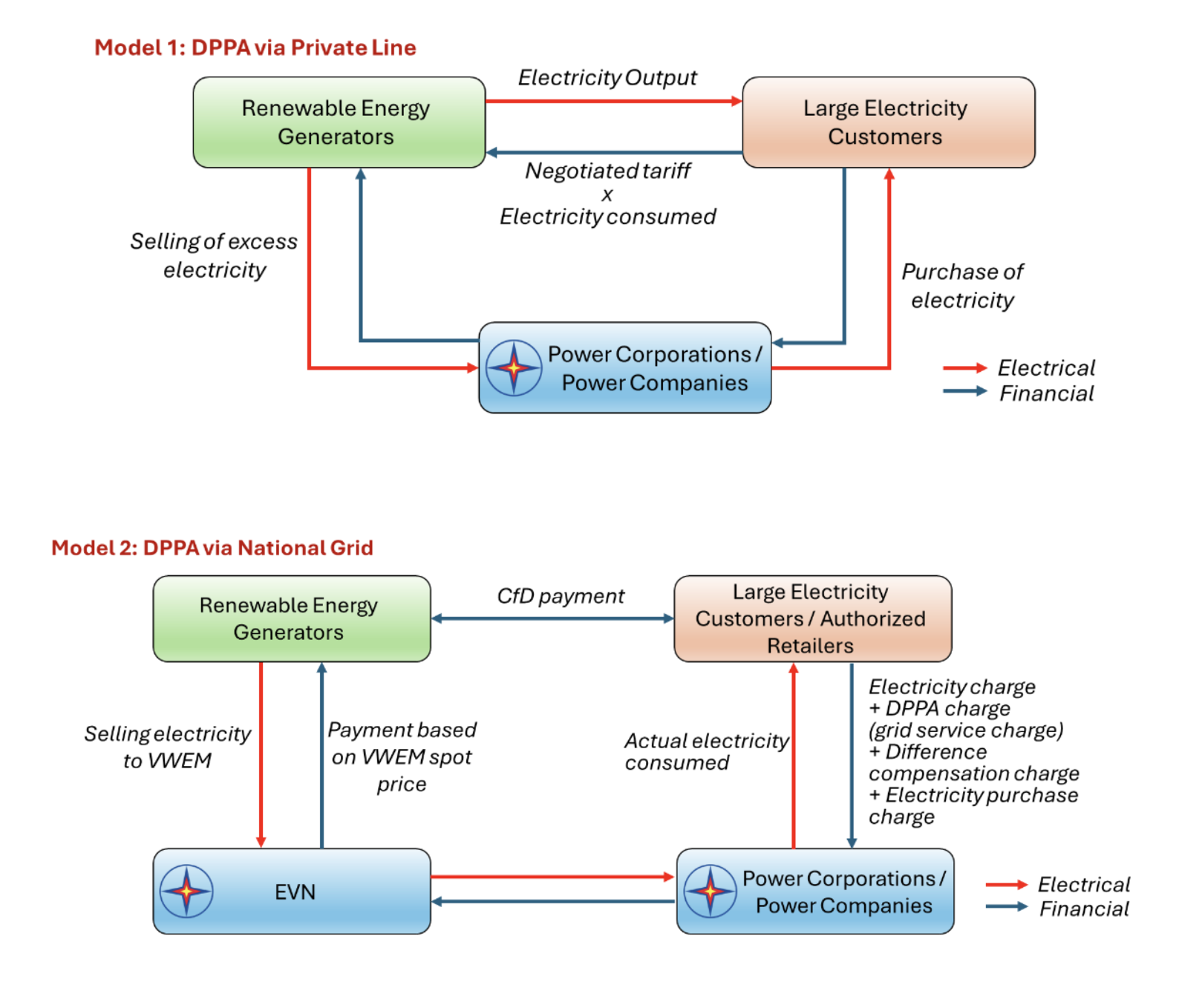
- Model 1 – DPPA via private connection line (Physical DPPA): the renewable energy generator sells electricity to the large electricity consumer via a direct and private transmission line. The DPPA is signed between the generator and consumer, and the electricity selling price is negotiated between the two parties but cannot be higher than the ceiling price of the corresponding type of power source defined by the Ministry of Industry and Trade (MOIT).
- Model 2 – DPPA via national grid (Virtual or Financial DPPA): the renewable energy generator sells its entire electricity generation into the spot electricity market within the competitive wholesale electricity market (VWEM), and the large consumer buys electricity from Power Corporations/Power Companies. In this model, the renewable energy generator signs a power purchase agreement with Vietnam Electricity (EVN) while the large consumer enters agreements with the generator and Power Corporations/Power Companies.
The electrical and financial flows in the two DPPA models are illustrated in the two figures below.
DPPA implementation faces hurdles in Vietnam
The substantial benefits offered by DPPA framework are obvious for the government, utility, renewable energy generators and consumers. However, the implementation of DPPA in Vietnam remains relatively limited to due uncertainties in pricing mechanism and challenges, including:
- Limited scope of eligible consumers: In the DPPA model via private connection line, only large electricity consumers whose monthly electricity consumption must be equal to or greater than 200,000 kWh/month are eligible. In the DPPA model via national grids, eligible consumers include large electricity consumers for production purposes or large electricity consumers providing electric vehicle charging services who purchase electricity from the Electricity Corporations/ Power Companies, and electricity retail units in zones and clusters authorized by large consumers.
- Ceiling price in the physical DPPA: The electricity selling price is negotiated between the two parties but cannot be higher than the ceiling price of the corresponding type of power source defined by MOIT. This constraint directly impacts the financial feasibility and bankability of renewable energy projects under the physical DPPA model. Foreign-invested (FDI) manufacturers and processing facilities are having strong demand for stable and reliable supply of green energy to meet their ESG requirements and they are willing to pay a premium for guaranteed renewable energy supply.
- Uncertainties in network service costs in the virtual DPPA: the total electricity cost paid by a large consumer to the utility comprises electricity charge, DPPA charge or grid service charge (CDPPA), difference compensation charge (CCL), and electricity purchase charge. CDPPA accounts for grid service costs for electricity transmission, distribution and retail, power system operation dispatch, electricity market transaction operation, and sector regulation and administration.
The DPPA charge per kWh electricity unit, CDPPAđv, is calculated by dividing the total costs and profits of the transmission, distribution and retail, system operation dispatch, electricity market operation, and sector regulation and administration by the total domestic commercial electricity production. The difference compensation charge per kWh electricity unit, PCL, is calculated based on the price and electricity production differences in accordance with the wholesale electricity market regulations.
Both charges are determined and announced annually by EVN. As these components may vary from year to year depending on system costs and market conditions, they introduce uncertainty and pose challenges for long-term cost forecasting and financial planning for DPPA participants. In response, industry stakeholders have proposed introducing a cap on the annual increase in these charges – such as limiting adjustments to no more than 3% per year.
Revised DPPA rules broaden eligibility
Following the issuance of the DPPA framework under Decree 57/2025/ND-CP, major industrial stakeholders and business associations raised concerns and submitted recommendations for improvement. In response, MOIT has issued the dossier of draft Decree amending and supplementing several provisions of Decree 57/2025/ND-CP, as well as Decree 58/2025/ND-CP detailing a number of articles of the Electricity Law regarding the development of renewable energy and new energy, and has collected consultations. Major recommendations from industry stakeholders include:
- BECAMEX – VSIP, a leading industrial park developer, proposed expanding the scope of eligible participants to include retail electricity units within industrial parks and clusters. This would allow them to purchase electricity directly from renewable energy generators for resale to investors within the parks or clusters who have demand for renewable energy.
- VinEnergo, a green energy company under Vingroup, recommended broadening eligibility to include large electricity consumers in business and service sectors, data center operators, and removing the 22 kV connection requirement for consumers operating EV charging infrastructure.
- DEEP C Green Energy, part of the DEEP C industrial park complex, highlighted the limitation imposed by the requirement that large consumers must have a minimum monthly consumption of 200,000 kWh/month. This threshold significantly restricts SMEs in industrial parks, many of whom have strong demand for renewable energy but do not meet the minimum consumption criteria.
- Several organizations also called for clearer guidance on the calculation methodology for DPPA charges and different compensation mechanisms under the virtual DPPA model.
Dated on 11 December 2025, the National Assembly of Vietnam approved the Resolution 253/2025/QH15 on mechanisms and policies for national energy development for the 2026–2030 period, which makes significant revisions to the DPPA mechanism, as below:
1. Electricity price under power purchase agreements pursuant to the DPPA mechanism via private connection lines, and under forward electricity contracts pursuant to the DPPA mechanism via the national grid, shall be negotiated and agreed upon by the electricity seller and the electricity buyer.
2. Expand the entities eligible to directly participate in the DPPA mechanism to include retail electricity units within industrial parks, economic zones, processing zones, industrial clusters, high-tech parks, centralized digital technology parks, high-tech agricultural zones, urban zones, and free trade zones.
3. The Minister of MOIT shall prescribe in detail the scale thresholds for large electricity consumers eligible to participate in the DPPA mechanism.
4. The Government shall provide detailed regulations for Clauses 1 and 2.
In response to stakeholder feedback and Resolution 253/2025/QH15, MOIT has submitted to the Government a draft Decree amending and supplementing several provisions of Decree 57/2025/ND-CP and Decree 58/2025/ND-CP. The latest draft makes important revisions to the DPPA framework, including the following key changes:
In the DPPA via private connection line:
- The scope of eligible participants is expanded to include retail electricity units in zones and clusters.
- For retail electricity units in zones and clusters that have purchased electricity for 12 months or more: electricity purchased from a Power Corporation, or an authorized entity, or a Power Company must not be less than 100,000 kWh per month.
- Electricity price under the power purchase agreement shall be negotiated and agreed upon by the electricity seller and the electricity buyer.
- The surplus electricity generated by rooftop solar power systems and sold to EVN, Power Corporations, or Power Companies shall not exceed 50% of the actual electricity output.
In the DPPA via national grid:
- The scope of eligible participants is expanded to include large electricity consumers for data center operation, and retail electricity units in zones and clusters (except urban zones, and free trade zones).
- EVN is responsible for determining the DPPA charge per kWh electricity unit, CDPPAđv, and the difference compensation charge per kWh electricity unit, PCL, in the most recent 10 years, and sends to the National Electricity System and Market Operator (NSMO) for public announcement.
These new provisions have enhanced the attractiveness and feasibility of DPPA mechanism significantly. It clearly reflects a strong reform-oriented ambition, marking a transition from a centralized and monopolistic electricity management model toward a competitively structured electricity market. For the business community, this is seen as a critical unlocking step – enabling access to more diversified power supply sources and allowing greater autonomy in energy strategy, particularly for enterprises with high demand for green and clean electricity to meet ESG requirements.
.jpg)
For DPPA via the national grid, EVN calculates the DPPA charge per kWh (CDPPAđv) and the difference compensation charge (PCL) using data from the past 10 years, and submits the results to the National Electricity System and Market Operator (NSMO) for publication. (Photo: EVN)
Price cap removal improves physical DPPA project financing viability
For the physical DPPA model via a private connection line, the removal of ceiling price presents a key enabling reform. Many large electricity consumers are willing to pay a premium for long-term and reliable renewable energy supply to meet ESG compliance. By allowing the electricity price to be freely negotiated between buyers and renewable energy generators, the removal of the price cap significantly enhances the bankability of physical DPPA projects and expands access to renewable electricity for enterprises.
Moreover, granting pricing autonomy to sellers and buyers strengthens the foundation for a competitive and transparent electricity market. Under this market-based mechanism, electricity prices will reflect the capability, reliability and value offered by renewable energy suppliers. This encourages suppliers to improve technical performance and service quality, while enabling buyers to select partners that best meet their requirements. In addition, this reform is a critical driver for the development of large-scale renewable energy projects under the physical DPPA model.
For the virtual DPPA model via the national power grid, the calculation and announcement of the DPPA charge per electricity unit and the difference compensation charge per electricity unit over the most recent 10 years help improve the ability of market participants to forecast these costs. However, the proposal by industry stakeholders to introduce a cap on the annual increase of these charges remains under consideration. In addition, under the current methodology for calculating the DPPA grid service charge, there is potential for double-charging of grid-related costs when the two-component retail tariff is implemented.
Virtual DPPA raises double-charging concerns under two-component tariff
EVN has piloted the two-component tariff for manufacturing customers which comprises energy charge (VND/kWh) and capacity charge (VND/kW). This tariff structure has significant impacts on the DPPA mechanism. Renewable energy generators and consumers under DPPA can negotiate more effectively based on actual capacity requirements rather than solely on energy output, resulting in pricing that more accurately reflects real system costs. The mechanism encourages enterprises to use electricity and manage peak demand more efficiently.
However, the two-component tariff structure also adds challenges to the virtual DPPA model in which the double-charging issue may arise. This is because in the virtual DPPA model via national grid, the DPPA charge which accounts for network services may have some overlap with the capacity charge. In the two-component tariff, the energy charge can be 20% - 25% lower than that in the current one-component tariff. There are studies showing that due to the double-charging issue of grid service costs under the current calculation methodology, the attractiveness of virtual DPPA would be reduced significantly. This underscores the need for clearer cost allocation and calculation methodologies to ensure transparency and avoid unintended duplication of charges.
The DPPA mechanism under Resolution 253/2025/QH15 and the draft Decree expands eligible participants and grants greater autonomy in price negotiation, meeting the growing demand for green energy while enhancing transparency in the electricity market, creating a turning point for a competitive electricity market, meeting the expectations of the business community and energy investors. Beyond granting the right to choose electricity suppliers, the DPPA mechanism also contributes to the development of a competitive retail electricity market. When electricity prices are determined through negotiation between buyers and sellers rather than being constrained by a fixed pricing framework, market signals become clearer and more transparent. This, in turn, creates stronger incentives for investors to develop renewable energy projects aligned with actual market demand.
From March 2026, the Government will issue implementing regulations for the Resolution under simplified and expedited procedures. With the mechanism set to remain in effect until the end of 2030, the DPPA framework is expected to foster a more dynamic electricity market. In the near term, the number of projects under the physical DPPA model is expected to increase significantly, driven by pricing flexibility and enhanced project bankability. Meanwhile, stakeholders interested in the virtual DPPA model may adopt a more cautious approach, monitoring the implementation plan of the two-component tariff and potential revisions to the calculation methodology of the DPPA grid service charge.
This column is a collaboration between RECCESSARY, Vietnam Clean Energy Association (VCEA), and Vu Ba Hau. All rights reserved. Reproduction without permission is strictly prohibited.
