Farmers in Thailand’s Chachoengsao province worry a planned 600 MW LNG power plant could increase water shortages and air pollution in an area already facing recurring drought.
.jpg)
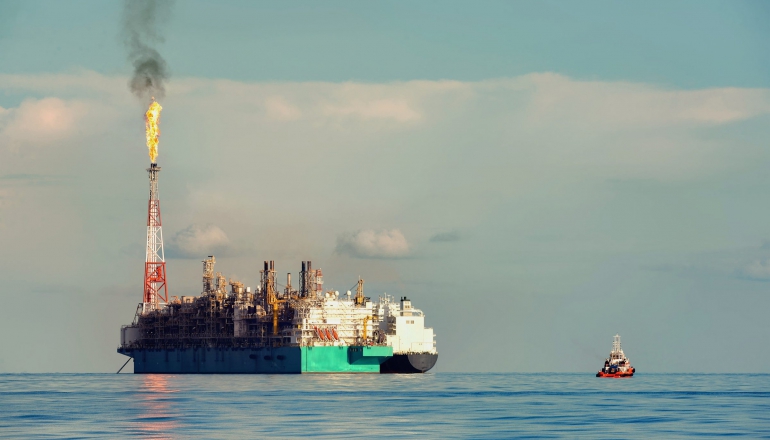
A fisher pulls in their nets in front of the 3,248 MW Bang Pakong Power Plant in Chachoengsao province, Thailand, on Monday, Feb. 2, 2026. The power plant is one of many operational facilities across the Eastern Economic Corridor already consuming water. Image by Andy Ball for Mongabay.
On a December afternoon, Suphut Hom Chunthit and his wife were tending to their 12 durian trees. Suphut showed reporters his homemade irrigation system, a series of pipes carrying water from the nearby Yang Deng canal.
The durian trees were in their fourth year, Suphut said, so they should fruit and be ready for harvest later in 2026 — if they survive.
“Last year, we could only water the durian trees for 15 minutes a day,” said Suphut, who also grows cassava, rice, plums, rubber and rambutan in Phanom Sarakham, a district in Thailand’s Chachoengsao province. “It’s barely enough to keep them alive.”
Three kilometers, less than 2 miles, down the road from Suphut’s 8-hectare (20-acre) farm sits the 304 Industrial Park (Chachoengsao), home to electronics, automotive and food-processing plants, and a biomass power station.
The park is also the site of the planned 600-megawatt Burapa power plant. But locals like Suphut say they fear the liquefied natural gas (LNG) facility could exacerbate water shortages and air pollution linked to the expansion of industry in Chachoengsao.
The Burapa plant will need up to 12,000 cubic meters (424,000 cubic feet) of water daily, per its 2021 environmental impact assessment (EIA) — equivalent to the daily consumption of some 49,000 Chachoengsao residents, as measured by a 2024 study. Meanwhile, Phanom Sarakham district already faces a “medium-high” risk of drought, according to the World Resources Institute’s Aqueduct Water Risk Atlas.
In 2019 and 2020, farmers across Thailand could only look on as one of the worst droughts in recent memory affected some 133,000 hectares (329,000 acres) of farmland, with damage estimated at 9.8 billion baht, roughly $301 million. In Chachoengsao, provincial authorities simply ran out of raw water for farms and factories, according to Kan Thatiyakhun, who leads the Chachoengsao RE-Power Network, a community group opposing the Burapa power project.
“[The authorities] had to cut the supply — there just wasn’t enough water,” Kan told Mongabay.
Ahead of this year’s predicted Super El Niño, Thai Agriculture Minister Suriya Juangroongruangkit advised farmers to plant “short-term crops that require less water,” while pledging to support farmers via El Niño monitoring, helping them adjust planting schedules and relocate livestock, and more.
Against this backdrop of regular water shortages, some Chachoengsao farmers worry the new LNG plant will push them closer to the brink.
“If they build the Burapa power plant, then we’ll lose too much water,” said Nathawan Handi, who manages an organic farming collective in Chachoengsao. “There won’t be enough left for everyone else.”
Mongabay sent multiple interview requests and a detailed list of questions to the Burapa plant’s developers, Gulf Energy Development and National Power Supply, but neither have responded. The Royal Irrigation Department, one of the key government agencies involved in managing water resources, also did not respond to requests for comment.
.jpg)
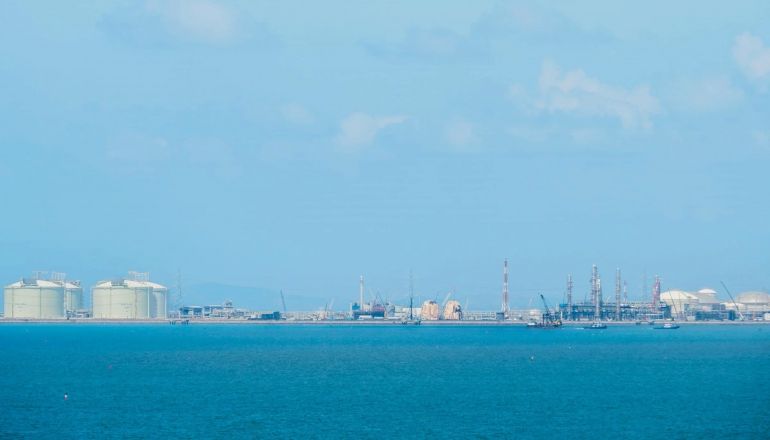
The 304 Industrial Park in Chachoengsao province, Thailand, on Monday, Dec. 8, 2025. If it moves forward, the Burapa power plant will be built inside the industrial park. Photo by Andy Ball for Mongabay.
Rising demand for water
Chachoengsao, an agricultural hub famed for its mangoes, is steadily industrializing. Sixty-five factories opened here in 2024 under the auspices of the Eastern Economic Corridor, a special economic zone covering Chachoengsao, Chonburi and Rayong provinces southeast of Bangkok.
Farmers across Chachoengsao are sustained by the 231-km (144-mi) Bang Pakong River via a series of canals. Water from the river flows into the Tha Lat canal, which branches off into three smaller channels: the Rabom, Si Yad and Yang Deng canals.
In Phanom Sarakham, decaying wooden bridges crisscross the canals and the irrigation dikes dug out from them. Many farmers here, including Suphut, sit downstream of the 304 Industrial Park, which is allowed to draw water from the Rabom canal from July to October, unless there’s a water shortage and the government orders it to stop, according to the Burapa power plant’s EIA. Local farmers told Mongabay that when supplies run short, available water reaches the industrial park before what’s left trickles to them, with little they can do in the way of seeking recourse.
Industrial water use in the Tha Lat subbasin has skyrocketed more than tenfold over the past two decades, reaching 50 million m3 (1.8 billion ft3) per year in 2024, according to data from grassroots network Friends of Bangpakong. Total water usage that year topped 817 million m3 (29 billion ft3), surpassing the subbasin’s estimated capacity of less than 754 million m3 (27 billion ft3) per year. The group projects demand to reach more than 919 million m3 (32 billion ft3) by 2034, in which case new water sources would be needed to sustain rising demand.
Alternative sources may be hard to come by. The Burapa power plant’s EIA says developers will build a reservoir large enough to hold 46,055 m3 (1.6 million ft3) of water, but that’s only enough to support the plant’s maximum usage for about four days. The EIA says the plant will cease production or shut down in the event it’s unable to secure water during a shortage, and will consider ways to improve efficiency.
Another irrigation dam, the Si Yad reservoir, sits 50 km (30 mi) downstream from the 304 Industrial Park, but data compiled by Friends of Bangpakong show that in six of seven years from 2019-2025, the reservoir’s water levels have dropped below emergency reserve levels, “indicating the rapidly increasing amount of water being used from the Tha Lat canal sub-basin,” the group says.
According to the Burapa power plant’s EIA, the new LNG plant will be supplied with water by Industrial Water Supply, a subsidiary of National Power Supply, one of Burapa’s developers.
Kan, the community organizer, said he fears the additional water demand from the Burapa power plant will further contribute to water shortages that, according to him, already disproportionately affect farmers.
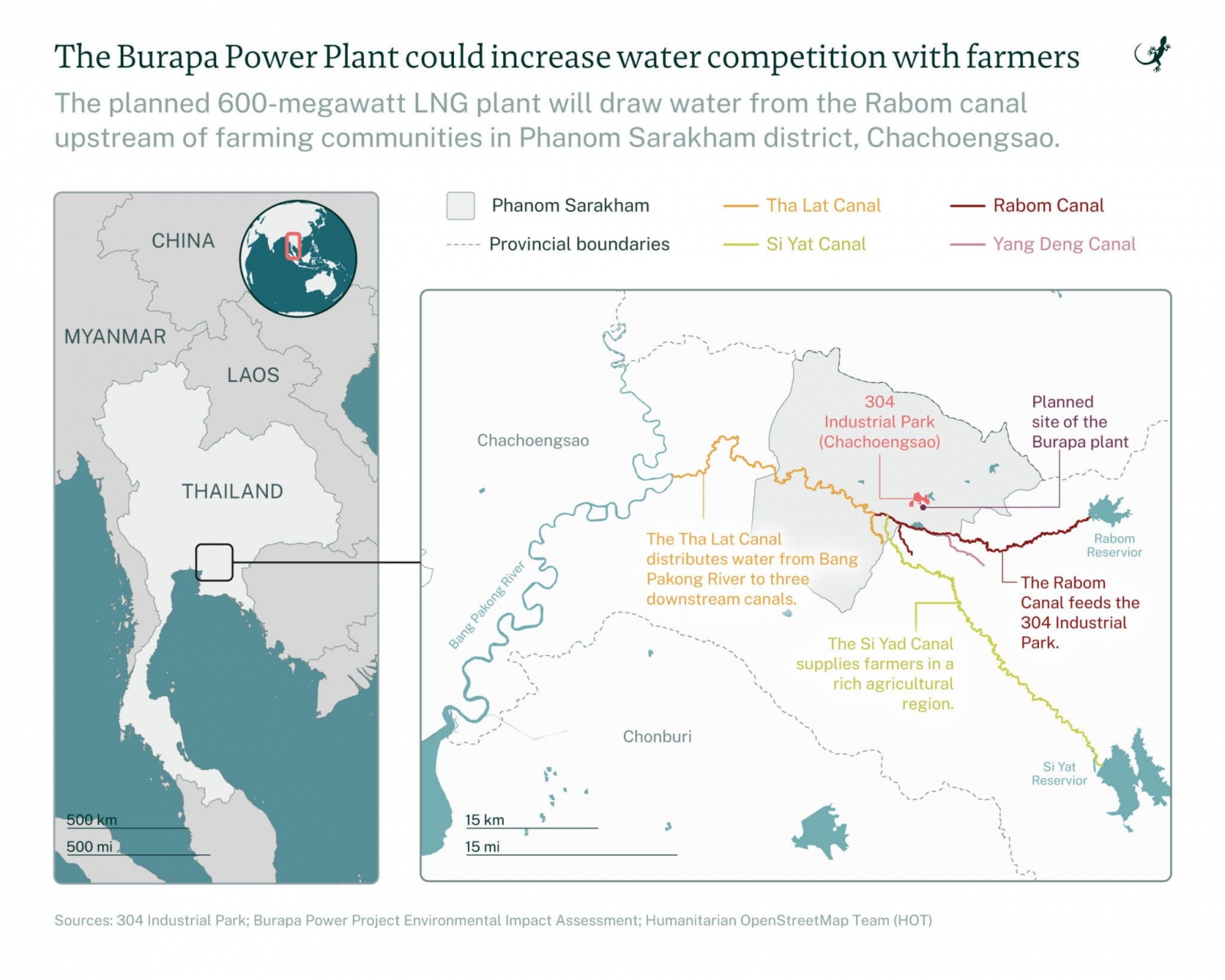
Map showing the flow of water from the Bang Pakong River through the Tha Lat canal, which feeds into a series of canals that farmers rely on, but that the Burapa power plant will have upstream access to. Image by Andrés Alegría/Mongabay.
An 18-year fight
Before it became the Burapa power plant, the project was the Khao Hin Son power station, a planned 600-MW coal-fired plant that stalled in the face of local opposition. According to Kan, the community’s tactics were learned from people opposing the Mae Moh power plant in Lampang province.
“We saw the impact on health, water, agriculture and the local communities” in Lampang, Kan said. “We didn’t want coal doing that to our community.”
After the coal plant had its EIA approved in 2009, the community turned to the National Health Commission Office, a government agency with a mandate to help communities carry out their own Community Health Impact Assessments (CHIA) when their health could be impacted by policy decisions.
The community’s study found the health impacts would be more far-reaching than what was flagged in the EIA, affecting their water, food security, livelihoods and health. EIAs are carried out by developers and aren’t meant to look as closely at public health.
After receiving the CHIA in 2012, Thailand’s Office of Natural Resources and Environmental Policy and Planning (ONEP) withdrew its approval for the 2009 EIA and required the developers to submit their own study of public health impacts, in the form of what’s known as an Environmental and Health Impact Assessment (EHIA). Between 2012 and 2017, ONEP rejected four EHIA submissions from the developers, National Power Supply and Double A. It seemed to be the end of the road for the power plant.
But the project soon received a new lease on life. In 2019, National Power Supply requested to switch the fuel source from coal to LNG. The following year, Gulf Development, one of Thailand’s largest conglomerates, bought a 35% stake in the project. In January 2021, ONEP approved a new EIA for the plant, now known as the Burapa power plant.
Kan says the community lacked information to effectively challenge the 2021 EIA before it was approved. Three months before the EIA was set to expire after five years, the Energy Regulatory Commission approved a license for the project on Oct. 15, 2025 — exactly one week before the commission was due to meet with community members to hear their grievances, according to activists.
In response, about 30 members of Chachoengsao RE-Power marched some 125 km (78 mi) to Bangkok, where they submitted a petition arguing against the plant to the National Energy Policy Committee.
“We walked from Chachoengsao to Bangkok for six days because I’ve known about this project for 18 years, back when it was supposed to be a coal power plant,” Pimjee Rakachaemkeat, a 29-year-old farmer, told Mongabay at the handover event.
Pimjee was just a child when the project was announced, but joined the march because she said she felt the developers weren’t listening to her community’s concerns over water and air pollution.
“Almost every year, the farmers of Chachoengsao are told [by the authorities] to stop working on agriculture, because there’s a water shortage,” she said. “The Burapa project is a fossil fuel power plant, so these impacts will be far worse, which is why we have to oppose it.”
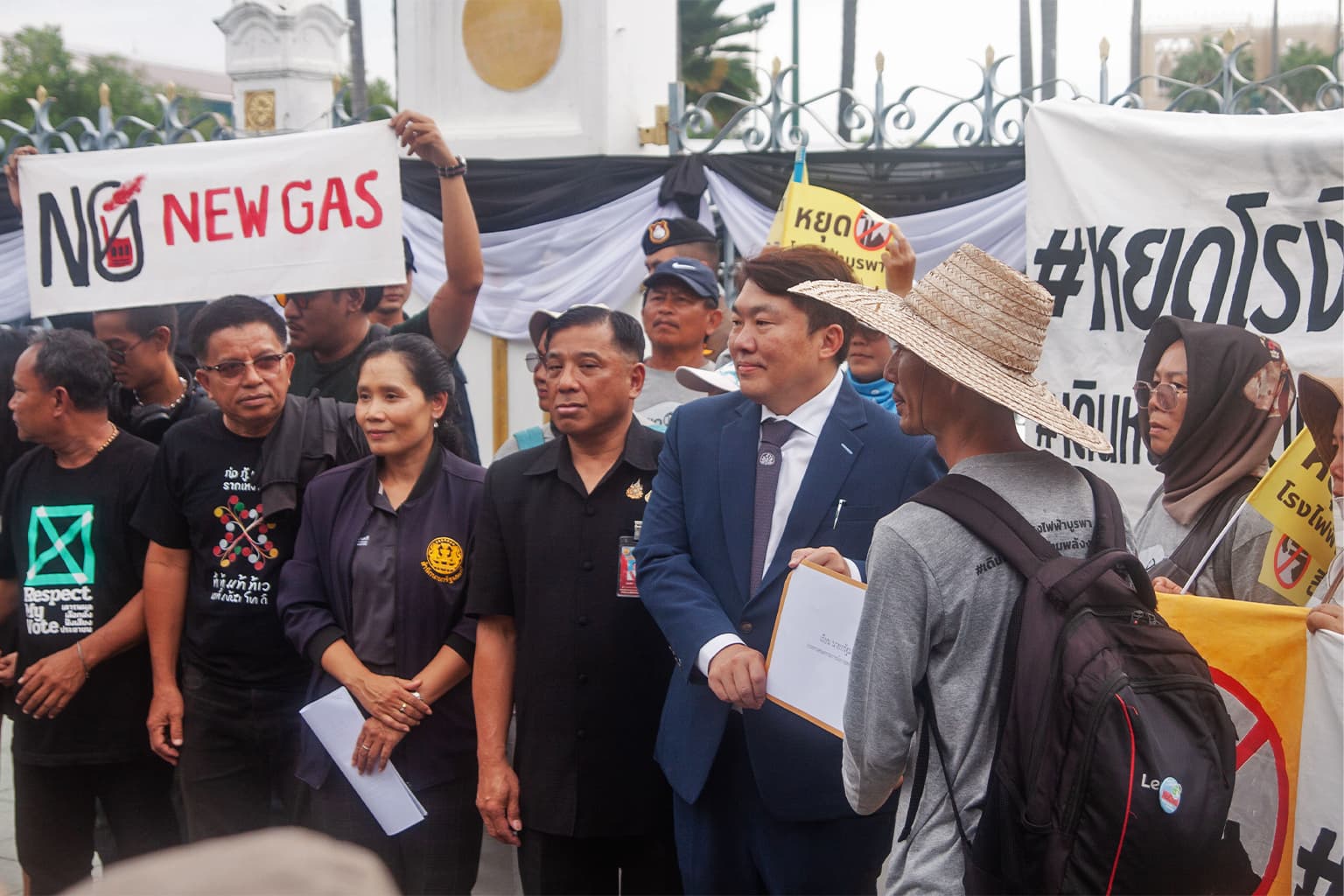
A representative of the Prime Minister’s Office receives a petition from Kan Thatiyakhun at the end of the Chachoengsao RE-Power group’s march to Bangkok on Nov. 6, 2025. Image by Gerald Flynn/Mongabay.
Air and land
It’s not just water — farmers say they also fear the Burapa plant could sully the air. Suphut said that since National Power Plant 3, which runs on biomass, came online in the 304 Industrial Park, air pollution has spiked.
“My trees are covered by fine dust, so I worry that it will affect my farm, my health, especially my breathing,” he said.
Air pollution in Thailand causes an estimated 32,200 premature deaths annually, according to a 2024 study.
But the Burapa power plant’s EIA suggests various forms of environmental monitoring will be conducted within a 5-km (3-mi) radius of the plant site, deeming areas across Khao Hin Son, Khu Yai Mi, and Ko Khanun subdistricts as environmentally sensitive. Data from the Ministry of Agriculture and Cooperatives, shared online by Kan, suggest nearly 19,700 hectares (48,700 acres) of farmland fall within this area, producing crops worth more than $35 million per year, as of 2024 prices.
Nathawan, the organic produce collective manager, told Mongabay that a decade ago there were the equivalent of around 11,200 hectares (27,700 acres) of mango farms in her collective, but now only 2,720 hectares (6,720 acres) remain. Farmers, she said, have cut down their trees due to worsening air pollution and droughts.
Community activists are well aware that Gulf, one of Thailand’s largest conglomerates, has sued several of its critics for defamation.
“We all need to be careful,” Kan said.
The plant’s planned transmission line corridor, which would run 14 km (8.7 mi) at a width of 60 meters (200 ft), has also led to a land dispute between the Electricity Generating Authority of Thailand (EGAT) and at least 62 stakeholders in Chachoengsao, some of whom, according to Kan, have launched appeals cases against EGAT in courts in Rayong province and in Bangkok.
“We wouldn’t be able to grow anything that could affect the poles — no eucalyptus, no bananas, no pepper,” said Chamriang, a farmer involved in the dispute.
A spokesperson for EGAT told Mongabay negotiations remained ongoing.
How much gas is enough?
Opponents of the Burapa project also point to Thailand’s energy surplus, arguing the new plant is unnecessary.
This year’s peak electricity demand reached 36,759 MW in April, while nationally 53,257 were available, according to government sources.
Despite strong reserves, the government is proceeding with plans to build a third LNG terminal, even though imports aren’t expected to exceed the annual capacity of the existing two terminals.
Chachoengsao already has more than 30 power plants. Last year, authorities postponed Burapa’s opening from 2027 to 2029, fearing an oversupply of electricity.
A fisher pulls in their nets in front of the 3,248 MW Bang Pakong Power Plant in Chachoengsao province, Thailand, on Monday, Feb. 2, 2026. The power plant is one of many operational facilities across the Eastern Economic Corridor already consuming water. Image by Andy Ball for Mongabay.
Thailand’s gas usage also has environmental costs. The plants emit large volumes of toxic air pollutants, such as nitrogen oxides, sulfur dioxide and fine particulate matter smaller than 2.5 micrometers, known as PM2.5, according to the Centre for Research on Energy and Clean Air.
Thailand views gas, which now makes up 65.5% of its energy mix, as a bridge fuel to facilitate its transition to renewable energy, and plans to reduce its share of the energy mix to 41% by 2037. But expanding LNG infrastructure risks locking the country into fossil fuel dependence and slowing down the green transition, warns Lam Pham, an analyst at energy think tank Ember.
“A faster shift toward renewable energy would provide greater long-term security, affordability, and sustainability for Thai people,” he said.
In Phanom Sarakham district, many farmers continue to question the rationale behind yet another LNG plant.
“It’s been 18 years since we started this fight,” Kan said. “We’ve tried to show the authorities that problems from natural gas are a problem for us [and] all of these problems remain, so why are they building this new power plant?”
Author: Gerald Flynn
This article was originally published on Mongabay under the Creative Commons BY NC ND licence. Read the original article.