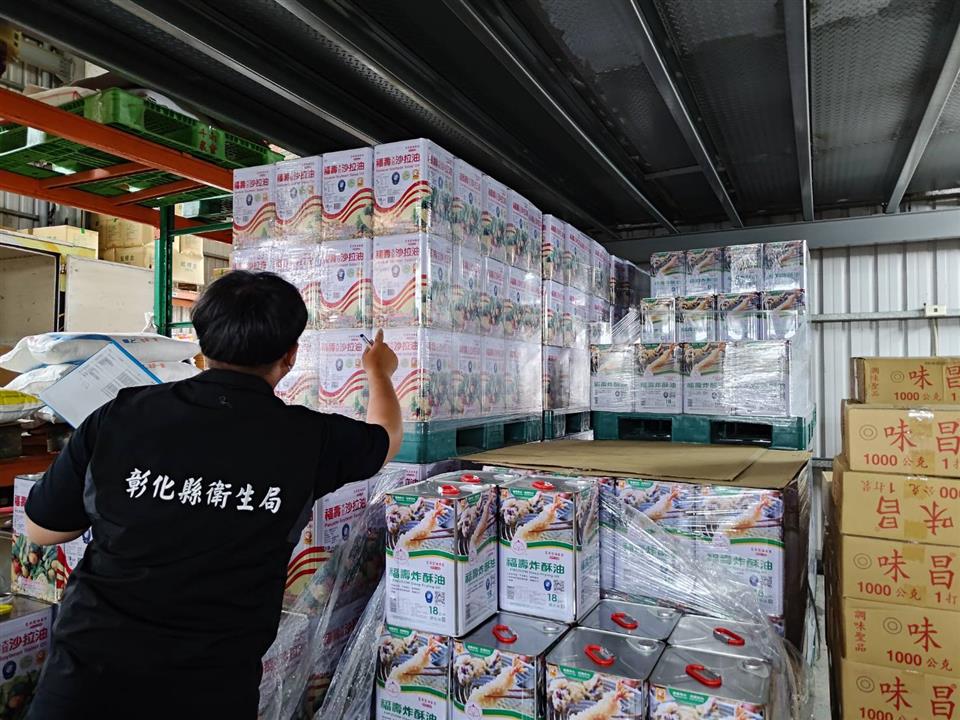
The volume of contaminated cooking oil converted into biodiesel is still being assessed. Any oil diverted for fuel use will be dyed to prevent it from re-entering the food supply. (Source: Changhua County Public Health Bureau)
Taiwan’s investigation into Central Union’s benzo[a]pyrene (BaP) contamination is ongoing. Authorities have traced about 1,300 metric tons of affected soybean oil to Formosa Oilseed Processing (588 metric tons), Fwusow Industry (421 metric tons) and Taisun Enterprise (291 metric tons). The contamination has also affected a range of downstream products and distribution channels, prompting product recalls across the market. Most of the recovered oil is expected to be converted into biodiesel or other industrial fuels.
After the contamination was uncovered, Taisun Enterprise announced on July 7 that it would convert 10 metric tons of the affected oil into biodiesel in accordance with Taiwan’s regulations. On July 24, Central Union’s shareholders — Taisun Enterprise, Fwusow Industry and Formosa Oilseed Processing — announced that all cooking oil products manufactured between April and June would be recalled, with the recovered oil to be processed into biodiesel or fuel oil in accordance with regulations.
Taisun Enterprise Chairman Liu Wei-long (劉偉龍) said the company would fully disclose where the recovered products are sent and how they are treated. “All of it will be converted into biodiesel or fuel oil and handled in accordance with waste disposal regulations,” he said.
How contaminated cooking oil is recycled into biodiesel
On July 24, Taiwan’s Food and Drug Administration (TFDA) confirmed that seven batches of affected products must remain under recall, while 19 batches that met safety standards were cleared for sale. Despite the clearance, Taisun Enterprise, Fwusow Industry and Fomosa Oilseed Processing said they would not return any of the affected batches to the market.
The Taichung City Government also estimated that more than 364 metric tons of recalled oil had been collected and would be converted into biodiesel and other fuels.
Unlock the full article to explore three key takeaways:
- Cooking oil from the Central Union Oil Corp. scandal can be converted into biodiesel after completing Taiwan’s legally required collection, treatment and recycling procedures.
- Industry sources say soybean oil is unlikely to qualify as a sustainable aviation fuel (SAF) feedstock under current international certification schemes because soy is considered a first-generation food crop.
- Taiwan currently has six licensed biodiesel producers and importers. About half of the country’s biodiesel is exported, while the remainder is sold domestically, making biodiesel the primary outlet for recycled waste cooking oil.