.jpg)
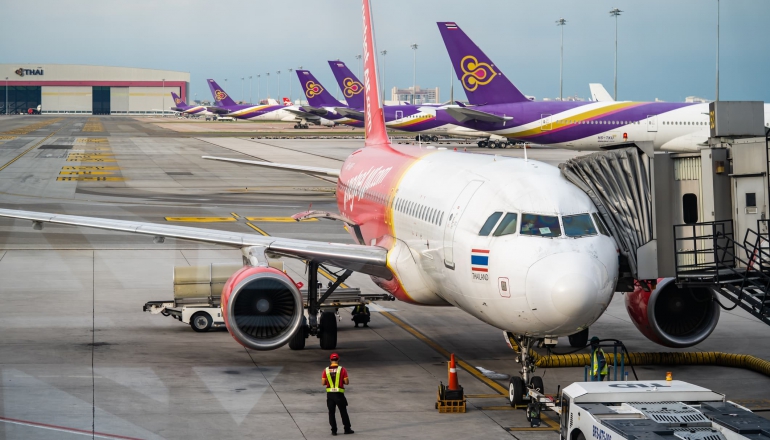
As the European Union moves to extend carbon pricing to international aviation, Asian airlines and exporters are preparing for higher compliance costs. (Photo: STARLUX)
RECCESSARY and EnergyOMNI will co-host the New Energy & Carbon Market Business Strategic Forum in Taipei on Aug. 20–21, bringing together industry leaders and experts to discuss the latest developments in corporate decarbonization. At the forum, Hilary Lu (呂佩玲), Chief Sustainability Officer at STARLUX Airlines, will share how sustainable aviation fuel (SAF) can serve as a practical Scope 3 decarbonization tool for corporations. Register here.
The European Union’s move to extend carbon pricing to international aviation is forcing Asian carriers to plan for a regulatory framework that remains unsettled, with the industry facing the possibility that today’s relatively low-cost global offsetting system could eventually give way to the much more expensive EU carbon market.
On July 17, the European Commission published its long-awaited revision to the EU Emissions Trading System, proposing that international flights arriving in Europe from destinations within 5,000 kilometers face carbon costs from 2029.
The proposal also includes a trigger clause with potentially greater consequences for Asian airlines. If the Carbon Offsetting and Reduction Scheme for International Aviation, or CORSIA, is deemed insufficient to deliver meaningful emissions reductions by 2032, the Commission would be required to propose extending the ETS to all international flights departing Europe.
Most direct Asia-Europe routes would remain outside the initial 5,000-kilometer scope, making the 2032 Review the more consequential threshold for carriers planning long-haul services, fleet investments and future carbon compliance strategies.
The timing is significant for STARLUX Airlines, which will launch its first European long-haul route, Taipei-Prague, in August as the EU and the International Civil Aviation Organization (ICAO) debate which system should govern its future carbon liabilities.
A negotiating move, not a final answer
ICAO has urged member states to maintain a globally harmonised approach and avoid duplicative regional measures, while the International Air Transport Association (IATA) has opposed the prospect of airlines being caught between overlapping carbon pricing systems.
The EU, meanwhile, has presented broader ETS coverage as a way to encourage stronger participation and enforcement under CORSIA, rather than necessarily as a framework it intends to operate alongside the global scheme indefinitely.
.jpg)
For airlines, the central concern is therefore not simply which system applies, but whether the same emissions could generate liabilities under both.
“As long as there is alignment between the two systems rather than parallel independent calculations, that should be workable,” Hilary Lu (呂佩玲), Chief Sustainability Officer at STARLUX, told RECCESSARY.
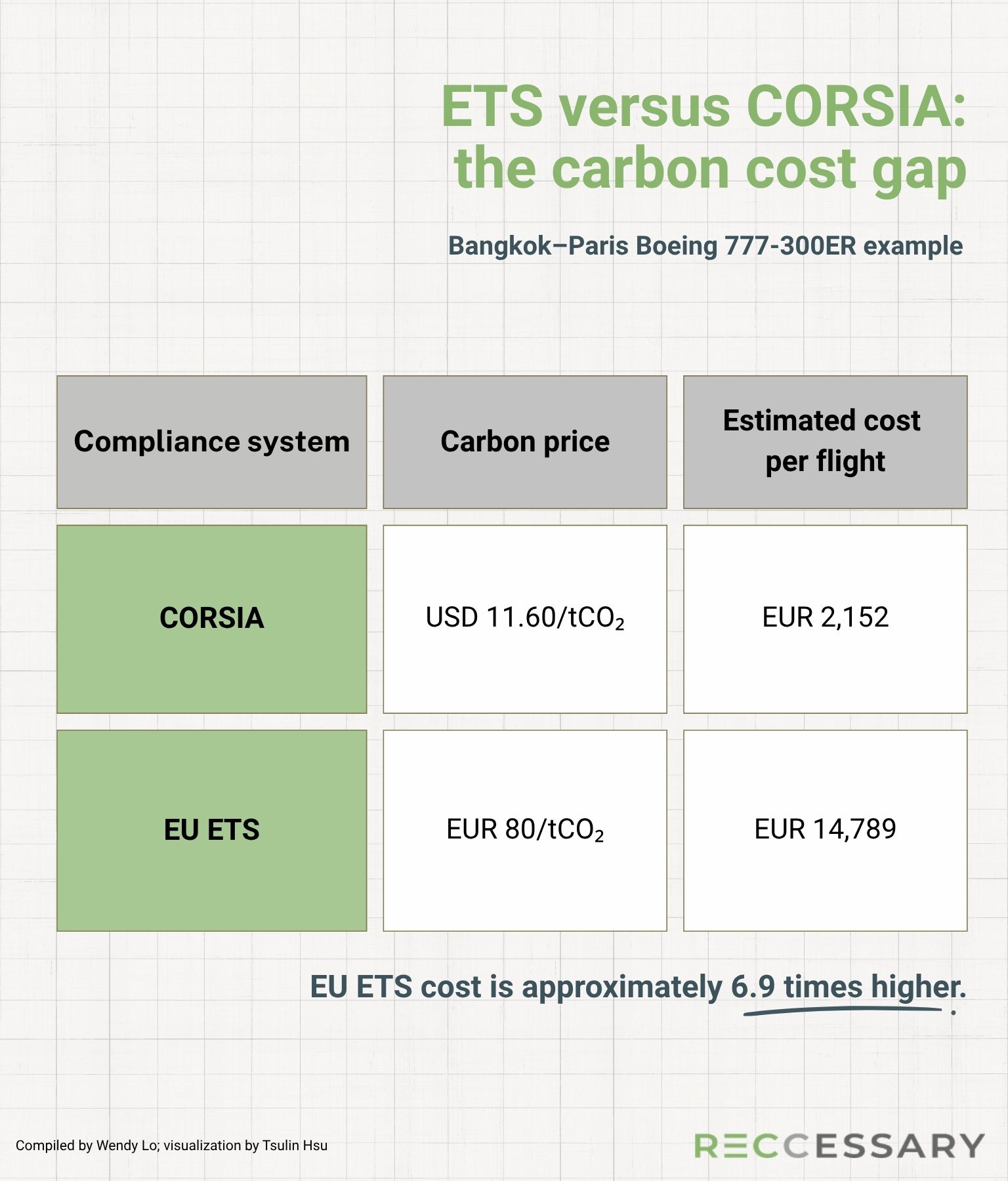
The wide gap between the two systems’ carbon prices makes that concern commercially significant. CORSIA Phase 1 spot credits were assessed at around USD 11.60 per tonne in mid-July, down from roughly USD 20 per tonne late last year, while EU ETS allowances were trading at around EUR 80 (USD 90.95) per tonne over the same period.
The difference is visible in individual route economics. A Boeing 777-300ER flying Bangkok-Paris burns about 60 tonnes of jet fuel and emits 189.6 tonnes of carbon dioxide. At current prices, covering those emissions would cost roughly EUR 14,789 under the ETS, compared with EUR 2,152 under CORSIA, according to RECCESSARY carbon market analyst Sherry Hu. Overlap or a shift to full ETS coverage could therefore materially increase Asia-Europe operating costs.
Airlines weigh when and how to secure CORSIA credits
Whether CORSIA can become the single global framework preferred by the aviation industry depends heavily on participation, but several major aviation markets remain outside the scheme’s voluntary phases.
China and India, two of the largest sources of international aviation emissions, have not joined CORSIA, while the United States has signalled a broader retreat from international climate commitments under the current administration.
Together, these absences create structural gaps in the scheme’s coverage and complicate its credibility as a comprehensive global solution, strengthening the EU’s argument that additional regional action may eventually be necessary.
Under CORSIA, airline offsetting obligations are calculated using an industry-wide sector growth factor based on emissions above the scheme’s baseline. As CORSIA enters its second phase in 2027 and participation becomes mandatory for most ICAO member states, the number of covered routes and the volume of emissions subject to offsetting are expected to increase.
For newer airlines such as STARLUX, which did not operate in 2019, there is no historical airline-level baseline to reference. Its future obligations will instead depend on the wider growth of international aviation covered by the scheme, making the eventual volume and cost of required credits difficult to forecast.
Lu said STARLUX is monitoring how Taiwan’s larger international carriers, such as EVA Air and China Airlines, manage their Phase 1 obligations before finalizing its own procurement strategy. Both carriers already face CORSIA offsetting requirements, which she estimated could amount to tens of thousands of tonnes each.
STARLUX’s first material compliance deadline is expected to come later because CORSIA Phase 2 covers emissions from 2027 to 2030, followed by settlement and credit cancellation. Lu said the airline’s first significant obligation is therefore likely to emerge around 2031.
Rather than purchasing credits in advance, STARLUX plans to wait until the supply, eligibility and pricing outlook becomes clearer.
“The supply and demand picture at that point will be very different from today,” Lu said. “We would rather wait and assess the market closer to the deadline.”
Waiting reduces the risk of buying credits that later become ineligible, but it could leave the airline exposed if demand rises sharply after mandatory participation expands from 2027.
Hu noted that if airlines procure credits at the same time, concentrated demand could push prices higher, with the increase likely to be passed through to freight rates via fuel surcharges. Exporters could therefore feel the impact before the 2032 ETS trigger is activated.

SAF supply is available, but demand remains stalled
Sustainable aviation fuel (SAF) provides airlines with a parallel way to reduce their CORSIA liabilities, as verified lifecycle emissions reductions can be deducted from the amount of carbon that must be offset.
STARLUX began incorporating SAF in 2025 and currently maintains a 2% usage target. Lu said the airline has deployed SAF opportunistically, including using stockpiled volumes when conventional jet fuel prices were high, allowing it to manage total fuel costs rather than treating SAF solely as a compliance expense.
The wider SAF market remains constrained by weak purchasing incentives. Without mandates or demand guarantees, suppliers have little reason to scale production or lower premiums, while airlines remain reluctant to commit at prices well above conventional jet fuel.
The risk of purchasing SAF that ultimately delivers no compliance value also shapes airline procurement. Under CORSIA, SAF reductions only offset costs when an airline has an actual obligation in that period. If its growth remains below the sector-wide threshold, surplus reductions cannot be banked or sold. Airlines that stockpile SAF for compliance could therefore find that the investment does not translate directly into lower obligations, Hu said.
What this means for Southeast Asian manufacturers
Hu said the gap between ETS and CORSIA prices will not affect all products equally for Southeast Asia industrial players. She identified garments and textiles, furniture, consumer electronics, general machinery and some automotive components as the categories most likely to shift towards sea freight, multimodal transport or sea-air combinations if aviation carbon costs rise. These products are generally less time-sensitive, allowing freight savings to outweigh longer transit times.
Semiconductors, printed circuit boards and other high-value electronic components are likely to remain heavily dependent on air freight because their unit value and delivery requirements make switching modes less viable in the short term, Hu said.
She also warned that manufacturers face compliance risks beyond freight costs because CORSIA and the EU ETS use different eligible instruments.
CORSIA accepts ICAO-approved Eligible Emissions Units, while the EU ETS relies primarily on ETS allowances. A unit purchased for one system may not qualify under the other, potentially forcing companies to repurchase compliant instruments closer to a deadline.
For manufacturers with European export exposure, Hu said the more immediate planning horizon is 2027, when CORSIA Phase 2 begins and airline carbon costs are expected to rise as participation expands. Whether those costs flow through to freight rates will depend on how airlines structure surcharges and how quickly credit prices respond to higher demand.
The 2029 and 2032 EU thresholds would deepen the same pressure. Exporters will need to assess not only whether air freight becomes more expensive, but also whether route changes, additional stopovers and different carbon standards alter delivery times, procurement decisions and the competitiveness of Asia-Europe supply chains.