_Rooftop%20Solar%20(1).jpg)
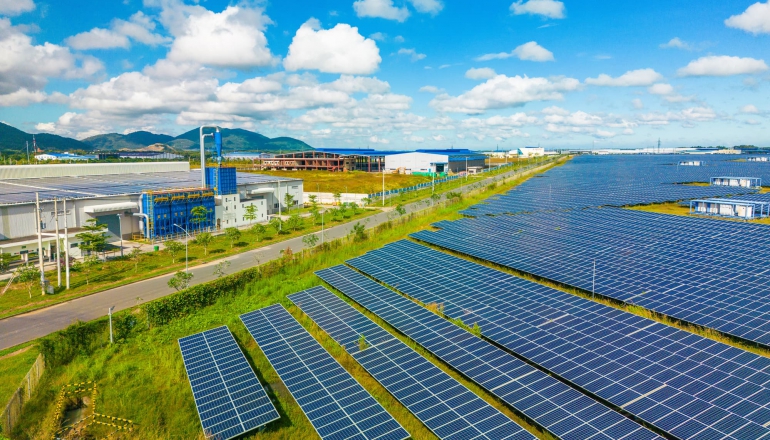
French developer GreenYellow is expanding solar and energy solutions for commercial and industrial customers in Vietnam. (Photo: GreenYellow)
As global manufacturers expand production across Southeast Asia, access to reliable renewable electricity is becoming an increasingly important factor in where companies choose to build factories. Multinational firms facing growing pressure to decarbonize supply chains are seeking locations where renewable power can be deployed quickly and at scale.
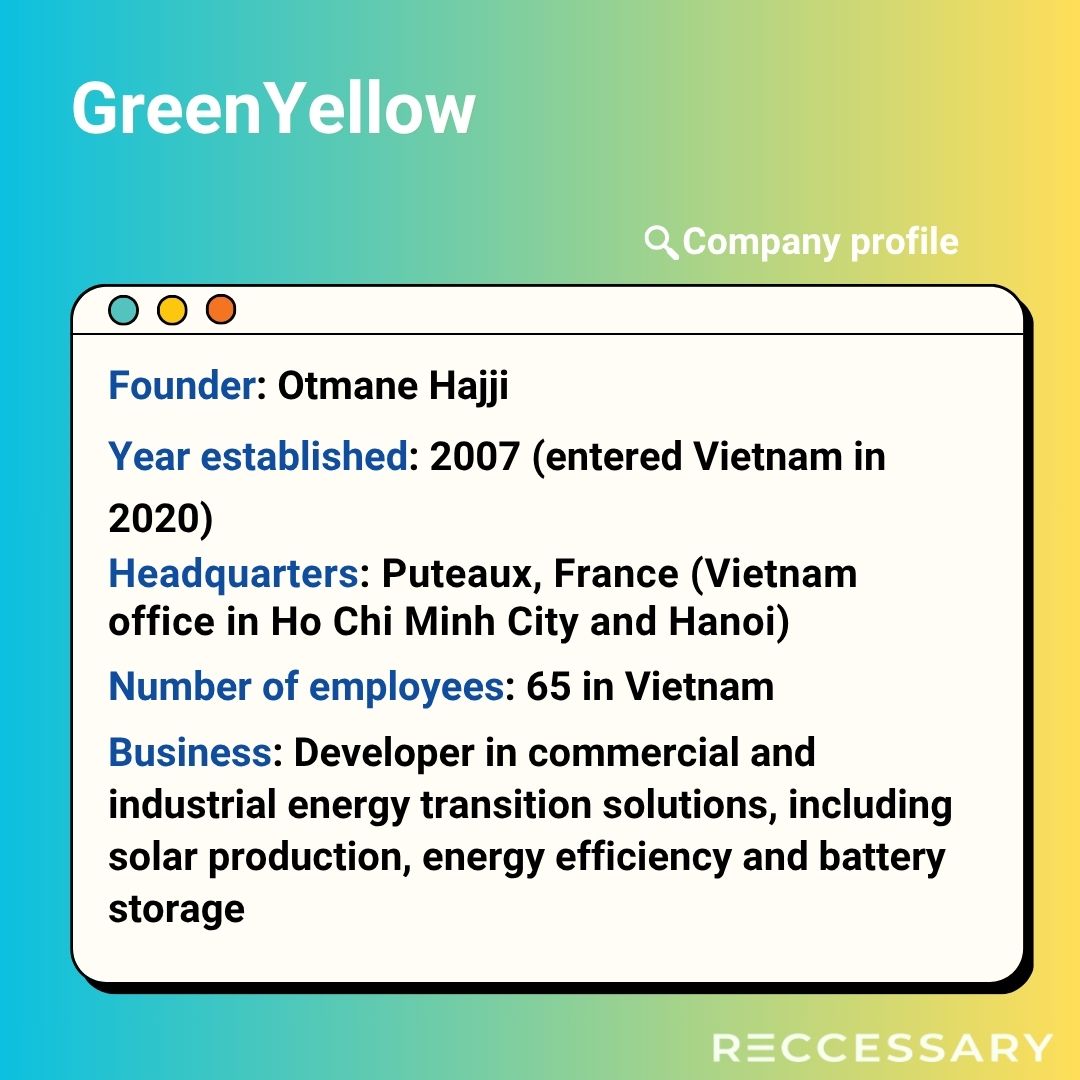
In Vietnam, developers are moving to meet that demand. Among them is French renewable energy company GreenYellow, which has built a growing portfolio of solar and energy solutions for commercial and industrial customers across the country.
The company currently operates over 200MW of solar capacity across more than 150 projects in Vietnam, primarily serving commercial and industrial clients. GreenYellow has positioned itself as a energy partner offering integrated turn-key solutions, combining solar PV production, energy efficiency upgrades, battery storage, and eventually, direct renewable power supply agreements.
In an interview with RECCESSARY, Nguyen Xuan Thang, General Director of GreenYellow Vietnam, discussed the company’s strategy for supplying renewable energy to manufacturers and how Vietnam’s market compares with Thailand, another key market for the developer.

GreenYellow Vietnam’s Nguyen Xuan Thang discussed renewable energy supply for manufacturers and Vietnam–Thailand market dynamics. (Photo: GreenYellow)
Following manufacturing investment
GreenYellow entered Vietnam in 2020, attracted by the country’s rapid manufacturing expansion and rising renewable energy demand from export-oriented industries.
Vietnam has emerged as one of Southeast Asia’s key production hubs, drawing large flows of foreign investment into electronics, consumer goods and industrial manufacturing. Many of these factories supply global markets where sustainability standards are tightening.
Export manufacturers require clean energy either to meet corporate decarbonization commitments or to satisfy expectations from international buyers and consumers. This demand has created opportunities for renewable developers working with industrial customers.
GreenYellow operates across several Southeast Asian markets, including Thailand and Vietnam, and the company sees the two countries as offering different advantages for renewable development. Vietnam’s renewable sector is relatively young and evolving rapidly, while Thailand’s market is more mature and stable, said Thang. For developers in Vietnam, the nascent environment “provides a lot of excitement and energy.”
A step-by-step strategy to support global manufacturers
GreenYellow’s approach in Vietnam focuses on gradually increasing the share of renewable electricity used by factories. The process typically begins with rooftop solar installations on factory buildings. Industrial facilities often provide large roof areas suitable for solar panels, allowing companies to generate electricity directly at their sites.
However, rooftop solar alone usually supplies only a limited share of a factory’s electricity demand. In most cases, rooftop systems provide between 5% and 15% of total electricity consumption.
To expand the role of renewable power, GreenYellow combines solar installations with additional energy measures. Energy efficiency improvements form the second component of the strategy. These may include upgrading machinery or optimizing industrial processes to reduce electricity consumption. Lower overall demand increases the proportion of electricity that can be supplied by renewable sources.
.jpg)
GreenYellow helps manufacturers improve energy efficiency, increasing the share of electricity supplied by renewable sources. (Photo: GreenYellow)
The third step involves battery energy storage systems. Storage allows companies to store excess solar power generated during the day and use it later when electricity demand rises or grid prices increase. Rapid advances in battery technology have made it possible to deploy storage economically even for relatively small commercial and industrial facilities.
Container-sized battery units can now be installed alongside rooftop solar systems, creating hybrid solutions that help companies manage both electricity costs and power reliability, Thang noted.
Beyond sustainability goals, electricity reliability remains a key concern for manufacturers. Vietnam has experienced periods of power shortages in recent years, and for factories operating continuous production lines even short disruptions can lead to significant financial losses. Hybrid energy systems combining solar power, battery storage and backup generators are increasingly seen as one way to manage these risks, said Thang.
Many of GreenYellow’s clients are multinational manufacturers producing goods for global supply chains. Major electronics manufacturers such as Quanta Computer and consumer goods companies such as Unilever have worked with the developer to install rooftop solar systems at factories. These projects represent an initial step toward broader renewable energy adoption.
.jpg)
Quanta Computer has worked with GreenYellow to install rooftop solar systems at factories in Vietnam. (Photo: GreenYellow)
Thang said factories built for global brands are often designed with long-term renewable electricity targets in mind, with the goal of operating on 100% renewable electricity over time. While rooftop solar cannot meet the full power requirements of large industrial operations, GreenYellow also aims to supply the remaining renewable electricity through off-site projects connected to factories via power purchase agreements.
Vietnam’s DPPA bottlenecks
Despite strong demand from manufacturers, renewable developers in Vietnam still face several regulatory challenges. Although Vietnam has introduced policies aimed at enabling direct power purchase agreements (DPPA), Thang said some elements of the framework are still under development.
The DPPA model includes two main structures. Under a physical PPA, renewable energy projects connect directly to an industrial customer. A virtual DPPA, by contrast, allows electricity to be transmitted through the national grid from a generation site located elsewhere.
One concern relates to price caps on negotiated electricity contracts. While developers and industrial clients are allowed to negotiate power prices, these agreements cannot exceed a government-imposed ceiling, which Thang said can affect project economics.
Another consideration is uncertainty over grid charges for virtual DPPAs. Greater clarity on wheeling fees and other grid-related costs would help developers better assess the feasibility of projects, said Thang.
The pricing uncertainty Thang raised reflects a broader structural problem in how grid costs are allocated. Legal advisors have identified a potential overlap where infrastructure charges appear both in DPPA pricing formulas and in the capacity fees EVN began piloting in October 2024 for large industrial users. This double-charging risk can push total virtual DPPA costs above standard retail tariffs, removing the cost advantage that typically motivates corporate buyers to sign long-term renewable contracts.
A September 2024 survey by the Asia Clean Energy Coalition found that around half of corporate buyers expect virtual DPPA costs to exceed EVN’s standard tariffs once transmission, balancing and system service fees are included.
Vietnam’s government has taken steps to address some of these constraints. Resolution 253, passed in December 2024, allows physical DPPAs using private transmission lines to negotiate electricity prices freely, effectively removing the price caps Thang referred to. The resolution also expands eligible buyers to include electricity retailers, enabling demand aggregation across industrial parks and export-processing zones.
However, these changes apply only to physical DPPAs. Virtual DPPAs, which are often more practical for manufacturers operating across multiple sites, still face the grid-related uncertainties highlighted by Thang.
Thang suggested that Vietnam’s renewable strategy could evolve toward a 2-tier system. While the national utility EVN is expected to continue its role in controlling the centralized backbone transmission and distribution infrastructure, the renewable energy sector could become a second tier, more decentralized, allowing greater flexibility for manufacturing investments scatter around the country with direct access to nearby renewable energy resource and direct negotiations with their developers.
Such an approach could help accelerate deployment, particularly in the commercial and industrial segment. Government plans call for around 2.6GW of rooftop solar to be installed by 2030, which would require the development of thousands of projects across factories and industrial sites. However, Thang noted that achieving this target will depend on a range of factors, including streamlining administrative processes.
“If developers have to go through multiple layers of approvals for each project, it will be very difficult to scale,” he said.
A crowded market with plenty of opportunities
GreenYellow expects its growth in Vietnam to continue through a combination of new projects and deeper engagement with existing clients. Many of the company’s current customers have only begun their transition toward renewable energy, Thang sees significant potential in expanding services to existing clients as technology costs fall and policy frameworks mature.
Vietnam’s renewable energy ambitions are substantial, with government plans calling for significant solar capacity expansion over the coming decades. For developers focused on the commercial and industrial segment, the market remains large enough to accommodate multiple players.
When asked about competitors in Vietnam, Thang pointed to European companies such as TotalEnergies and EDF, alongside regional developers including Thailand’s GULF and Singapore’s Sembcorp, as well as local firms such as VinEnergo. However, he said the growing number of participants has not necessarily translated into intense competition, given the scale of opportunity in the market.
At the same time, companies are preparing for the eventual rollout of direct power purchase agreements, which could enable larger renewable projects dedicated to supplying industrial customers. Vietnam is a long-term market to invest in that requires developers to “be patient and stick around,” Thang said.
Corporate demand is also expected to shape the direction of Vietnam’s energy policies. Multinational manufacturers have already signaled the importance of renewable electricity access when making investment decisions.
“Major multinational companies made it very clear from the start that if the country cannot provide 100% renewable energy, they will go somewhere else,” he said.
Vietnam vs. Thailand competitiveness' series
- Energy as a competitive lever: How Vietnam, Thailand compete for green manufacturing investment
- Energy as a competitive lever: How GreenYellow is building renewable energy solutions for manufacturers in Vietnam
- Energy as a competitive lever: WHAUP integrates green power and infrastructure for industrial growth
- Energy as a competitive lever: CCET navigates renewable opportunities and constraints in Thailand
- Why Vietnam’s rapid rise and Thailand’s slower growth tell different investment stories
- How Thailand and Vietnam’s power reforms will reshape corporate energy strategy
- Execution over incentives: Thailand and Vietnam’s structural investment shift
RECCESSARY’s upcoming webinar, “Beyond ASEAN: Mastering Decarbonization Strategy in Thailand & Vietnam,” will take place on April 21.
The session will unpack net-zero regulations, CBAM readiness, green power procurement strategies, and what lies ahead for low-carbon manufacturing across Vietnam and Thailand.
Seats are limited. Register now.