.jpg)
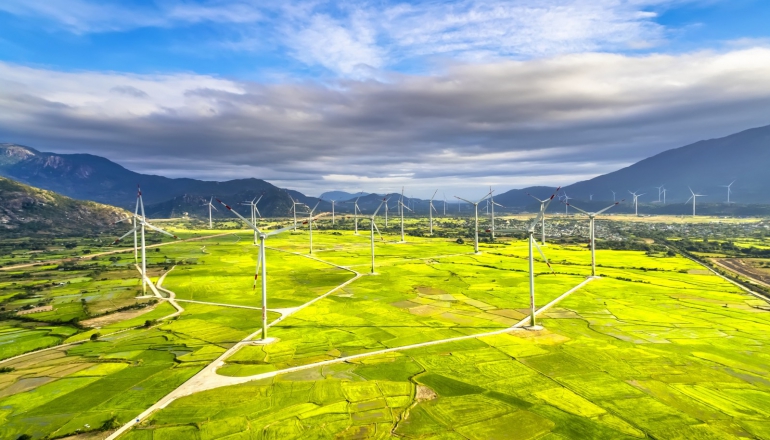
Renewable energy growth will significantly affect power costs for companies in Vietnam and Thailand. (Photo: iStock)
AI-led data center investments and Southeast Asia’s manufacturing boom are intensifying corporate concerns over power supply security and electricity prices. Thailand and Vietnam are both preparing to roll out new power sector policies in 2026, moves expected to reshape national power systems, accelerate renewable energy deployment and influence electricity prices and the broader power market. The changes will have material implications for corporate energy strategies and cost management.
ASEAN power prices show wide dispersion
Electricity prices across ASEAN vary widely. Data from GlobalPetrolPrices show that Singapore recorded an average commercial electricity tariff of USD 0.269 per kilowatt-hour (kWh) over the past three years, the highest in the region. The Philippines, Malaysia, Thailand and Myanmar follow, with prices ranging between USD 0.10 and USD 0.15 per kWh. Vietnam and Indonesia remain at the lower end, at around USD 0.07 per kWh, while data for some ASEAN members are not publicly available.
Singapore’s commercial power prices, above USD 0.20 per kWh, are comparable to those in other developed economies. Tariffs in Malaysia, ranked third, through to Myanmar sit broadly in the global mid-range. Power price differentials reflect variations in income levels, energy market structures, infrastructure development, and government pricing policies. For corporates, tracking long-term trends is essential to formulating energy procurement and decarbonization strategies.
Energy expert Supa Waisayarat told RECCESSARY that, compared with Singapore and the Philippines, electricity tariffs in Vietnam and Thailand remain among the lowest in Asia. This continues to underpin both countries’ competitiveness as manufacturing bases, particularly for export-oriented industries.
Waisayarat is an adviser to Thailand-listed renewable energy developer Super Energy Corp. and focuses primarily on the Thai and Vietnamese markets.

Retail tariffs rising, but at different speeds
A closer look at average retail electricity tariffs shows diverging trajectories in Vietnam and Thailand. Vietnam’s tariffs rose steadily between 2023 and 2025, with four adjustments over three years—3%, 4.5% and two consecutive hikes of 4.8%—bringing current tariffs to around USD 0.085 per kWh. In Thailand, where retail tariffs are relatively higher, price fluctuations have been more limited, with tariffs capped at around USD 0.13 per kWh since September 2023.
A report by CASE (Clean, Affordable and Secure Energy for Southeast Asia), a German-funded programme, attributes Thailand’s higher average retail tariffs partly to the absence of broad-based government subsidies. However, given Thailand’s heavy reliance on imported natural gas, the government has stepped in with price support measures or payment flexibility when surging global gas prices threaten electricity affordability. Experts note that such interventions can at times expose state-owned utility EGAT to liquidity constraints.
By contrast, Vietnam has long subsidised domestic coal supply and maintained retail tariffs below cost recovery, resulting in recurring losses for state utility EVN. These financial strains have weighed on grid expansion and slowed the pace of renewable integration. While consumers benefit from low electricity prices, prolonged price suppression risks undermining service quality over time.
In both Vietnam and Thailand, electricity prices do not purely reflect market fundamentals. Despite rising generation costs, governments have sought to limit pass-through to end-users to secure public support and maintain investment appeal.
Siripha Junlakarn, a researcher at Chulalongkorn University’s Energy Research Institute, told RECCESSARY that electricity pricing would be a more salient political issue than renewable energy in Thailand’s early-2026 election cycle. Power prices affect households as much as businesses, she said, adding that a cost-reflective tariff would be closer to THB 6 per kWh (around USD 0.19), compared with the current level of about THB 4 per kWh (USD 0.13).
Industry participants nonetheless expect Thailand’s electricity tariffs to drift higher over the long term. Supa Waisayarat noted that the scale of investment required for energy storage, grid upgrades and firming capacity makes an upward drift in average system costs more likely than a structural decline.
Policy reforms to redefine renewable energy economics
Across ASEAN, power sector decarbonization is increasingly seen as central to achieving national net-zero targets. Vietnam is moving ahead with the Revised Power Development Plan VIII (Revised PDP8) and plans to introduce a two-component tariff in 2026. Thailand’s long-delayed new Power Development Plan (PDP) is also expected to move forward this year, with the post-election political landscape removing excuses for further delays.
Under Vietnam’s planned two-component tariff, electricity bills will be split into capacity and energy charges to better reflect system costs and market fundamentals. Some market participants expect headline tariffs to fall sharply under the new framework, with reductions of up to 35% from current levels.
EVN said the proposed new pricing mechanism for large electricity users aims to encourage more efficient power use. Under the scheme, users’ electricity bills are expected to fall if they reduce peak demand, even if total consumption remains unchanged. The move is also intended to ease pressure on the national power grid.
Calculations show that for a manufacturing firm with monthly electricity consumption of 200,000 kWh and with a peak power of 500 kW, power costs could fall by 4.55%—equivalent to savings of about 20 million Vietnamese dong (around USD 765) per month.
While lower electricity costs would be a major boon for large power users, they could undermine incentives for the transition to renewable energy. Vietnam’s Institute of Energy said that if the new pricing mechanism is widely applied to industrial and commercial users, it could reduce the need for additional power generation and grid investment by tens of trillions of dong.
Eta Tsai, vice president of international development at Taiwan-based renewable solutions provider Greenrock Energy, cautioned that sharply lower tariffs could dampen corporate appetite for renewable power procurement and squeeze margins for project developers, contributing to the market’s wait-and-see sentiment.
He added, however, that the 35% reduction is a long-term policy target and that adjustments are likely during the pilot phase.
Supa Waisayarat argued that the two-component tariff could mark a milestone for Vietnam’s renewable energy market. Greater cost transparency could improve the bankability of utility-scale projects, particularly capital-intensive, long-payback wind projects, while also creating new opportunities for storage, hybrid renewable systems and behind-the-meter solutions.
In Thailand, Siripha Junlakarn said the levelised cost of electricity (LCOE) for self-consumption solar PV is around THB 2 per kWh (about USD 0.064), which is cheaper than buying electricity from the grid, giving companies a clear incentive to invest.
However, she argued that the updated PDP still lacks policy clarity and does not envisage as high a share of renewables as market participants had hoped.
While Thailand is home to several large and capable renewable developers, policy and regulatory constraints continue to weigh on market development.
“Delays to the PDP update and the slow progress of the direct power purchase agreement (DPPA) framework have pushed many Thai developers to expand into Vietnam and other regional markets, " she added, “Vietnam, however, faces its own challenges, with grid constraints posing a material risk to renewable project deployment.”
As Vietnam and Thailand approach pivotal power sector reforms, experts point to policy stability, grid reliability, supply chain readiness and international compliance requirements as key determinants of corporate renewable energy adoption.
Despite near-term uncertainties over tariffs and market design, the structural shift towards low-carbon power is clear, and both governments are expected to intensify efforts to attract investment into clean energy.
'Vietnam vs. Thailand competitiveness' series
- Energy as a competitive lever: How Vietnam, Thailand compete for green manufacturing investment
- Energy as a competitive lever: How GreenYellow is building renewable energy solutions for manufacturers in Vietnam
- Energy as a competitive lever: WHAUP integrates green power and infrastructure for industrial growth
- Energy as a competitive lever: CCET navigates renewable opportunities and constraints in Thailand
RECCESSARY’s upcoming webinar, “Beyond ASEAN: Mastering Decarbonization Strategy in Thailand & Vietnam,” will take place on April 21.
The session will unpack net-zero regulations, CBAM readiness, green power procurement strategies, and what lies ahead for low-carbon manufacturing across Vietnam and Thailand.
Seats are limited. Register now.