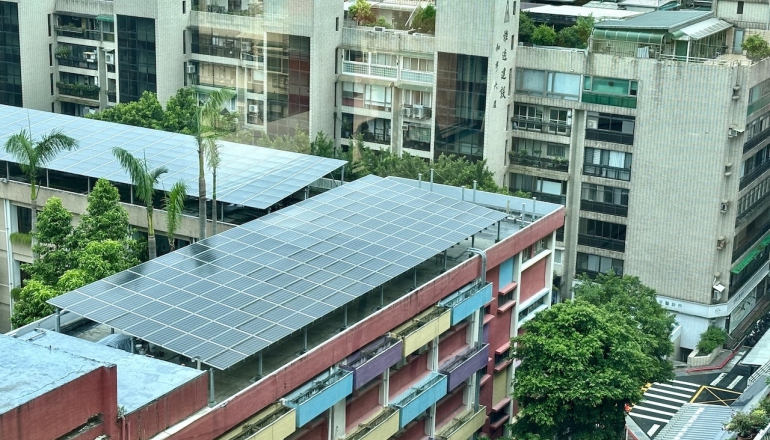
As growth in Taiwan’s solar industry slows, companies are finding new opportunities in optimizing existing projects. (Photo: Freepik)
For the past decade, Taiwan’s solar industry has largely focused on finding land and building more projects. The rules of competition, however, may now be changing.
As of June 2026, Taiwan had around 16 GW of installed solar capacity, still well short of its 2030 target of 31.2 GW. Yet land disputes, a series of corruption cases, growing local opposition and tighter environmental review rules have made banks more cautious about financing solar projects, further slowing new development.
As building new projects becomes harder, another market that has long received less attention is beginning to emerge: How much more electricity can Taiwan generate from the 16 GW of solar capacity already in place?
Solar development slows as market consolidation takes shape
The problem facing Taiwan’s solar market is not a lack of buyers for renewable electricity, but that supply is failing to keep pace with demand. Developing new projects, however, requires substantial capital.
ARK Solar, once Taiwan’s largest developer of fishery-solar projects, was recently reported to owe as much as USD 31.3 million. Its financial problems have persisted since last year. Contractors that have not been paid have formed a group to seek government assistance, while the fallout has also reached major customer TSMC, putting its renewable electricity procurement at risk.
Controversy over fishery-solar projects that generate electricity but fail to maintain fish farming is only one of the challenges facing the solar industry. Chih Kao (高治強), co-CEO of Formosa Solar Renewable Power, said the concentration of solar development in designated areas, including land subsidence zones and fishery-solar sites, has led large numbers of developers to compete for land in the same locations, driving up rents and development costs.
Kao said land rents have been pushed as high as USD 15,660 per hectare, while development costs have risen 15-fold. He said the government therefore needs to reconsider whether concentrating solar development in designated zones is the right approach.
A series of corruption cases in the solar industry, along with negative and misleading information, has reinforced negative public perceptions of the sector. Longer project development timelines have added to the uncertainty. Banks, which are particularly sensitive to market conditions, have become more cautious about financing solar projects, making developers more hesitant to invest in new projects and creating a vicious cycle.
Adam Hsu (徐碩賢), general manager of Optimal Power, said that among the financial institutions he works with, around eight or nine banks were willing to finance conventional solar projects two years ago. Today, only two or three remain active in the market. Solar projects can take two to four years to move from construction completion and grid connection to obtaining the necessary licenses, making banks even more cautious about lending.
“In the past, I could have eight banks discussing a project with me and choose the best offer. Now there are only two,” Hsu said. He added that the pullback in bank lending is, in turn, making developers question whether to invest in new projects.
Financial pressure is also beginning to reshape the industry. Companies with weaker capital positions may be forced to sell assets, setting the stage for broader market consolidation. Kao said Taiwan’s solar industry has reached a bottleneck after its first decade of development, and he expects much of the market opportunity over the next two to three years to come from large-scale consolidation.

Annual additions to Taiwan’s solar capacity. (Chart: RECCESSARY)
From finding land to getting more power from Taiwan’s existing 16 GW
The emergence of abandoned and unfinished solar projects has triggered a wave of asset sales. Buyers worry about acquiring projects with poor generation performance or defective equipment, while sellers are reluctant to accept steep discounts because of underperformance. This gap between buyers and sellers has created a growing role for asset optimization, putting Optimal Power, which has developed AI-based technology for assessing solar projects, in a favorable position.
Hsu said Optimal Power has found that around 40% of older solar projects generate less electricity than expected. He cited a solar plant in Taichung where the normal annual decline in power generation would be around 1%. In one year, however, output fell by 6%, six times the normal rate of decline.
Optimal Power uses AI-based image recognition and data accumulated from years of solar project operations to identify problems with modules, inverters and electrical wiring. It then quantifies these defects in terms of potential losses in power generation.
For a 100-MW solar project, addressing problems with equipment, wiring and modules could restore 15% of lost generation and add around 17 million kWh of electricity a year. At an estimated renewable electricity price of USD 0.16 per kWh, that would translate into more than USD 2.5 million in additional electricity value annually.
Demand initially came mainly from factory rooftop projects. Hsu expects the market to expand further as fishery-solar and large-scale ground-mounted projects gradually age. He estimated that the company’s revenue this year will be more than 10 times its level two years ago, with significant room for further growth. The company plans to make a public share offering within three years to raise capital from investors.
Hsu stressed, however, that going public is not the company’s ultimate goal. Optimal Power intends to maintain an asset-light model rather than committing large amounts of its own capital to project upgrades for clients. This approach helps limit its exposure to risks associated with equipment and material procurement, as well as changes in government policy.
Why replacing everything may not pay off for aging solar projects
The government has also recognized the potential of aging solar projects. In 2026, Taiwan introduced a solar repowering program that encourages older projects to replace their existing modules with more efficient ones, increasing installed capacity within the same area. The Energy Administration previously estimated that repowering can provide meaningful benefits for projects that have been operating for 12 to 13 years or more, particularly rooftop solar installations.
Hsu, however, said the policy’s biggest blind spot is its emphasis on replacing all modules. For a solar project that has been operating for 10 years, a full module replacement may also require upgrades to mounting structures, wiring and inverters. With only around 10 years potentially remaining under the existing power purchase arrangement, the project may not generate enough additional returns to recover the new investment.
Formosa Solar Renewable Power pointed to another challenge: repowering only makes financial sense when there is enough room to increase generation. That means having available rooftop space, sufficient grid capacity and a lease that can be extended long enough to recover the additional investment. Many existing projects, however, have already reached their limits on both rooftop space and grid capacity. If an upgrade adds little generation, it risks becoming simply another capital expense for investors.
Taiwan’s solar industry is undergoing a structural shift. Kao said Taiwan, like other markets around the world, will continue to need solar power as part of its electricity system. What needs to be rebuilt, he argued, is trust between the industry and the public.
Kao called on the government and the solar industry to better explain the actual cost of purchasing solar electricity, the amount of land required and the role of solar power in the energy transition. Otherwise, he said, public perceptions that solar relies on heavy subsidies and occupies excessive amounts of land will continue to shape the debate.
Kao also said local governments need to take greater responsibility for where their electricity comes from, particularly as cities and counties compete to attract investment from AI and semiconductor companies. Improving the system that compensates communities hosting power generation facilities, with clearer and more reasonable benefits for local residents, could also help build public support.
As AI drives up electricity demand and new solar projects become harder to develop, Taiwan’s roughly 16 GW of existing solar capacity is taking on greater value. Beyond adding energy storage, improving the performance of existing projects is emerging as the solar market’s next growth opportunity.