A stable biogas facility should have two main revenue streams: waste treatment fees and electricity sales, the industry player says. (Image: iStock)
Taiwan is accelerating its bioenergy push, seeking to turn organic waste into a resource for energy generation and the circular economy rather than simply a waste management problem. But industry players told RECCESSARY that the real challenge is not anaerobic digestion or power generation technology. It is securing stable feedstock supplies, reasonable treatment fees and a commercial framework that can work across multiple regulatory authorities.
As biogas facilities scale up, costs can erode profitability at every stage, from feedstock collection and transportation to the disposal or reuse of byproducts. How these challenges are addressed will determine whether biogas projects can expand at scale.
Taiwan targets biogas expansion, but industry sees barriers to growth
Taiwan’s Ministry of Environment (MOENV) launched the Biogas and Bioenergy Resources Industry Alliance in June to bring together the agricultural, industrial and waste treatment sectors, with an aim to unlock 1.36 billion kWh of green electricity from bioenergy resources.
As of 2025, however, Taiwan had around 50 biogas-related facilities and was tapping just 6% of its estimated potential. By 2050, the government wants to double the number of facilities to 100 and raise the utilization rate to 50%.
The MOENV acknowledge several barriers, including dispersed feedstock sources, fragmented rules for collection, transportation and disposal, and a shortage of large-scale regional facilities that can operate on a financially self-sustaining basis.
Nelson Fang (方耀華), general manager of Universe Circular Technology (UCT), told RECCESSARY that Taiwan has long treated biomass such as livestock manure as a pollution control issue rather than an energy resource. Although the government has shifted its policy direction in recent years, changing regulatory frameworks and industry practices built up over decades will require broader consensus and take time.
Unlike intermittent solar and wind power, the reliability of bioenergy generation depends on a stable feedstock supply and treatment process. Biogas facilities require a sufficient daily supply of organic material, while factors such as moisture content, organic loading, the carbon-to-nitrogen ratio and substances that could inhibit fermentation bacteria must be carefully managed. Sudden increases or decreases in feedstock supply can affect both biogas production and power generation revenue.
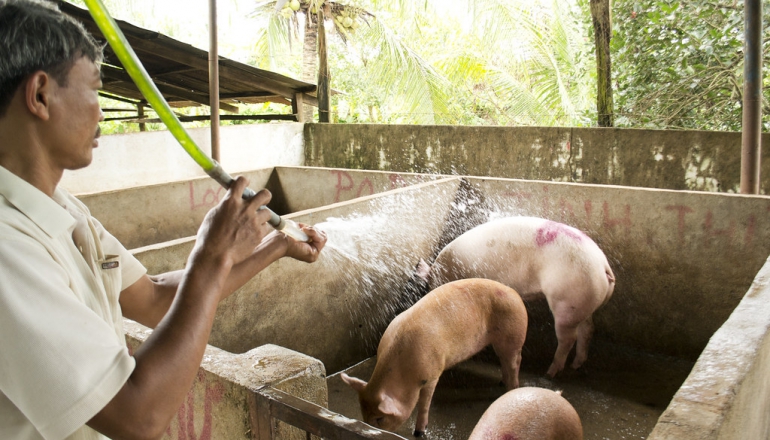
Taiwan’s livestock farms are generally small and geographically dispersed, while manure also has a high moisture content. For large, centralized treatment facilities, expanding the feedstock collection radius can quickly drive up logistics costs, including tanker trucks, drivers, fuel and equipment maintenance. These costs can erode project returns, while emissions from transportation can also reduce the overall carbon reduction benefits.
Fang noted that Taiwan’s heavy rainfall and hot climate mean pig farmers tend to wash pig barns frequently, leaving manure with a solids content of only around 2%. By comparison, solids content can reach 8% to 12% in Europe and the U.S., giving Taiwan lower power generation efficiency.
Transportation adds another challenge. If regional treatment facilities need to collect feedstock from 20 or even 50 kilometers away, the resulting costs could wipe out the project’s entire profit.
Biogas facilities need two revenue streams to remain viable
Biogas power generation currently benefits from Taiwan’s renewable energy feed-in tariff, but Fang said electricity sales alone are not enough to support regional facilities.
He said that a viable biogas facility needs at least two sources of revenue:
- Waste treatment fees to cover fixed costs such as labor, treatment chemicals and maintenance.
- Electricity sales that provide table cash flow and improve investment returns, giving investors greater confidence to enter the market.

Digestate liquid and solids can theoretically be used as organic fertilizer, but their actual use is constrained by crop seasons, application standards, transportation distances and market acceptance. Fang said they should not be treated as a major source of revenue at this stage, as they could instead become an additional disposal cost.
“From a financing perspective, if there is not enough demand or the transportation distance is too great, digestate liquid and solids can turn from a resource into a liability that costs money to dispose of,” he explained.
Given these constraints, Fang said livestock manure alone is unlikely to support a viable business model. A more practical approach is co-digestion, which combines pig manure with organic feedstocks such as food processing waste, fruit and vegetable waste, and food waste.
Co-digestion allows manure to provide a stable microbial environment, while food waste can increase biogas yields and generate additional treatment fee revenue, improving the overall economics of the project.
Similar challenges also apply to the use of combustible waste and bamboo for energy. A waste-to-energy technology provider, who spoke to RECCESSARY on condition of anonymity, said that even though companies have developed technologies for solid recovered fuel (SRF), biomass pellets and mechanized bamboo harvesting, technology alone is not enough to sustain a viable market.
Without consistent feedstock specifications upstream, as well as stable energy users and long-term purchasing commitments downstream, it is difficult for any single technology to support a complete market.
Industry calls for green channel as facility approvals take up to three years
Most waste-to-energy projects in Taiwan are not yet financially self-sustaining, regardless of the type of waste involved. Subsidies or other forms of policy support are still needed to keep projects moving.
Fragmented governance is part of the problem. The same organic material may fall under different authorities depending on its source and where it is generated. Livestock manure is overseen by the Ministry of Agriculture, while waste treatment falls under the MOENV. Power generation and electricity sales are regulated by the Ministry of Economic Affairs. Once digestate is returned to farmland, it comes under agricultural regulations again.
Fang said investors are less concerned about technologies such as biogas production than about how feedstocks are legally classified. The key question is whether a material is considered waste, a reusable material, fertilizer or a feedstock for power generation.
That classification has practical consequences. It determines who is allowed to collect and transport the material, where it can be sent and whether a facility is authorized to process it on site.
In practice, developing a fully permitted resource recovery facility can take two to three years from initial planning and application to final approval. Fang suggested that the government establish a cross-agency “green channel” to standardize review procedures across environmental, agricultural and energy authorities, as well as local governments. Priority should also be given to assessing suitable land, permitting requirements and regional feedstock availability.
Private capital is more likely to enter the market if the government can provide mechanisms that guarantee minimum long-term feedstock volumes and treatment fees, Fang said.
“What Taiwan’s biogas power sector lacks is not generators or anaerobic digestion technology, but a commercial framework that integrates feedstock supply, treatment fees, transportation and energy revenue,” Fang said. While the current framework remains underdeveloped, he expects the industry could enter a growth phase over the next five years as the MOENV takes a greater role in coordinating stakeholders.
In the near term, bioenergy in Taiwan will continue to focus primarily on power generation and pollution management. As the industry scales up and the market matures, biogas could eventually be upgraded into biomethane for use in industry, transportation or shipping.
Reaching these higher-value applications, however, will first require Taiwan to strengthen the industry’s basic infrastructure and develop more stable supply and demand.