RECCESSARY’s “ASEAN Weekly” highlights Southeast Asia’s new energy and carbon market updates. (Image: RECCESSARY)
This week in Southeast Asia, renewable energy, carbon markets, and green industry investment take center stage. Malaysia kicks off major solar projects under the Solar ATAP scheme and begins implementing its carbon tax, prompting companies to accelerate low-carbon technologies and project planning. Vietnam sees growing momentum in biogas adoption for livestock and new industrial park investments, while Singapore introduces a beverage container return scheme to boost its circular economy. Below are ASEAN’s key stories from Jan. 5–11.
Malaysia's energy storage demand driven by LSS6, Solar ATAP in early 2026
Malaysia’s renewable energy sector is entering 2026 with a packed first quarter, as new policy frameworks take effect, fresh solar tenders approach, and large electricity buyers, particularly data centers, move closer to the market. The momentum is expected to shape project activity and investment decisions in the months ahead, according to an analysis by Kenanga Investment Bank. Read more here
2026 Sustainability Trends: Top 10 new energy and carbon issues in ASEAN
With the European Union’s Carbon Border Adjustment Mechanism (CBAM) entering into force and electricity demand from data centers rising rapidly, ASEAN is approaching a critical inflection point in its sustainability transition in 2026. As carbon pricing frameworks advance alongside energy transformation, investment flows and industrial competitiveness across the region are being reshaped. RECCESSARY maps out ten key issues in Southeast Asia’s energy and carbon markets, offering readers a clear view of the year’s defining trends and the evolving global landscape. Read more here
Singapore to launch beverage container return scheme, extend transition
Singapore is set to roll out its long-awaited Beverage Container Return Scheme (BCRS) this year as part of efforts to raise national recycling rates.
Under the scheme, consumers who return designated empty bottles or cans to collection points will receive a refundable deposit of SGD 0.10 (about 0.078 USD) per container. Responding to industry feedback, the government has agreed to extend the transition period from the originally planned three months to six months, giving beverage companies more time to clear existing inventory. Read more here
Vietnam’s livestock sector adopts biogas, slashing power costs
Australia is supporting Vietnam’s livestock sector in shifting toward bioenergy-based power generation by introducing an energy service company (ESCO) model that allows farmers to lease biogas generators.
The approach has helped cut electricity expenses and maintenance risks for livestock operators, while also opening up new business opportunities for equipment suppliers. However, experts caution that limited awareness of emissions reduction among farmers, coupled with the need for compliant waste treatment infrastructure, could slow the sector’s progress toward net-zero emissions. Read more here
Amata to invest $182 million in eco-industrial park amid Vietnam’s strong GDP growth
Thailand’s Amata Corporation subsidiary, Amata VN Plc, has secured government approval to build its fifth industrial estate in Phu Tho province, as Vietnam’s economy continues to post strong growth despite a volatile global environment.
The project, Amata City Phu Tho, carries an estimated investment value of 5.7 billion baht (USD 182 million) and comes as Vietnam’s gross domestic product (GDP) expanded by an estimated 8.02% year on year in 2025, reinforcing the country’s appeal to foreign manufacturers and industrial developers. Read more here

Thailand-based industrial estate developer Amata has been approved to develop its fifth industrial estate in Vietnam. (Photo: Amata VN)
Inside Indonesia’s first renewable power export: What opportunities emerge amid unresolved domestic constraints?
Indonesia’s plan to export renewable electricity to Singapore could mark a turning point, but only if it can resolve deep domestic contradictions between energy security, fossil fuel subsidies, and an uneven energy transition at home. Read more here
Analysis: Why companies should build carbon readiness ahead of Malaysia’s carbon tax
Malaysia plans to introduce a carbon tax in 2026. As the new year begins, the clock is also starting to run on how prepared Malaysian companies are for carbon pricing. “I would say Malaysian companies’ carbon readiness is still quite low,” Jia Xin Ng, an ESG and sustainability consultant at Bernard Business Consulting, told RECCESSARY.
While key details are still being finalized, government signals over the past year have begun to narrow the range of uncertainty. In November 2025, policymakers floated an initial carbon tax rate of RM 15 (USD 3.58) per tonne of emissions, while Prime Minister Anwar Ibrahim confirmed in his October budget speech that iron, steel and energy companies would be among the first sectors covered when the tax takes effect in 2026. Read more here
Vietnam advances carbon market framework, experts warn of MRV and global standards gaps
Vietnam is accelerating efforts to build an internationally connected carbon market, but experts highlight gaps in global standards alignment and MRV capacity.
The country has set 2029 as the target year for full operation of its domestic carbon market, following a pilot phase from 2025 to 2028 under Decree No. 119/2025/ND-CP. During the pilot period, Vietnam will test a carbon credit exchange, strengthen technical guidelines, refine compliance tools, and put regulatory structures in place to support future integration with international mechanisms. Read more here
Changing diets amid changing climate: Hidden costs to food quality
The increasing demand for animal protein has caused much concern because of its impact on the environment and contribution to climate change. Calls to reduce meat consumption and to move towards more plant-based diets have received much attention, exemplified by the release of the highly-respected EAT–Lancet Commission 2.0 report in October 2025. A global move to plant-based diets could lead to reductions in greenhouse gases by as much as two-thirds. Read more here
Malaysia to launch carbon tax in 2026, with low rates seen as risk to emissions cuts
Malaysia is set to roll out its carbon tax framework from January 2026, with regulated companies required to begin measuring and reporting their carbon emissions as a preparatory step ahead of full implementation.
While the government is still deliberating the carbon tax rate and enforcement details, tax specialists have suggested that Malaysia take a gradual approach similar to Singapore’s, starting at SGD 5 per tonne (about USD 3.89) to avoid placing excessive cost pressure on businesses. Industry experts, however, warn that continued uncertainty over the carbon tax mechanism could dampen momentum for carbon capture, utilization and storage (CCUS) projects. Read more here
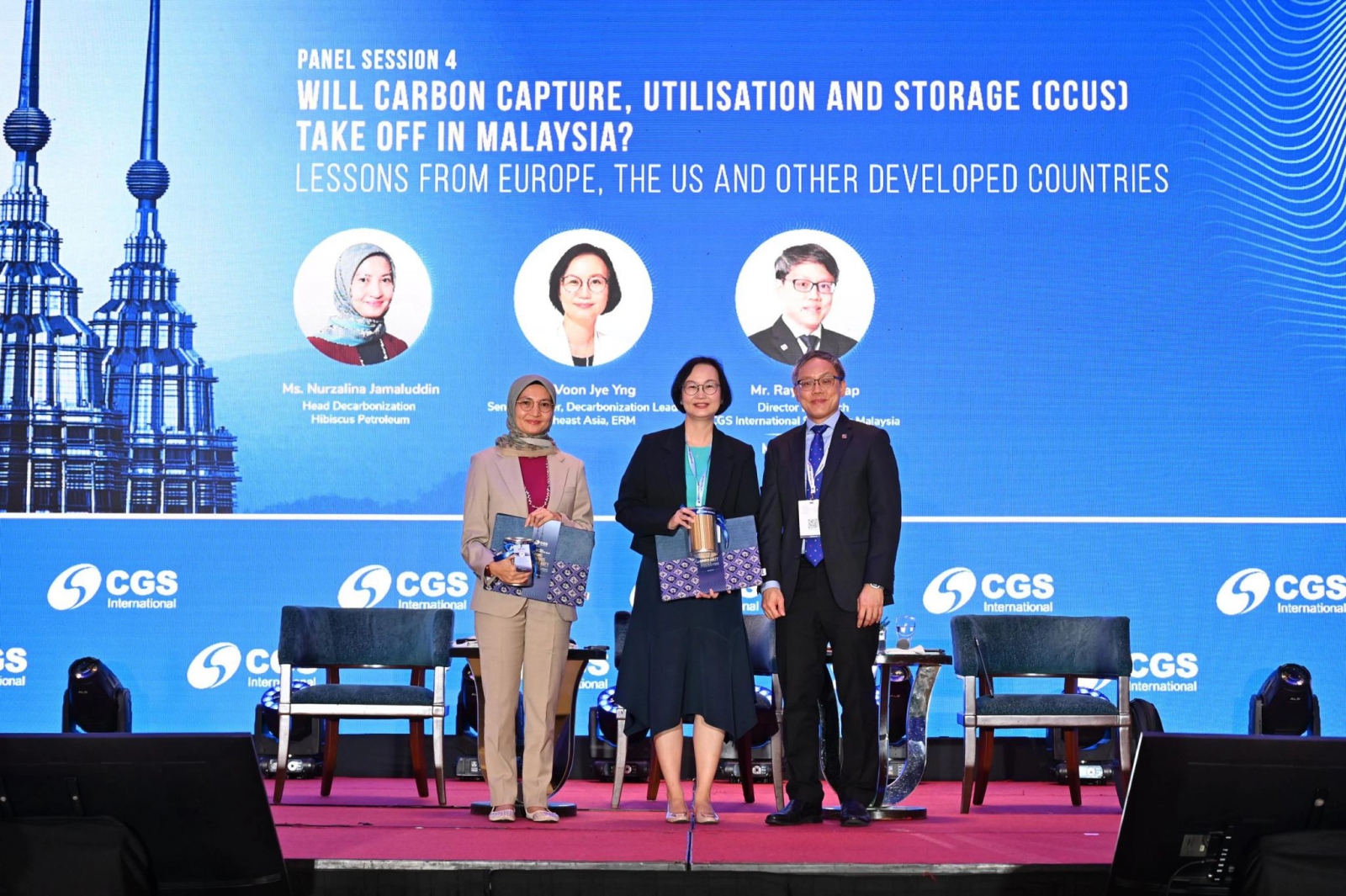
Malaysia launches its carbon tax, as experts warn that low tax rates could slow the development of the carbon capture industry. (Photo: CGS International)
Track ASEAN energy and carbon markets with clarity. Subscribe to RECCESSARY for policy intelligence and business-ready insights across Asia-Pacific.