%20(1).jpg)
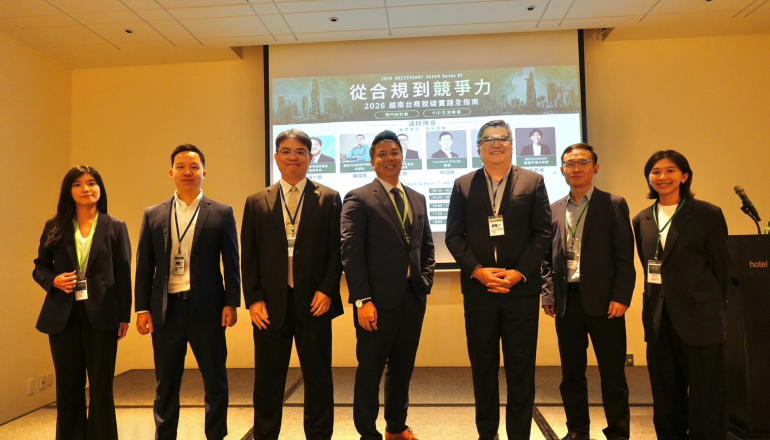
RECCESSARY’s Bangkok seminar discussed how Thailand’s supply chains are navigating global buyer expectations and clean energy procurement constraints. Front row, from left: Chen Wang-kun, Chief Advisor of the Thailand Carbon Neutral Technology Alliance Association; Lin Ju-yin, President of the Global Federation of Chinese Business Women of Thailand Chapter; Kuo Hsiu-min, Chairperson of the Overseas Compatriot Culture and Education Foundation; Ambassador Lan Hsia-li, Taiwan’s Representative to Thailand; Jason Huang, CEO of RECCESSARY; Chen Han-chuan, Chairman of the Thai-Taiwan Business Association; and Sophia Yang, Chair of the Thailand ESG Service Corporation Trade Association.
Back row, from left: Sherry Hu, Analyst at RECCESSARY; Yi-ning Wang, Consultant at E&C Group; James Moore, Board Member of the Renewable Energy 100 Association in Thailand; Cheng-chieh Chang, Secretary-General of the Thai-Taiwan Business Association; Shih Meng-hsin, Secretary-General of the Thailand Carbon Neutral Technology Alliance Association; Lobo You, Chief Sustainability Officer and Vice President of Kinpo Electronics; Hsu Shih-jung, Director of the Overseas Community Affairs Division at the Taipei Economic and Cultural Office in Thailand; Joseph Lai, Director at Galaxy Software Services Corporation; and James Chen, Associate Analyst at RECCESSARY. (Photo: RECCESSARY)
Global brands are turning decarbonization into a condition of doing business in Thailand, forcing manufacturers that once treated carbon reporting as paperwork to see it as a competitiveness issue.
At a RECCESSARY seminar in Bangkok on July 2, “Green Resilience: Global Decarbonization Competition & Strategic Positioning in Thailand’s Supply Chain,” industry representatives and experts said Thailand’s supply chain faces a widening gap between global buyer expectations and clean energy procurement limits.
For Taiwanese manufacturers operating in Thailand, compliance is only one part of the issue. Federation of Taiwanese Chambers of Commerce in Thailand chairman Chen Han-chuan (陳漢川) said sustainability should not be viewed as a cost, but as a capability that can help steady Thailand’s role in high-value-added supply chains.
Why recycled material offers the clearest early cost advantage
RECCESSARY analysts presented cost modeling that showed why some low-carbon material shifts are becoming commercially viable before carbon prices become punitive. Carbon market analyst Sherry Hu (胡湘渝) modeled the cost of switching to lower-carbon material inputs as a marginal abatement cost, measured in euros per tonne of CO2e avoided.
In the automotive sector, recycled aluminum saved an estimated €21 per tonne avoided, meaning the material switch pays for itself without an added carbon price. In electronics, recycled copper showed an even stronger result, saving about €88 per tonne avoided, while recycled aluminum casings saved about €21 per tonne.
A companion analysis by associate analyst James Chen (陳彥達) showed why the gap between virgin and recycled material could widen as CBAM costs rise. In a case study, CBAM-related costs on 10,000 units of virgin aluminum could rise from about €32 in 2026 to roughly €6,243 by 2034 as free carbon allowances phase out. For the same volume using recycled aluminum, the cost increases from about €1 to roughly €230.
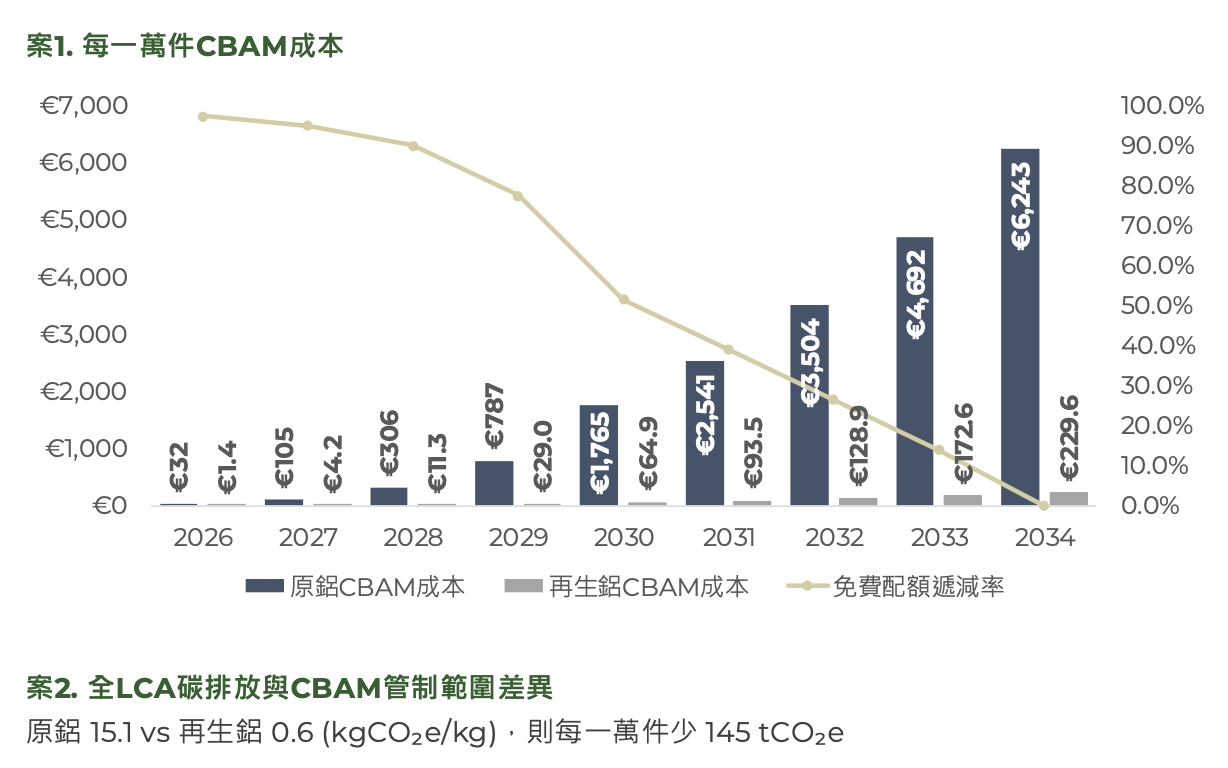
RECCESSARY analysis shows CBAM costs for virgin aluminum rising sharply through 2034, while recycled aluminum remains significantly lower due to its smaller lifecycle carbon footprint. (Source: RECCESSARY)
For Thailand’s automotive and electronics exporters, the cost modeling points to a broader market access risk. Requirements from CBAM and RE100 are already functioning as non-tariff barriers, said Renewable Energy 100 Association in Thailand board member James Moore, as manufacturers increasingly need to prove clean power access to maintain overseas customers.
How carbon data turns into procurement strategy
For manufacturers supplying global brands, emissions data is already expected, and the bigger test is whether that data can withstand scrutiny. Kinpo Group Chief Sustainability Officer Lobo You (游乃溥) said suppliers account for about 70% of the carbon footprint of global brand companies.
That pressure runs both ways, with Kinpo asking its suppliers to disclose and reduce emissions while Kinpo itself sits inside its customers’ Scope 3 inventories and faces the same scrutiny it applies downstream.
Accurate baselines are the first step, said Joseph Lai (賴俊仁), Director at Taiwanese enterprise software firm Galaxy Software Services (GSS), which builds carbon accounting platforms for manufacturers operating across multiple countries. “To lose weight, you first have to step on the scale,” Lai said.
GSS’s platform standardizes emissions factors across Taiwan, mainland China, Thailand, Vietnam, Japan, and the U.S. to reduce inconsistencies that arise when different countries publish different default figures for the same activity. For manufacturers with regional production footprints, standardization is becoming part of audit readiness.
Once a reliable baseline is established, carbon credit procurement decisions still require a strategy. Wang Yi-ning (王怡甯), consultant at E&C Group, said buyers typically move through three tiers as their carbon programs mature: spot purchases, long-term procurement, and long-term investment in a sustainability program.
Convenience may make spot purchasing attractive, Wang said, but real decarbonization impact and supply security depend on deeper long-term partnerships. Long-term investment in a sustainability program offers the highest level of engagement and the strongest assurance over credit quality, she added.
At the association level, those company-level decisions are becoming part of a wider industrial agenda. Thailand ESG Service Corporation Trade Association chair Yang Ching-ping (楊菁萍) said the association is focusing on three priorities for member companies: training carbon management talent, adopting energy-saving equipment, and strengthening cooperation between Thai and Taiwanese industries..jpg)
Speakers said supply chain competitiveness now depends on audit-ready carbon data, cost-effective low-carbon alternatives, and credible procurement partnerships. (Photo: RECCESSARY)
Across the seminar, speakers agreed that the next stage of supply chain competitiveness will depend on companies’ abilities to measure their footprint, assess lower-carbon alternatives, and secure procurement relationships strong enough to pass a global customer’s audit.