.jpg)
How will renewable energy access, industrial ecosystem depth, and carbon market readiness shape Vietnam and Thailand’s long-term manufacturing competitiveness by 2050? (Photo: iStock)
Net zero by 2050 may seem distant, but the decisions that will determine competitiveness are being made today. As carbon constraints tighten and supply chains realign, three factors are emerging as decisive filters: access to renewable energy, the depth of industrial upgrading, and the maturity of carbon markets.
Vietnam and Thailand, the region’s two leading manufacturing hubs, are advancing along these trajectories at different speeds. The way these paths converge or diverge by 2050 will shape not only their decarbonization outcomes, but also their position in the global manufacturing landscape.
For investors and manufacturers, the timeline has already begun. By 2030, companies must respond to immediate constraints around power access and carbon exposure. By 2040, structural differences in grid systems and supply chains will begin to lock in. By 2050, these trajectories will define each market’s long-term positioning in global manufacturing.
2030: Where policy meets execution
DPPA frameworks are live, but green power remains out of reach for most factories
Both Vietnam and Thailand now have DPPA mechanisms on paper, but the gap between framework and factory-gate access remains wide.
In Vietnam, the mismatch is geographic and financial. Most solar and wind capacity is concentrated in the south and south-central regions, while manufacturing clusters led by firms like Samsung sit in the north. The country’s north-south 500kV transmission backbone has been running at capacity for years, meaning power generated in the south often cannot reach northern factories even when buyers are willing to pay.
Vietnam’s DPPA took effect in March 2025 and no longer restricts which large users can participate, but pricing mechanisms and wheeling fees remain unclear. “Developers and buyers still face a reality where they can see the green power, cannot buy it, and cannot get it delivered,” said Jessie Tsai, renewable energy analyst at RECCESSARY.
Thailand’s constraint is structural rather than geographic. The country’s high reserve margin, which has exceeded 40%, reflects legacy take-or-pay contracts with gas-fired generators that make regulators cautious about opening the grid to private green power.
A 2,000 MW DPPA pilot launched in 2026, but “the 50 MW data center threshold still acts as a high wall protecting the state-owned power system,” Tsai said. For most manufacturers, the simpler path is purchasing green power through the government’s Utility Green Tariff, which is more expensive but procedurally straightforward.
Until third-party grid access expands beyond data centers, most industrial users will rely on rooftop solar, unbundled RECs, and energy efficiency upgrades as interim measures.
Vietnam leads in assembly, Thailand in upstream integration
Vietnam and Thailand both serve as major electronics manufacturing bases in Southeast Asia, but the depth of their industrial ecosystems differs significantly. Vietnam’s electronics exports reached USD 126.5 billion in 2024, accounting for roughly 30% of total exports, while component imports exceeded USD 102 billion. Only 14 to 15% of local companies have integrated into FDI supply chains, leaving the country locked in a model of importing components, assembling finished products, and shipping them out.
Thailand’s export volume is smaller at USD 51.33 billion, but its ecosystem runs deeper. Printed circuit board (PCB) production alone was worth USD 3.5 billion in 2024, ranking first in ASEAN and top five globally, and more than 60 PCB manufacturers have relocated from China and Taiwan since 2022.
The two countries are increasingly positioned not only as alternatives but also as complementary nodes serving different functions within the same supply chain, said Hoang Le, consulting manager at Arches. EV manufacturers including BYD, Changan, and Hyundai have committed manufacturing facilities in Thailand, drawn by its more mature upstream automotive supply chain, while no equivalent upstream EV manufacturing commitment has materialized in Vietnam. Electronics assembly continues to flow into Vietnam through firms like Apple and Foxconn, reinforcing a twin-sourcing model in which Thailand handles upstream production while Vietnam focuses on final assembly.
Vietnam’s position in this model is anchored not only by lower labor costs but by a trade access advantage that Thailand cannot replicate, with 17 active FTAs covering more than 60 economies, including simultaneous preferential access to the EU through EVFTA, the Pacific through CPTPP, and the United States.
Vietnam’s ETS lacks a price signal, while Thailand has introduced carbon costs
While both countries are building carbon pricing frameworks, the readiness gap between them is already translating into measurable cost differences for exporters. Vietnam’s emissions trading system (ETS) is currently in a pilot phase covering steel, cement, and thermal power across roughly 150 facilities, which together account for about half of national emissions. However, the system is unlikely to generate a meaningful carbon price signal before 2029, said Sherry Hu, carbon market analyst at RECCESSARY, because free allocation and intensity-based benchmarks limit reduction pressure, the trading platform is not yet operational, and only about one-third of large enterprises have completed carbon inventories.
Thailand has progressed further in aligning policy with implementation, as its Climate Change Act, approved in December 2025, establishes a unified legal framework that incorporates both a carbon tax and an emissions trading system. The country already applies a carbon tax of THB 200 per tonne, equivalent to about USD 5.7, while the TH-ETS is being rolled out in phases starting with pilot and simulation exercises.
As sub-legislation enters the drafting stage in 2026, companies are expected to complete emissions inventories early in order to assess their exposure under the combined carbon pricing framework, Hu said.
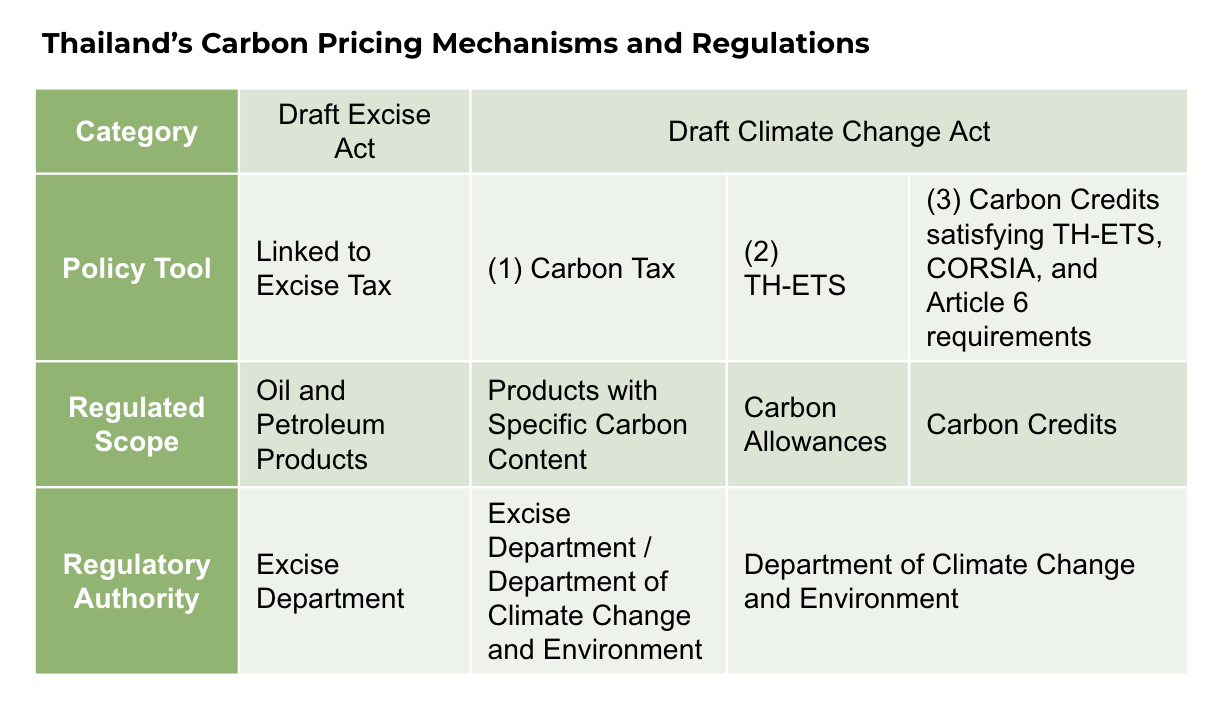
Thailand’s carbon pricing mechanisms operate under two parallel legislative tracks. (Chart: Sherry Hu)
Under CBAM default values with a 20% surcharge from 2027, the cost gap between the two markets is already visible. Vietnam’s carbon cost for hot-rolled steel coil is estimated at around EUR 238 per tonne, compared with EUR 194 for Thailand. On a 10,000-tonne shipment to the EU, this translates into roughly EUR 436,000 in additional costs for Vietnamese exporters, which is sufficient to affect competitiveness in a sector where margins are already thin.

2040: Where structural gaps widen or close
Vietnam’s grid needs rebuilding, while Thailand’s grid needs to open up
“Vietnam’s grid bottleneck is a structural constraint, whereas Thailand’s challenge is not power delivery itself, but its ability to integrate private green electricity,” said Tsai.
Vietnam’s challenge lies in physical infrastructure. Its north-south transmission system can only absorb a portion of the renewable energy generated in southern provinces, and years of underinvestment have left the grid struggling to keep pace with industrial demand.
While PDP8 outlines large-scale grid upgrades supported by international financing under the Just Energy Transition Partnership (JETP), progress has been slowed by EVN’s financial deficits and rigid tariff adjustment mechanisms. Although the government has repeatedly committed to accelerating grid expansion, execution has yet to match the scale of planned investment, Tsai said.
Thailand’s grid, by contrast, is technically advanced and supported by stable funding through EGAT. The constraint lies in regulatory openness rather than infrastructure capacity, Tsai noted. Because the country does not face immediate power shortages, there is limited urgency to liberalize access for private green electricity.
Pressure for reform is driven mainly by hyperscale data center operators such as Google and Microsoft, and once these demands are met, the political incentive to extend third-party access to the broader manufacturing sector may not follow, Tsai said.
By 2040, Thailand’s grid may be highly digitized and efficient, yet still restrictive in terms of who can supply and sell renewable power.
Anchor investments versus ecosystem spillover
Both countries are placing large bets on semiconductor-related investments, but the question is whether individual anchor projects can reshape an entire ecosystem.
Vietnam has attracted a wave of high-profile investments in semiconductor packaging and testing from companies such as Amkor, Intel, and Samsung. Additional developments include NVIDIA establishing an AI research and development center, Viettel moving forward with a domestic semiconductor fabrication project, and FPT launching an advanced testing and packaging facility.
However, without stronger linkages to local suppliers, Vietnam risks remaining dependent on isolated anchor projects rather than achieving systemic upgrading, Le said. The transition from individual investments to ecosystem-wide capability building will determine whether these projects translate into long-term industrial depth.
Thailand’s pathway from PCB manufacturing toward advanced packaging is supported by stronger talent and government-backed semiconductor research facilities. However, moving further upstream into high-end materials remains capital-intensive and “will be a hard ceiling for Thailand to surpass,” requiring sustained coordination with international partners, said Le.
While Thailand is likely to continue strengthening its ecosystem, there is a risk that progress could plateau before reaching the most advanced segments of the value chain, Le added.
.jpg)
Both countries are betting on semiconductor investments, but the key question is whether anchor projects can reshape the broader ecosystem. (Photo: iStock)
MRV gaps will determine CBAM exposure
By 2040, the focus in both markets will shift from policy design to enforcement and data integrity. Vietnam will need to establish a fully functioning carbon registry and trading platform well before its planned 2029 auction launch, or its emissions trading system will remain largely symbolic, Hu said. Thailand’s TH-ETS is expected to move into implementation by that stage, with the key challenge being whether enforcement can scale beyond pilot sectors.
The gap in monitoring, reporting, and verification (MRV) capacity highlights different constraints. Vietnam faces institutional limitations, with no national carbon registry currently in place and fewer than 11% of large firms having undergone third-party verification. Thailand, on the other hand, has an established system but limited capacity, with only 17 certified verification bodies serving the entire country and many small and medium-sized enterprises lacking CBAM-compliant reporting capabilities.
As a result, Vietnam is likely to encounter CBAM compliance pressure earlier, although both countries face the broader challenge of building high-integrity carbon data systems at scale, Hu said. Thailand is also better positioned to develop a more mature voluntary carbon market by 2040, supported by its T-VER system and early experience with Article 6.2 transactions. However, both markets will need to address issues of liquidity and the availability of high-quality credits to support corporate decarbonization strategies, Hu noted.
2050: The endgame
Vietnam offers lower costs, while Thailand offers higher reliability
By 2050, Vietnam and Thailand are likely to present distinct value propositions in renewable energy.
Vietnam benefits from strong solar and wind resources and a policy trajectory that increasingly favors decentralization, allowing private developers and large users to transact more directly through DPPA mechanisms. If grid upgrades under PDP8 are successfully implemented and market mechanisms mature, competition among private generators could drive down the cost of green power, making Vietnam one of the most cost-competitive renewable markets in Southeast Asia, Tsai said.
Thailand’s advantage lies in supply stability and system reliability. Its early investment in battery storage and smart grid technologies positions the country to deliver round-the-clock carbon-free power at scale. This capability is particularly important for precision manufacturing sectors that require continuous decarbonization rather than relying on annual REC matching.
Track record over ambition
At a 25-year horizon, both markets face considerable uncertainty. Vietnam has articulated an ambitious vision for industrial upgrading, but Le said he remains skeptical about Vietnam’s ability to achieve a significant breakthrough in upstream supply chains within that timeframe.
Thailand faces a different challenge as its ecosystem is already relatively mature and continues to expand, but there is a risk that progress could slow before reaching the most advanced upstream segments, Le said. For companies making long-term investment decisions, implementation track record is likely to carry more weight than policy commitments alone.
CBAM expansion raises the stakes for both markets
If CBAM expands into electronics and other manufacturing sectors during the 2030s, the competitiveness gap between Vietnam and Thailand could widen further, Hu said.
For companies operating across both markets, managing carbon risk will become a central strategic priority. This includes diversifying production across locations, developing product-level carbon accounting capabilities, and incorporating carbon costs into pricing models. Companies that move early in building these capabilities are likely to gain a structural advantage as compliance requirements become more stringent, Hu noted.
(3).jpg)
By 2050, Vietnam could become one of Southeast Asia’s most cost-competitive renewable markets if its strong resource base is matched by effective execution and enabling mechanisms. (Photo: iStock)
For companies operating across Vietnam and Thailand, the race to 2050 has already begun.
In the near term, businesses need to secure access to renewable energy under existing constraints, whether through pilot DPPA schemes, utility tariffs, or on-site generation, while accelerating internal carbon accounting to prepare for both domestic carbon pricing and CBAM exposure.
At the same time, supply chain strategy is becoming inseparable from decarbonization strategy. Decisions on where to locate upstream and downstream operations increasingly depend on ecosystem depth and the ability to scale low-carbon production over time.
As Hu noted, firms that move early to quantify and manage carbon exposure will be better positioned as compliance costs rise. Tsai and Le both pointed to the same underlying signal, noting that while policy direction is clear, execution will vary, and companies that plan around implementation realities rather than policy intent will hold a structural advantage.
RECCESSARY’s upcoming webinar, “Beyond ASEAN: Mastering Decarbonization Strategy in Thailand & Vietnam,” will take place on April 21.
The session will unpack net-zero regulations, CBAM readiness, green power procurement strategies, and what lies ahead for low-carbon manufacturing across Vietnam and Thailand.
Seats are limited. Register now.
Read more: Vietnam vs. Thailand competitiveness